Automatic Instantaneous Water Heater
air, pipe, feet, cubic, submersion, depth, lift, cent and total
The successful operation of the air-lift de pends principally upon two things—the ratio of depth of submersion to total lift, and the ratio of the area of the air-pipe to the area of the water pipe. The best efficiency, all things con sidered, is generally obtained when the ratio of depth of submersion to total lift is 0.65; and when the ratio of the area of the air pipe to that of the water pipe is about 0.16; in other words, the submerged portion of the water pipe should represent sixty-five per cent of the total length, and the area of the air pipe should be sixteen per cent of the area of the water pipe. These ratios are not adhered to in all cases, and ap parently without affecting the efficiency of the apparatus, which is probably due to differences in friction and air-pressure, temperature of water, and condition of water as regards purity.
When the depth of submersion is increased beyond about eighty-five per cent, the pressure must be raised; and the consumption of air, and consequently the volume of free air required per cubic foot of water raised, are increased. When the depth of submersion is considerably de creased—that is, below sixty-five per cent—the air-bubbles or pistons of air form irregularly and are of varying size, many working up through the water without causing a proper dis charge of water, so that the volume of air re quired per cubic foot of water discharged is increased. The more economical range, there fore, when considering depths of submersion, lies between fifty-five and eighty per cent, and in the majority of cases it is not necessary to exceed these values. The depth of submersion referred to is the average depth measured from the water level before pumping, and when the water has lowered as far as it will go.
The ratio of the area of air to water pipe pre viously given (0.16), should be adhered to, re gardless of the arrangement of the water'and air pipes, as shown in Fig. 122. The air pipe should be so proportioned that the velocity of the air will not exceed 4,000 feet per minute. When the air pipe is placed inside the water pipe, the area of the air pipe may first be determined, then the required size of the water pipe may be found by means of the formula, in which p and P equal the actual areas in square inches of the air and water pipes respectively.
The various levels may readily be indicated and measured, by means of a float and a stout cord. If the cord be run over a pulley inches in diameter, and the float be lowered from the level of the ground, the depth to the water level in feet will be indicated by the num ber of revolutions made by the wheel while the float is descending. By counting the revolutions as the water level is lowered by the pump, the difference in levels may be similarly obtained. When the depth of submersion at starting is considerably lower than that previously referred to—eighty-five per cent of the total height of the pump—the air pipe should enter the water pipe from 30 to 35 inches from the bottom of the water pipe, to facilitate starting.
The volume of air required to raise 1 cubic foot of water by means of the air-lift, varies from 3.9 cubic feet as the minimum, to 4.5- cubic feet as the maximum, giving a mean of 4.2 cubic.
feet of air per cubic foot of water. This is, however, a general statement, and applies only to air-lifts properly proportioned and working under favorable conditions.
The volume of air required per minute to raise a given volume of water in the same length of time, may be found by means of the formula: LC Cubic feet of in which L equals the lift in feet above the sur face of water; C, the number of cubic feet of water to be raised per minute.
Transposing the symbols in the foregoing formula, we have for the capacity of the air-lift expressed in cubic feet per minute: 16.824 A Cubic feet of water.= and for the lift corresponding to a given dis charge and the approximate volume of air, we have: 16.824 A in which A equals the number of cubic feet of free air per minute.
The efficiency of the air-lift, as previously stated, varies with the ratio of depth of sub mersion to total lift, the efficiency generally in creasing with increased submersion up to ap proximately eighty-five per cent of the total lift, while the efficiency decreases slowly below sixty-five per cent until the submersion reaches about fifty-five per cent of the total lift.
The capacity in cubic feet per minute for varying depths of submersion beyond these limits may be found by means of the formula: in which D equals the depth of the submersion in feet.
It is not practicable, under ordinary condi tions, to attempt to raise water by means of the air-lift to heights exceeding 180 to 200 feet above the lowest water level; nor to attempt to carry the discharge pipe horizontally to a greater dis tance than 700 or 800 feet. When greater hori zontal distances must be covered by the dis charge, it is better to carry the pipe on an in cline from the well or reservoir to the point of discharge.
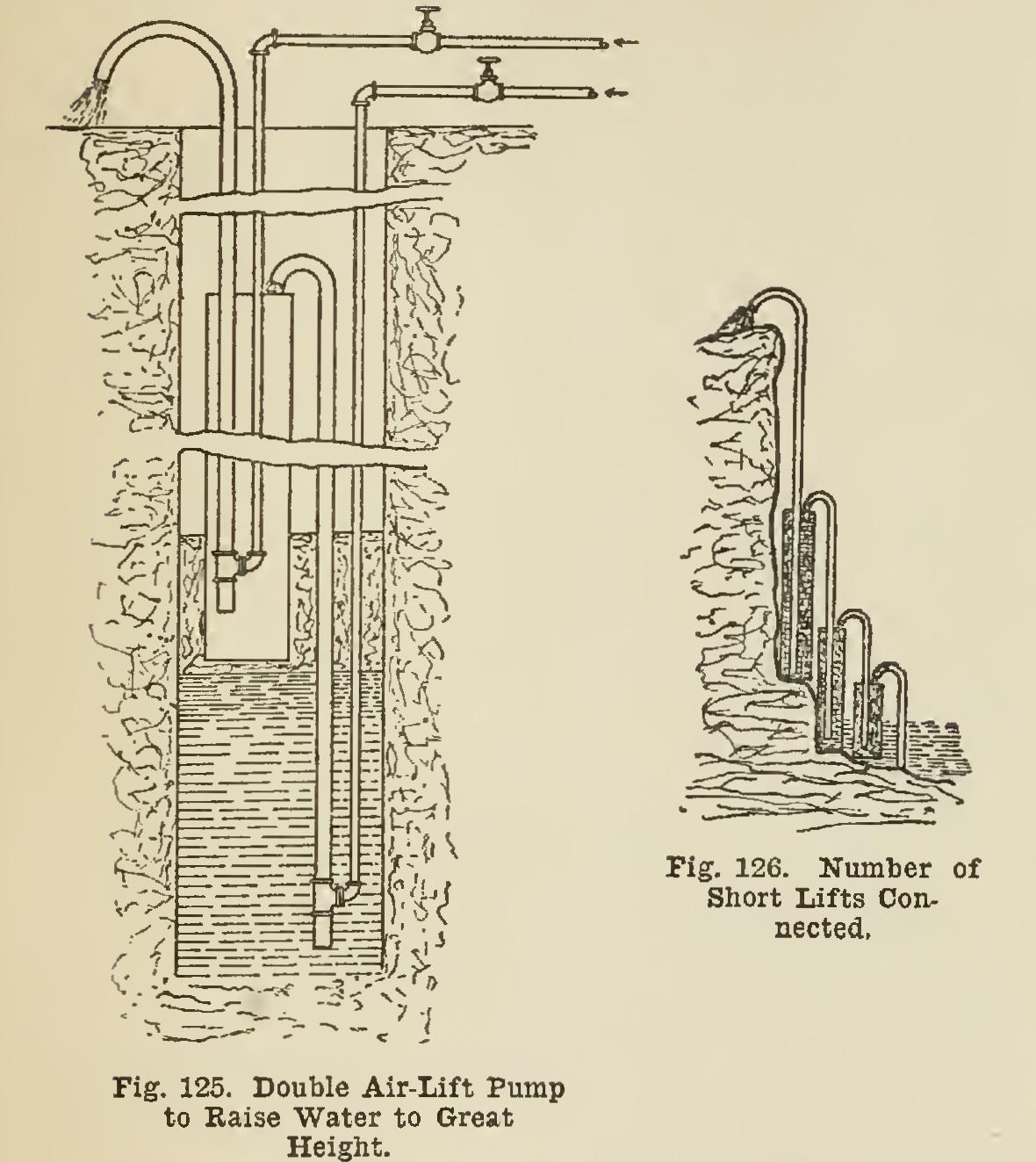
When it becomes necessary to raise water to heights exceeding, say, 175 or 180 feet above the level of the well or reservoir, it will be found more economical, all things considered, to put in a second lift pump something on the plan of Fig. 125. And where the air-lift is to be employed in shallow reservoirs or shafts, a number of short lifts arranged in a manner similar to that shown in Fig. 126 may be employed. In the latter case, each lift should be correctly proportioned with reference to submersion and the lift above the water level.