Automatic Instantaneous Water Heater
air, pipe, fig, air-lift, column and pressure
AUTOMATIC INSTANTANEOUS WATER HEATER Fig. 121 illustrates a type of water heater which is designed to supply automatically a large or small amount of hot water at any given tem perature, for instant use. The water is heated as fast as it is drawn for use. The mixers in this apparatus are furnished in units, which allow large or small deliveries of hot water. This de vice makes it possible to dispense with storage tanks where exhaust steam is not available. These heaters are especially adapted for use in hotels, hospitals, manufacturing plants, laun dries, and in connection with swimming pools and shower baths.

The Air-Lift The air-lift is a simple arrangement of piping whereby water may be raised by means of com pressed air. It depends for its action upon the difference in specific gravity between com pressed air and water, and to some extent upon the expansive force of the compressed air. No valves are employed in the air-lift, except to regulate the admission of the air to the water pipes, and consequently there are no parts to become deranged and thus impair the operation of the pump.
The air-lift is employed for raising water and other liquids from comparatively small as well as great depths, it being found particularly economical in raising water from deep mines and bored or drilled wells. It is applicable to any place where water is to be raised, and has proven highly economical where compressed air has been used for other purposes previously to installing the air-lift, owing principally to the first cost of the apparatus.
The air-lift consists of two pipes—the water pipe and the air pipe, the latter being the smaller of the two. The water pipe contains a tapped hole near the lower end, into which the air pipe is screwed, the latter, in some cases, being ex tended to about the middle of the water pipe, where it is bent at right angles so as to direct the air jet upwards. In other cases, the end of the air pipe projects slightly beyond the wall of the water pipe.
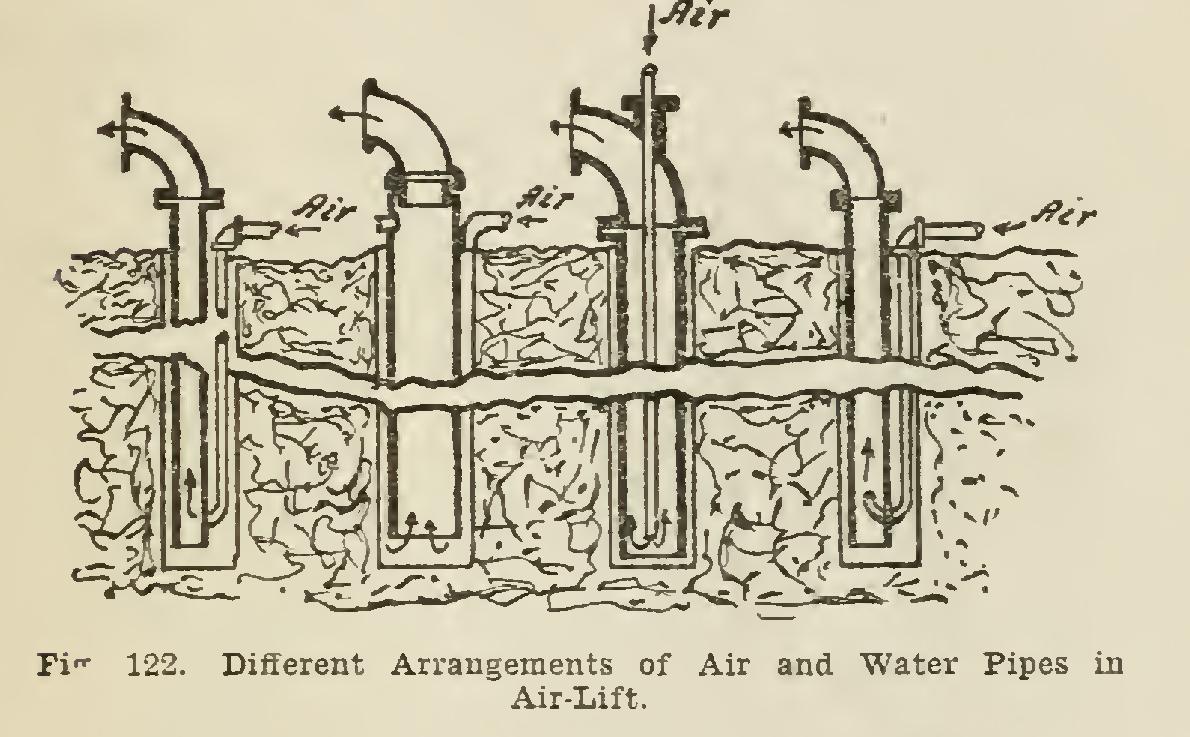
There are several arrangements of air and water pipes, four of which are shown in Fig. 122. Air being forced into the water pipe, a huge bubble is formed about the orifice of the air pipe, as shown at a in Fig. 123, which fills the pipe and forms what may be called a piston of air. The pressure of the air when escaping from the air pipe is sufficient slightly to overcome the weight of the column of water in the water pipe, and a quantity of water equal to the volume of air admitted flows out at the top. The bubble of air immediately begins to rise through the water: and, as it rises, it continues to expand, owing to the constantly decreasing weight of the column of water above it. The expansion of the air, and the consequent increase in volume, displace a corresponding volume of water at the top, until the air reaches the outlet, where it escapes, car rying a quantity of water in the form of spray. The next bubble reaches the top in the same manner, and raises a similar quantity of water.
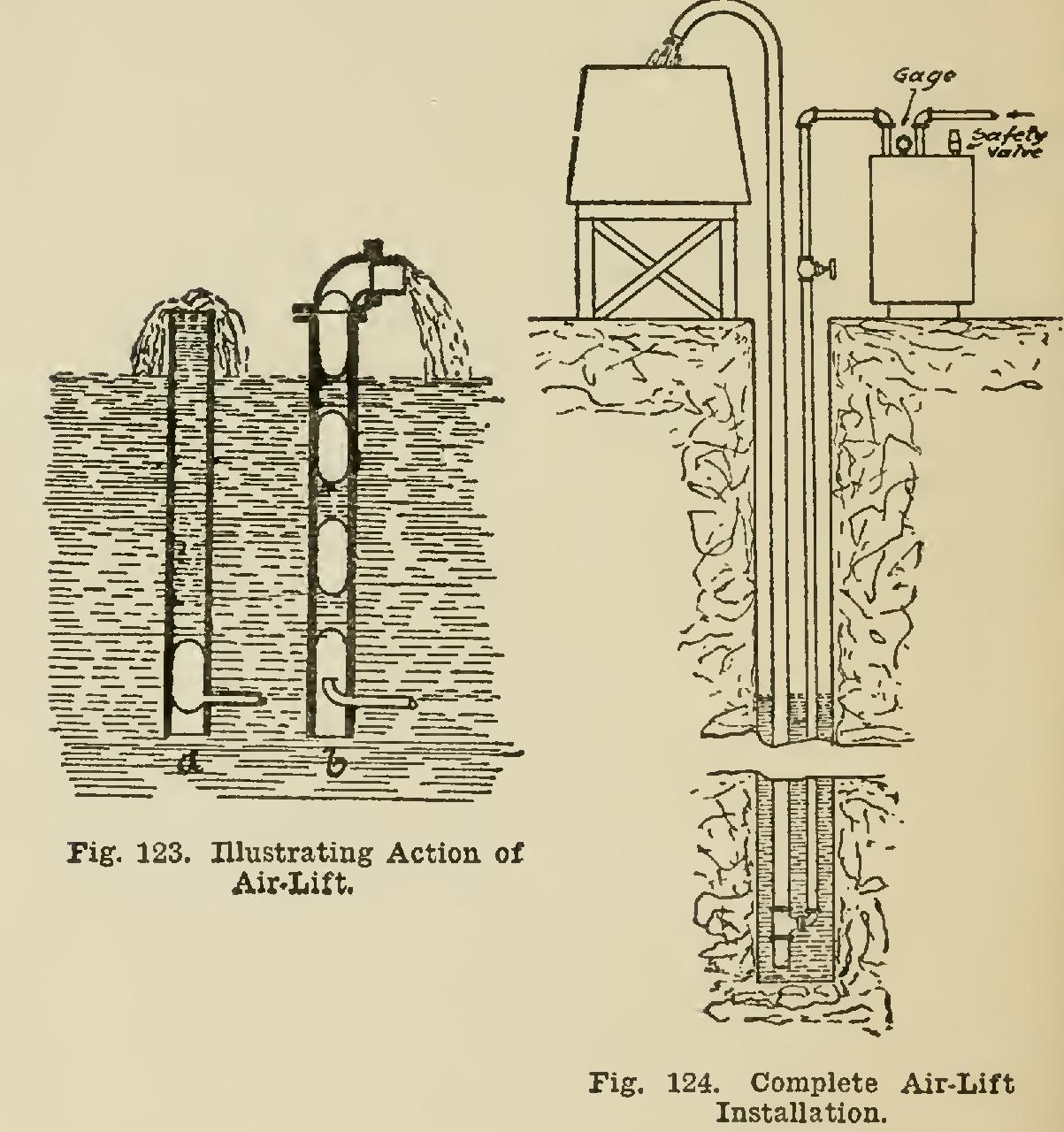
These air-bubbles form in rapid succession, thus dividing the column of water into alternate lay ers of air and water, each bubble or piston having a layer of water above it, as shown at b in Fig. 123 and also Fig. 124.
Fig. 124 shows the complete apparatus. It will be seen that after the column of water has once become divided into alternate layers of air and water, the air admitted at the bottom does not have a solid column of water to sustain or balance, consequently the pressure of the air may be reduced after the pump begins to work properly; and the volume of air thus reduced accordingly, lessens the work of the air compressor.
The pressure of air required to operate the pump after it is once started, is considerably less than the pressure of the water due to the head; while the air-pressure required to start the pump is slightly greater than the water pres sure corresponding to the head, and is generally equal to the water pressure per square inch, plus 5 lbs.