Private Sewerage Systems
cesspool, water, fig, matter, waste, solid, outlet and pipe
PRIVATE SEWERAGE SYSTEMS It frequently happens that the plumber is called upon to install fixtures in localities where sewer systems, and the disposition of the waste matter from water-closets, become quite a problem.
Fig. 103 illustrates the use of the old-fash ioned cesspool. For an ordinary residence, this may be about 10 feet deep, and 10 feet in diameter, and constructed of brick or stone laid up with without the use of cement or mortar, thus allowing the liquids to soak away through the ground, and the solid matter to remain at the bottom. If the cesspool has a closed top, this solid matter will be gradually reduced to a liquid state, by the action of a special kind of bacteria, or minute organisms, which live and thrive in dark, damp places. Care should be exercised in locating the cesspool, to avoid the contamination of surrounding sources of water supply, such as wells, etc., and also to avoid the water getting into the basement of the building. It is good practice to locate the pool at least 50 feet away from the building.
A study of the sketch, Fig. 103, will make the manner of construction of a cesspool quite clear. If the ground is porous or absorbent, the size may be reduced to some extent; but when the pool is located in hard clay or other non absorbent earth, the above dimensions may have to be increased, depending, of course, upon the quantity of matter emptied into it—this can be easily determined.
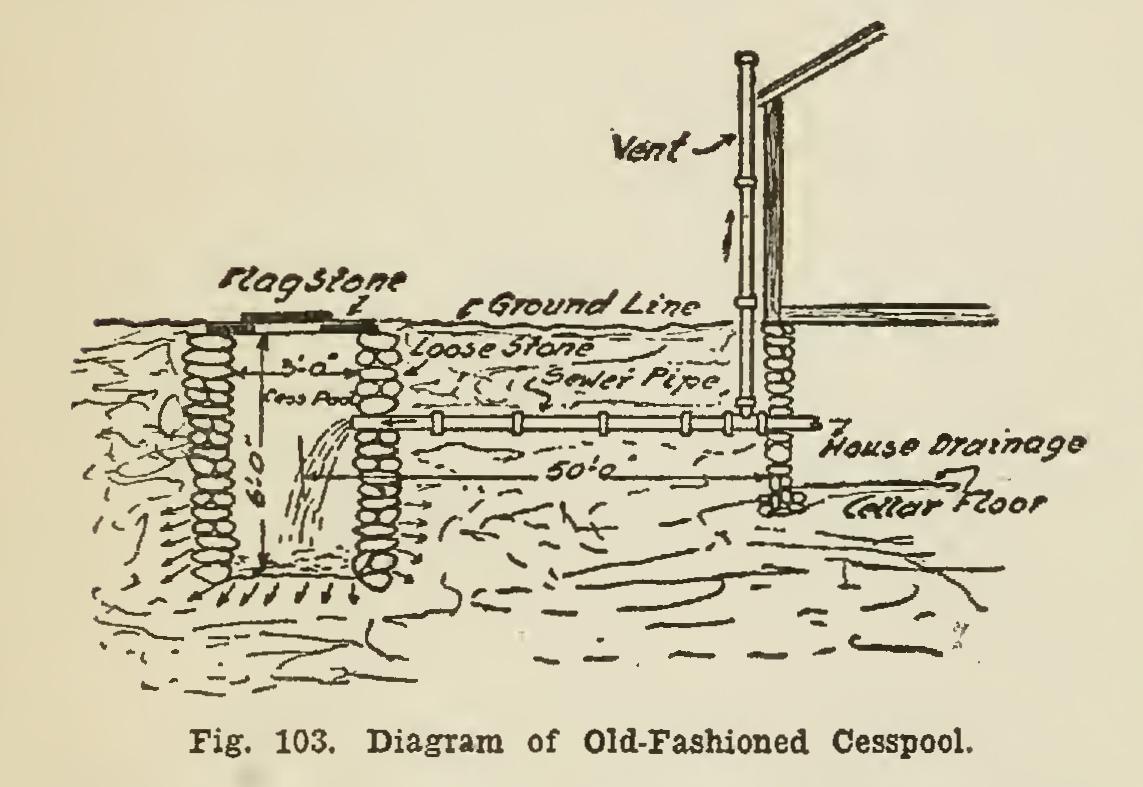
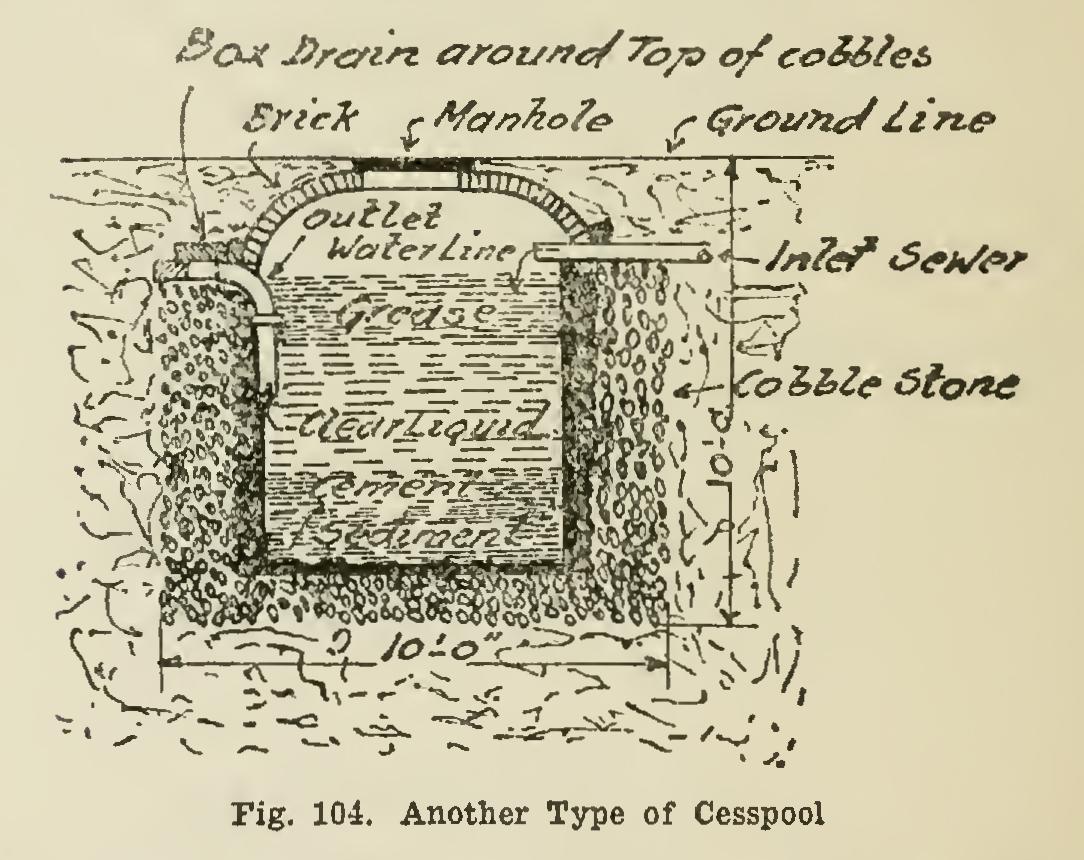
Fig. 104 shows another type of cesspool, in which the sides and bottom are cemented to a point above the discharge pipe, thus retaining the solid matter until it is reduced to a liquid state. The grease, remaining at the top of the pool, will not pass into the cobblestones placed around the outside of the pool to allow the water to pass from the outlet pipe quickly. The outlet pipe extends down below the line of the grease, thus passing clear liquid into the box drain placed above the cobblestones.
Cesspools are usually built circular in shape. The manhole cover on top will permit of access for cleaning when necessary—which is not often, as a rule, in porous soil, since numerous instances might be cited, of cesspools that have been in daily use for over twenty-five years without cleaning.
It is to be distinctly borne in mind, and strongly emphasized, that it is far preferable to dispose of sewage matter through a regular sewerage system than by any cesspool however well constructed. As before said, however, there are times when the plumber is called upon to install plumbing fixtures where there is no regular sewer system, and he is then compelled to look for some other method of disposing of the sewage, and this calls the cesspool into the limelight.
Fig. 105 illustrates a double cesspool, where the outlet water is discharged into a stream, or over the surface of the ground, in gardens or fields. This double arrangement insures the waste or outlet water being many times purer than it would be if it were passed through only one cesspool. Both the cesspools are cemented to a point above the water-line, retaining the water in themselves until discharged through the outlet pipe, and thus not saturating the sur rounding earth.
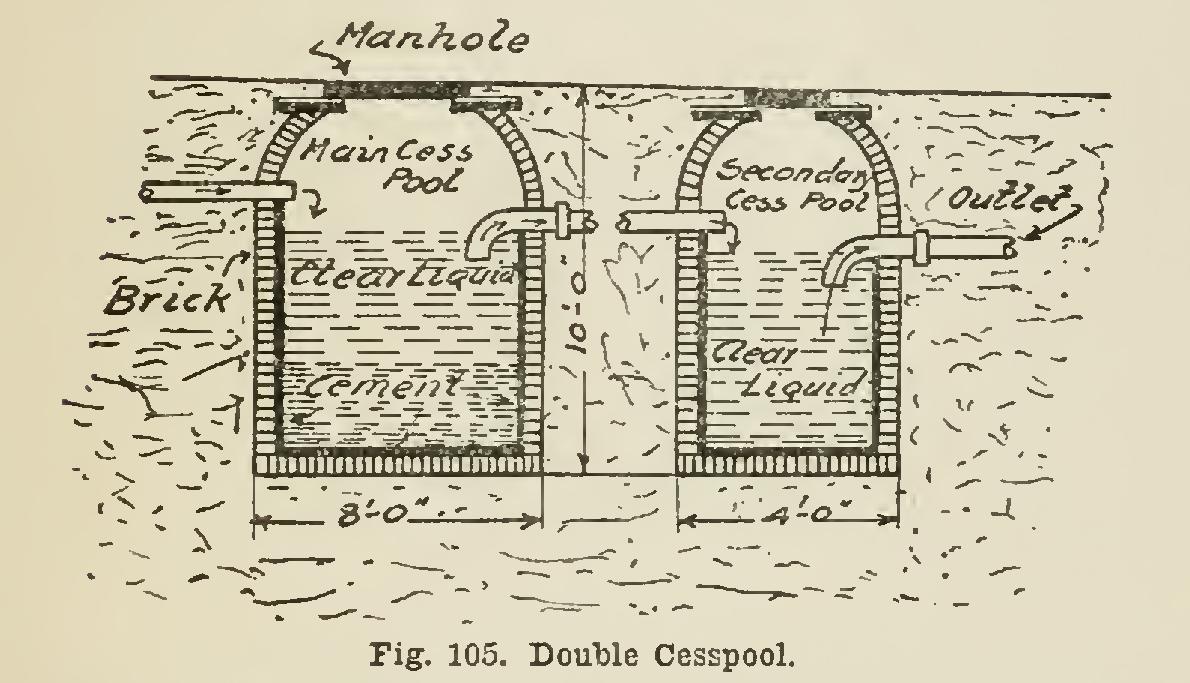
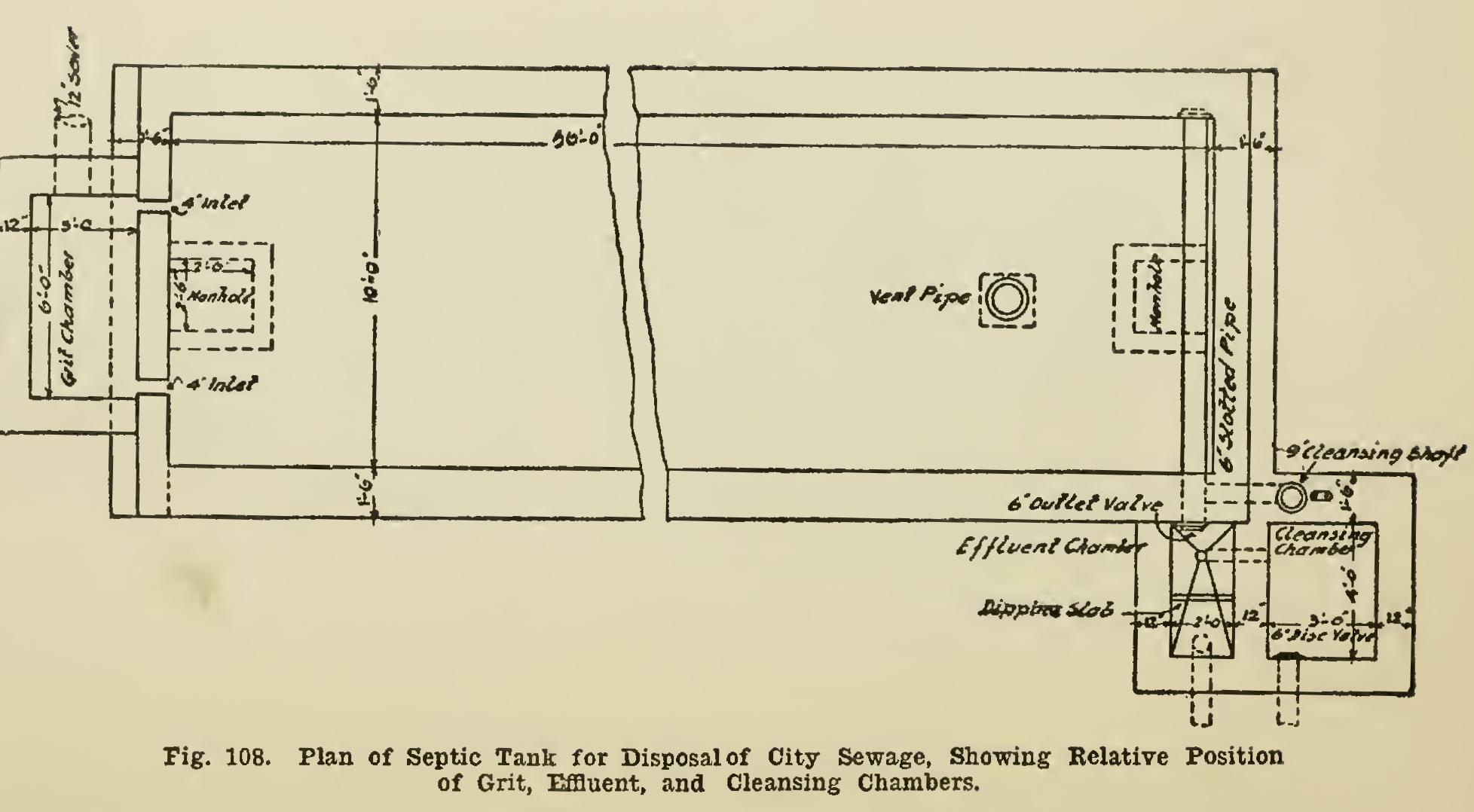
There is nothing mysterious in the action of the cesspool, in the process by which the solid matters are reduced to a liquid state by bacterial action, as other examples of this action may be seen daily, and perhaps never noticed. For instance, a quantity of waste water, con taining some solid refuse, may be thrown upon the ground. The water will soak into the ground, or, in case it is thrown upon an im pervious or non-absorbent surface, will stand there until gradually taken up by evaporation. The bacteria immediately begin work upon the solid matter, but not so rapidly as would occur if the refuse were in a dark-moist place; and in time, the refuse is gone. This action is multi plied very rapidly in tanks or chambers built especially for this purpose, and many cities dis pose of their entire sewage in this manner.
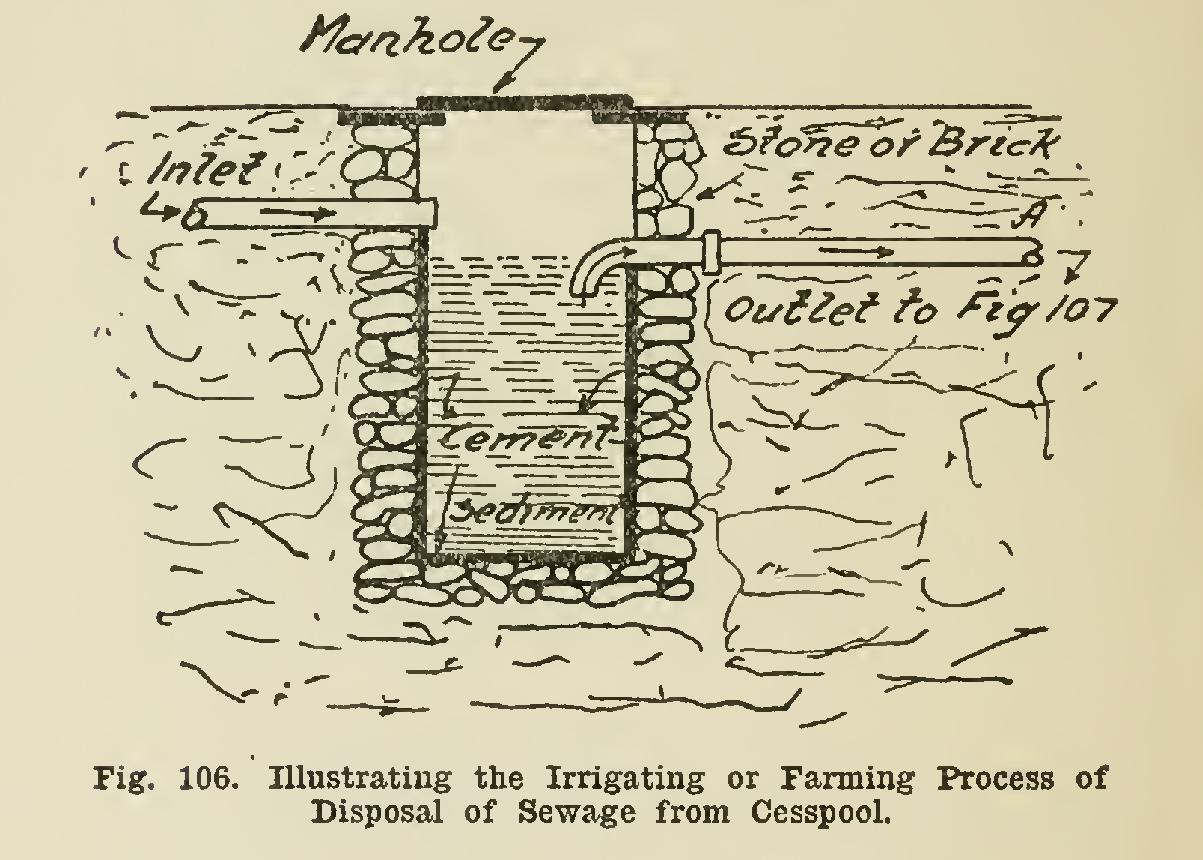
Fig. 106 shows a system of disposing of the waste water from the cesspool, known as the irrigating or farming process. For an ordinary residence, the cesspool need not be so large as indicated in Fig. 104, as the waste water has more surface to discharge into. The outlet pipe is continued to a point in the garden or field, market A, where it is connected to the system of piping shown in Fig. 107, which is a plan view. This piping may be constructed of sewer pipe or field tile, with the joints open or un cemented, which will allow the waste water to escape rapidly into the surrounding earth. The lateral arms may be extended to as great a distance as may be desired to suit the require ments. This type of cesspool is perhaps the best of those described in this treatise, and may be used with some degree of satisfaction. There are a large number of this type in daily use and giving good results; but, as already insisted upon, if it is possible to discharge the sewage into a main sewer, do it.