Rules Useful Tables
inches, water-closets, soil-pipe, fixtures, cement, iron and water
Soil-Pipe Sizes Allowed by Various Cities. Municipal regulations ordinarily govern the sizes of soil-pipe that are allowed to be installed in towns and cities of any considerable size. The regulations in some of the leading Amer ican cities are indicated in the following: Baltimore, Md. Buffalo, N. Y. Chicago, Ill. Cincinnati, Ohio. Denver, Colo. Detroit, Mich. Minneapolis, Minn. New Haven, Conn. Omaha, Neb. St. Joseph, Mo.
San Francisco, Cal. Minimum diameter, 4 inches.
Alleghany, Pa. Pittsburg, Pa. Scranton, Pa. For 1 to 4 water-closets, not less than 4 inches. For 4 to 8 water-closets, not less than 6 inches.
Jersey City, N. J.
For 1 and less than 10 water-closets, with other fixtures, 4 inches.
For 10 and less than 20 water-closets, with other fixtures, 5 inches.
For 20 or more water-closets, with other fix tures, 6 inches.
Milwaukee, Wis. For 4 water-closets, 4 inches. For 10 water-closets, 5 inches. For 25 water-closets, 6 inches. For over 25 water-closets, 8 inches.
Newark, N. J. Paterson, N. J.
For main soil-pipe, 4 inches.
For main soil-pipe for water-closets on 5 or more floors, 5 inches.
For main soil-pipe for tenements or factories, 5 inches.
New Orleans, La. For 1 to 5 water-closets, 4 inches.
For more than 5 water-closets, 5 inches.
In buildings over 5 stories, and having more than 8 water-closets, 6 inches.
Philadelphia, Pa.
For 1 to 6 water-closets, 4 inches.
For 7 to 12 water-closets, 5 inches.
For 13 to 20 water-cloSets, 6 inches.
If building is 5 up to 12 stories high, 5 inches.
If building is more than 12 stories high, 6 inches.
Rochester, N. Y.
For 1 to 30 fixtures, 4 inches.
For 30 to 50 fixtures, 5 inches.
For 51 or more fixtures, 6 inches.
One water-closet is counted as 2 fixtures; one tub, or sink, etc., is counted as 1.
St. Paul, Minn.
For main soil-pipe, not less than 4 inches.
For main soil-pipe for water-closets on 5 or more floors, 5 inches.
Cleveland, Ohio Columbus, Ohio The maximum number of fixtures connected to pipe of various sizes is indicated as follows: Washington, D. C. For 1 to 12 water-closets, 4 inches. For 13 to 35 water-closets, 5 inches. For 26 to 40 water-closets, 6 inches.
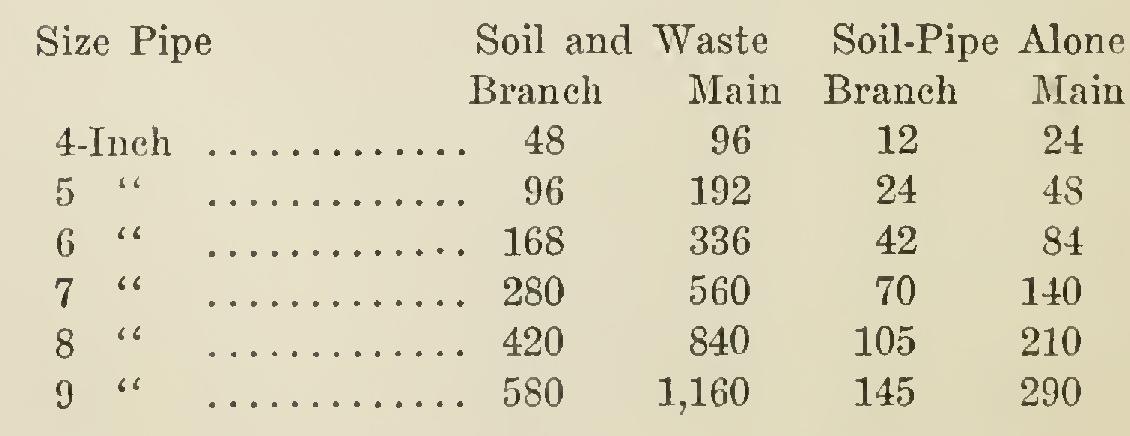
Toledo, Ohio For main soil-pipe from 6 water-closets or bath rooms, 4 inches.
For main soil-pipe from 6 to 10 bathrooms or water-closets, 5 inches.
For main soil-pipe from more than 10 bath rooms, 6 inches.
A 3-foot urinal trough or wash-sink, or 1 bath, basin, sink, or small fixture, is counted as 1 fixture; and 1 water-closet, pedestal urinal, or slop hopper, is counted as 2 fixtures.
The above shows the sizes used in daily in stallations in various cities where local rulings govern, and all work is tested and inspected before being covered up by the other trades.
Rust spots on marble may be removed by applying a mixture of 1 part nitric acid and 25 parts water, then rinsing off with 3 parts water and 1 part ammonia.
Painting Galvanized Iron. First wash with vinegar, which roughens the surface, then apply the paint.
Painting Pipes in Greenhouses. Do not use asphaltum or tar paints in a greenhouse, as they will injure the plants. Use a mixture of lamp black and boiled linseed oil, thinned with turpentine.
Cement for Iron and Marble.
To cement iron to marble, use the following mixture: 30 parts plaster paris, 10 parts iron filings, 1 part sal ammoniac; mix to a fluid state with vinegar. Use at once, as it hardens rapidly.
To Cement Brass Work to Glass.
Mix 2 parts litharge, 1 part white lead, 3 parts linseed oil, 1 part gum copal, and use immediately.
Cement for Porcelain.
Soak 1 dram isin glass in water; pour upon this a sufficient quan tity of alcohol to cover the isinglass; allow it to dissolve, placing it in a warm room. Next dis solve 1/2 dram of mastic in 1 fluid drain of rectified spirits of wine. Mix both solutions together; add 1/2 dram of powdered gum am monias, and evaporate the mixture in a water bath until it is the right consistency. Keep the cement in a glass bottle. Warm before using, and also warm the part of the porcelain to be cemented.
A cement that will resist white heat is made in the following manner: Mix 4 parts pulver ized fire clay, 1 part plumbago, 2 parts iron borings or filings free from oxides, 1 part peroxide of manganese, I-A part borax, I-A part sea salt. Mix to a stiff paste with water, and use immediately. Heat should be applied grad ually the first time.