Sewer and Connections
pipe, size, usually, cement, overflow, soil-pipe and water
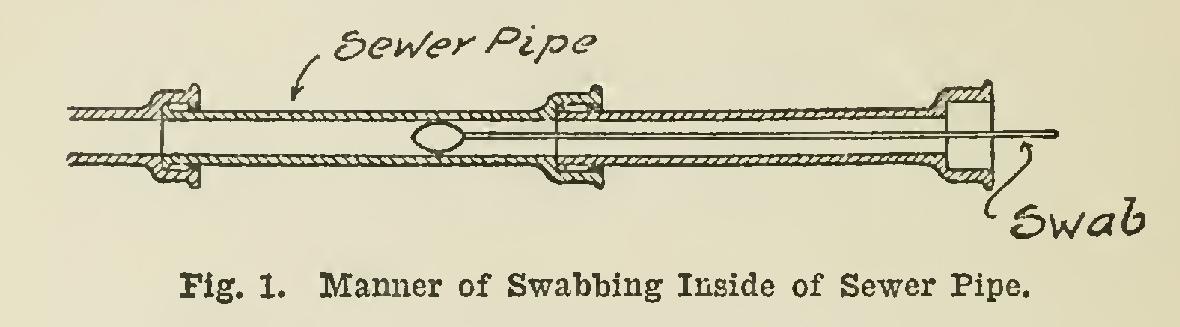
SEWER AND CONNECTIONS About the first thing to be considered in the layout of any plumbing is the Sewer. This is usually constructed of salt-glazed vitrified sewer-pipe, laid to an even grade, with the joints well cemented with Portland cement and clean sharp sand in the proportions of 1 part cement to 2 parts sand, and all joints carefully cleaned on the inside of the pipe after cement ing, to prevent waste matter catching on the edges of cement which will be formed at each joint when the pipes are butted together. Fig. 1 shows the manner of using a "swab" for this purpose. This swab may be made of a stick 161 with nails driven in it, and then cloth wound tightly around it and securely fastened on. The swab should be the full size of the pipe to insure the thorough removal of the cement.
Connections to the main sewer are usually regulated by local conditions and rulings; and this matter need not be discussed further than to state that a connection should never be made with a "tee" joint, but should be made with a "Y;" or, when the main sewer has no Y con nection, the entrance to the sewer should be made in such a manner that the sewage will strike at an angle in the direction in which the main sewer flows.
The sewer pipe will continue toward the building with a gradual pitch up to same, and should terminate at a point not less than 5 feet from the building at which point it will be ex tended into the building with cast-iron soil-pipe, and—for the slight difference between the "Standard" and "Extra Heavy" grades in cost —preferably with the Extra Heavy.
Sewer Traps and Ventilation. The neces sity of a kouse, main, or intercepting trap in the sewer line is a question that has called forth considerable discussion both for and against the use of such a device; and both sides have their good and bad points. Local rulings usually govern this feature. Whether trap is used or not used, the soil-stack or stacks should always extend up to and through the roof, and should never be inserted into a chimney as is too often done. The chimney was built to serve the pur pose of a chimney, and not as a vent for the plumbing system.
Rain Water Pipes. When rain leaders or downspouts are connected to the sewer, the proper size of pipe can be determined from Table I, which is based on an average rainfall. All leaders should be trapped at their base.
An easy rule to remember is to allow 1 square inch in pipe area for each 250 square feet of roof area.
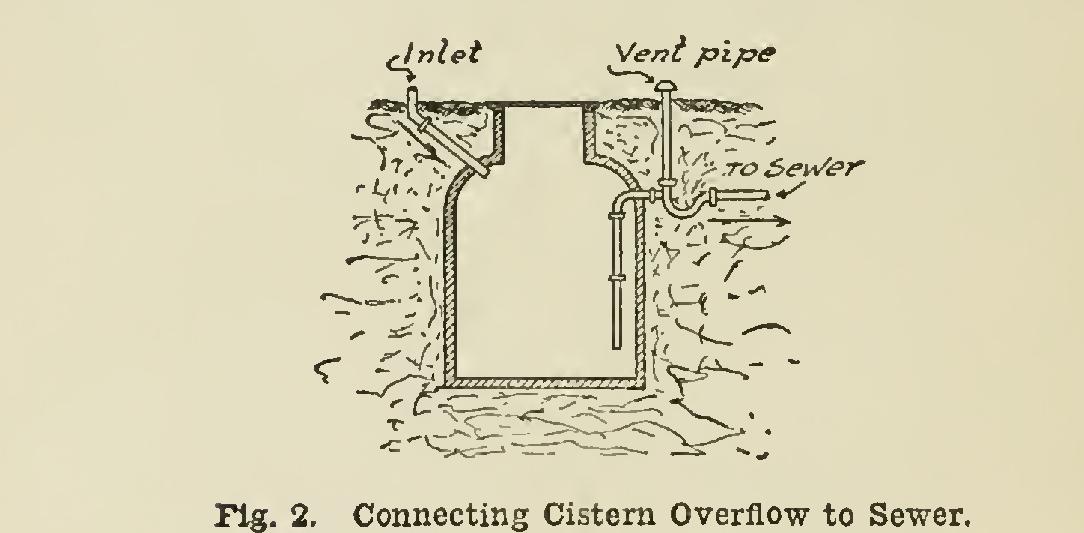
Cistern Overflows. A cistern overflow should never be connected into the house sewer if it can be avoided, as there always exists the possibility of the sewer choking or clogging up and backing into the cistern. Sickness usually results before this is noticed, if there are no fixtures in the basement to overflow and thus denote the stoppage. It is much better to allow the overflow to run out upon the surface of the ground. As houses are usually built on a higher elevation than the street level, the overflow may terminate in the street gutter. When the cis tern overflow must go into the sewer, a good connection can be made as shown in Fig. 2.
Sizes of Sewers. Regarding the proper size of sewer to put in for the various installations, it should be borne in mind that it is always good practice to avoid putting in a sewer too large, or giving same too much pitch. It is better practice to install a size that will be flushed, or nearly so, by the water flowing through it, than to put in a size in which the water will never reach higher than part way up the sides, since the latter have a tendency to allow the floating matter to adhere to the sides, and in time the accumulation may cause a stoppage.
For example, it is better to use a 5-inch sewer-pipe than a 6-inch, when the soil-pipe is 4-inch. It is good practice to run the sewer-pipe one size larger than the soil-pipe which dis charges into it, on account of the frictional resistance being greater in the clay sewer-pipe than in the cast-iron soil-pipe. The water that fills the 4-inch pipe would not fill a 5-inch pipe to the same height, while a 6-inch pipe would be filled still less, and thus the thorough flush ing of the larger sized pipe is made impossible.