Temperature Regulation
heater, motor, thermostat and types
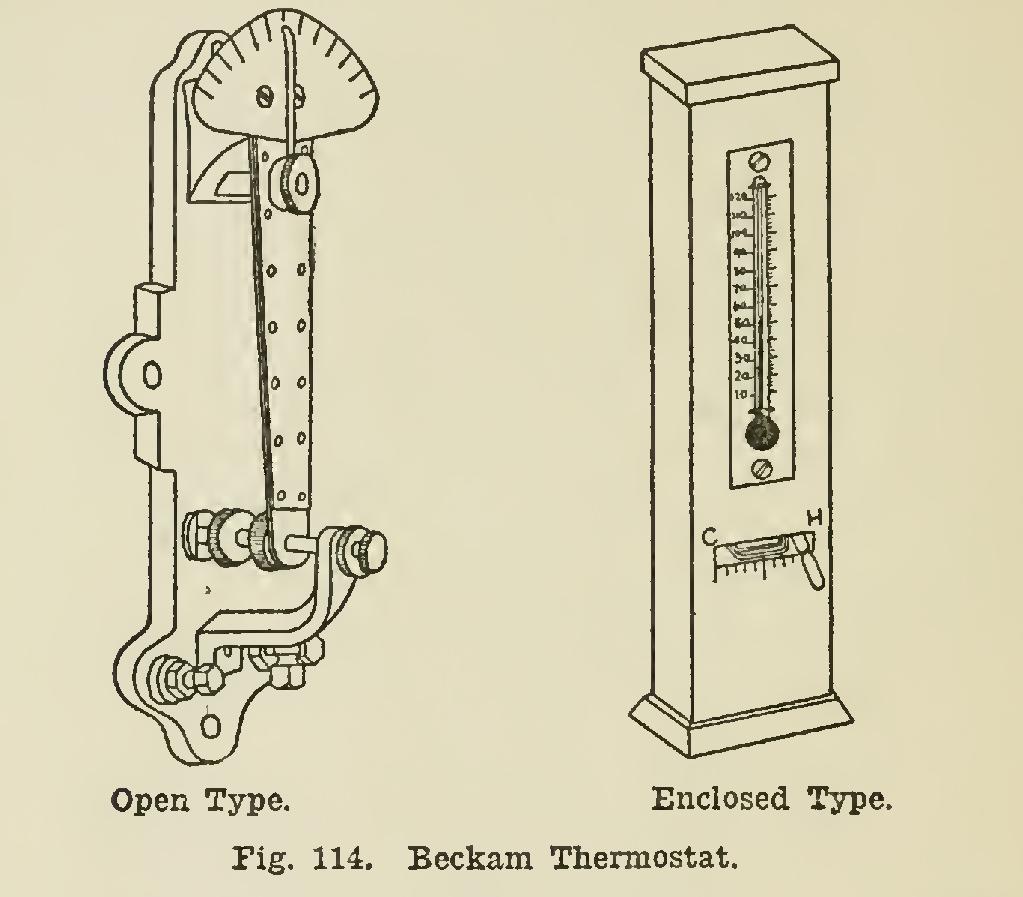
The thermostat employed usually consists of a metal frame holding some form of metal or other substance very susceptible to variations of heat and cold. When expanded by heat, this substance is thrown against a pin, by this move ment closing the electric circuit to the motor, which then operates to close the draughts of the heater. When the temperature of the room falls, the substance contracts and is cast back against another peg, whereupon an action the reverse of the above occurs. Fig. 114 shows two types of the Beckam thermostat.
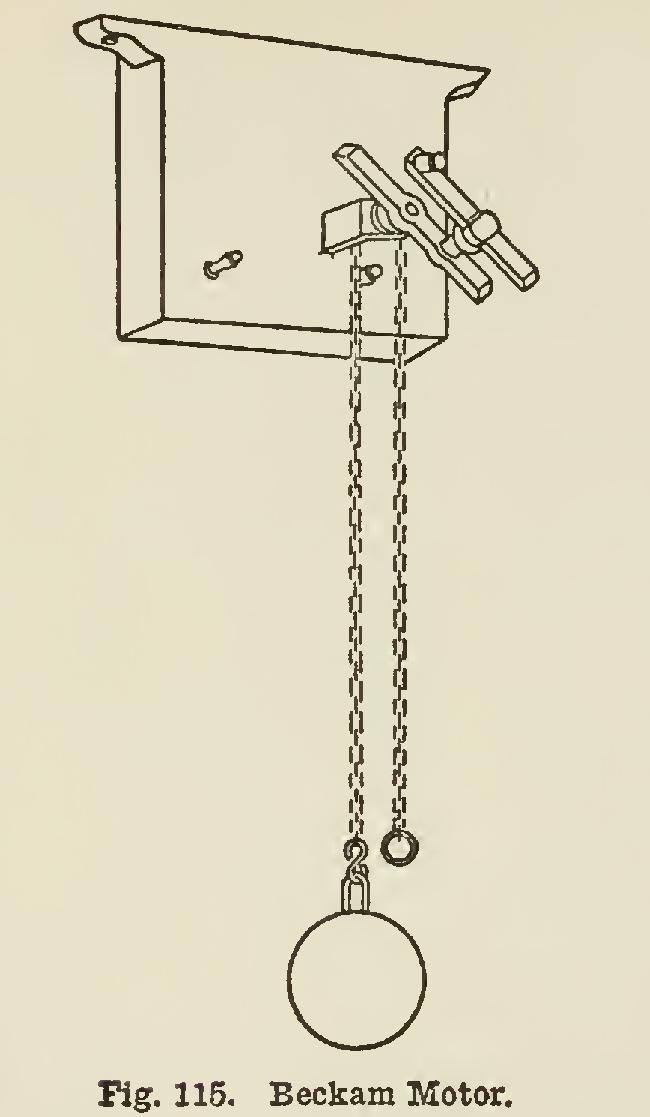
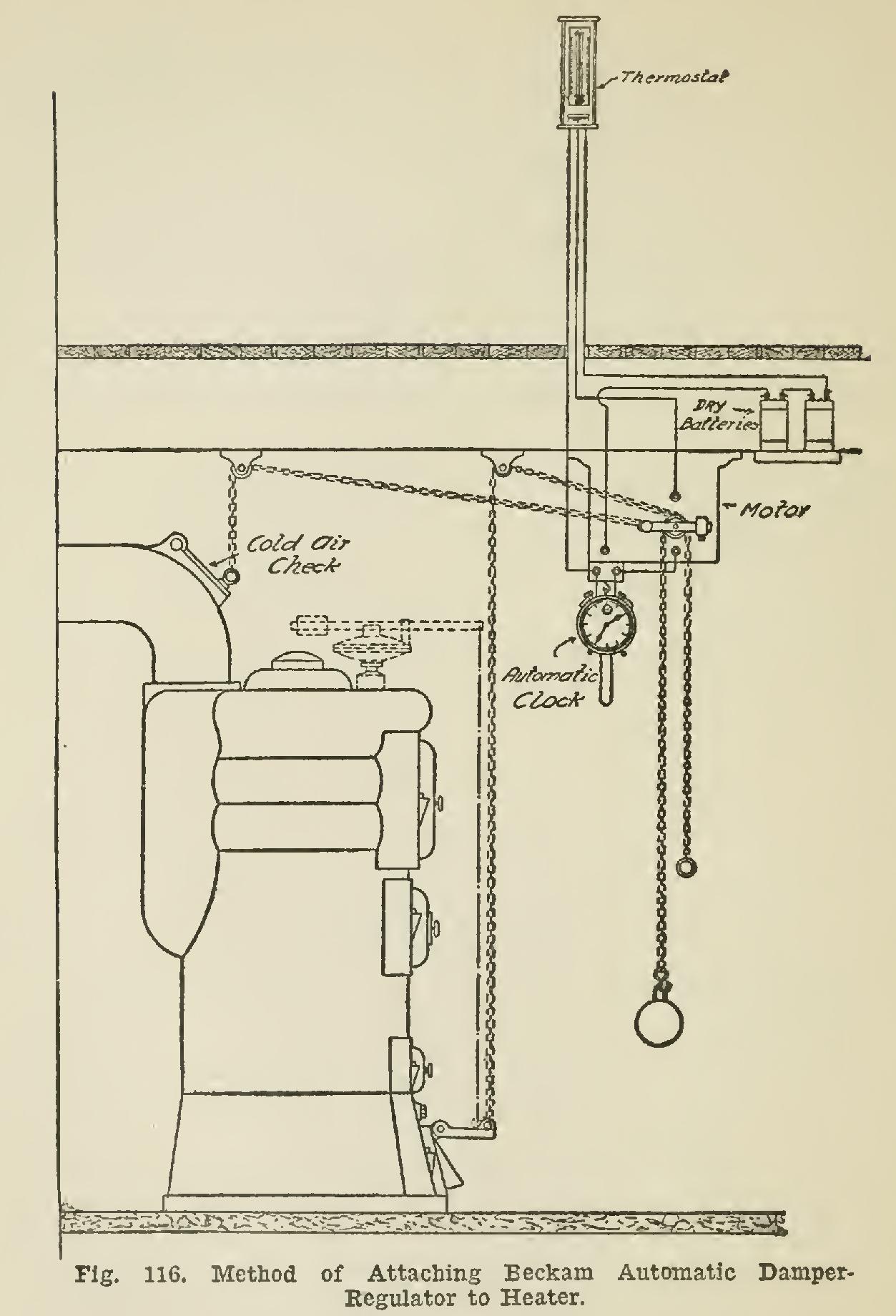
The motor may receive its power from a spring wound up within it; or, as in the Beckam types, the force to drive the motor may be gen erated by a weight wound up daily in much the same manner as a Swiss clock. Fig. 115 illus trates the Beckam motor; and Fig. 116, the method used for attaching the various parts to the heater, the light dotted lines showing how the connections are made to a steam boiler.
The non-electric regulators, of which there are many individual types, involve the use of power derived from the expansive force of metals, rubber, or liquid. In this class we have the "Regitherm," a regulator in some respects similar in principle to the "Sylphon," already described, using a volatile liquid and a metal bellows; the "Powers," with a volatile liquid; the "National," having the rubber in its thermostat; the "Howard," using a triangular disc of a rubber composition, which is fastened on the lower side, the point of the triangle being free for moving back and forth by expansion and contraction from the effects of heat or cold.
The thermostats and motors of the different types, while varying somewhat in principle, all aim to accomplish the same purpose—namely, the furnishing of power to open or close the draughts of the heater.
Practically all thermostats will work ac curately within a margin of two degrees from the desired temperature; for instance, with the indicator set for 70° in the room, the tempera ture will not rise above 71° before the regulator will check the fire; and prior to a fall of the temperature in the room to 69°, the regulator will again operate to open the draughts on the heater.
The extent of the saving in fuel within one, two, or three years, according to the size and character of the job, will pay for a first-class thermostat, after which length of time its usage will annually help to meet the cost of the fuel bill.