Temperature Regulation
heating, draught, liquid, bulb, steam, heater and volatile
TEMPERATURE REGULATION No heating apparatus can be considered fully complete unless equipped with some form of device which provides a method for automatic ally regulating the draught and check doors of the heater to accord with the varying tempera tures of the rooms in the building. However, only a small percentage of heating apparatus now in use is supplied with such appliances.
Temperature-controlling devices usually in clude a thermostat, which is placed in one of the living rooms (a place in which a regular, uni form degree of temperature is desired) and connected to a form of motor or similar agent, to furnish the power necessary for operating the dampers of the heater.
Of all the accessories to a heating appliance which assist in insuring its economical and satisfactory operation, there is no other one to be compared with an adequate system of temperature regulation.
While all low-pressure steam boilers are provided with a draught regulator of the type illustrated in Fig. 88, hot-air furnaces and hot water heaters, as a rule, have no such provision for draught control. The operation of the regu lator of a steam boiler is not governed by the temperature of the room; it simply regulates the draught doors of the boiler according to the motive force of the pressure of steam within, and, by reason of this action, cannot be consid ered strictly a temperature-regulating device.
For use on systems in residences and on ordinary heating work, the temperature-regu lating devices adaptable can be divided into two classes—(a) those that are controlled by the temperature of the water within a hot-water heating system; (b) those controlled by the temperature of the atmosphere within the building.
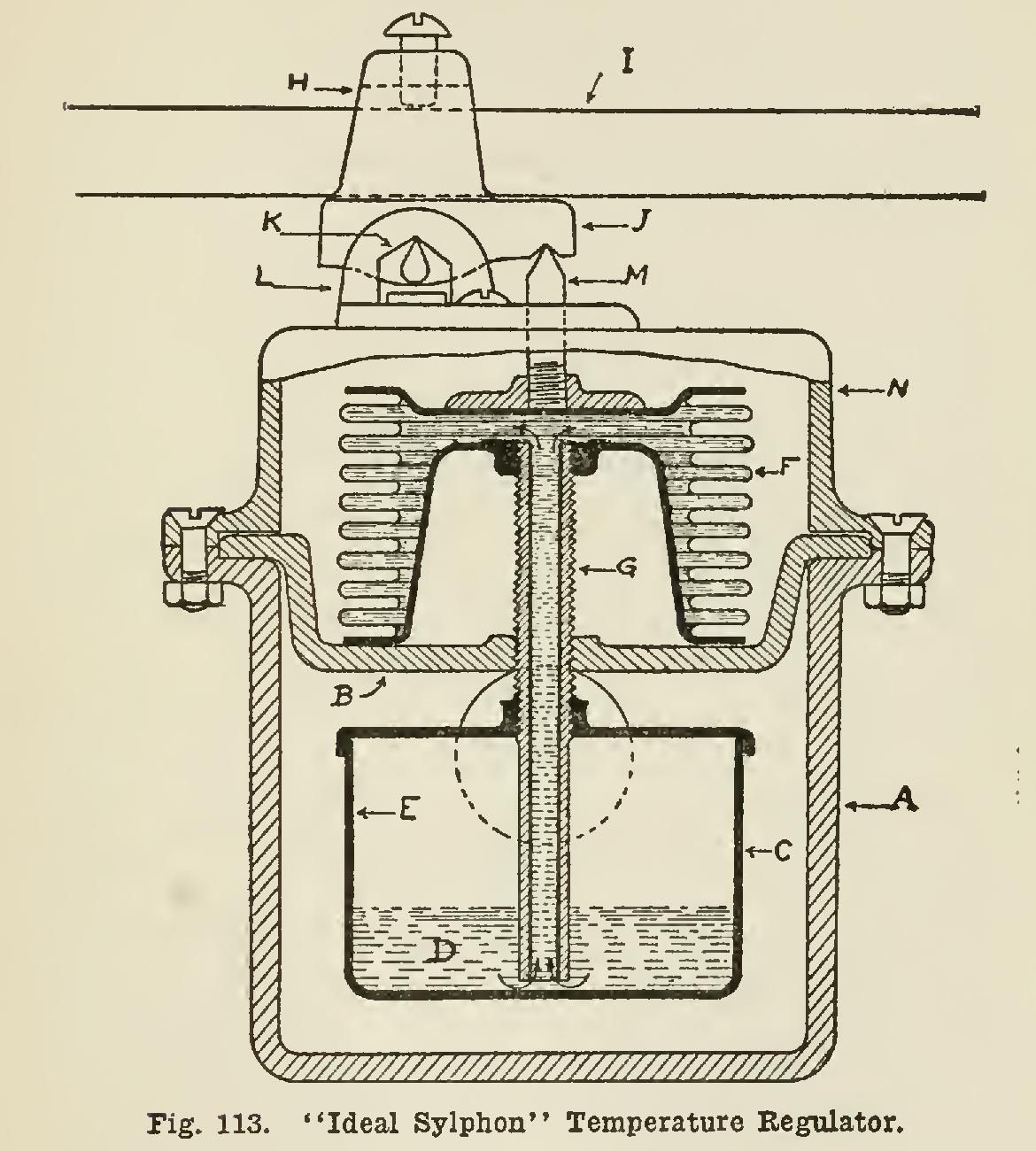
There are several styles and types of each, but we can describe here only one or two of the representative regulators in each division. Of those in Class (a), above, the "Ideal Sylphon" shown in Fig. 113 is a good illustration. It will operate at any desired temperature ranging from 120° to 180° F., and may be adjusted by simply moving a weight on the lever rod. In its construction the cast-iron pot A is divided horizontally by the partition B. The lower com
partment contains the bulb C, which holds a vol atile liquid vaporizing at a loW temperature and fiVing the space E. This bulb is made of a metal having a high conductivity for heat, which allows slight variations of temperature to pene trate quickly to the volatile liquid. The water from the heating system flows through the space between A and C, completely surrounding the bulb C. The upper compartment contains a metal bellows F, which is hermetically sealed and which communicates with bulb C through pipe G. The construction of the rocker and lever are shown by H, I, J, and K.
As the temperature rises, the vapor in space E increases in pressure, forcing a portion of the liquid up pipe G into the bellows, as indicated by arrows. This action causes the bellows to expand, raising the plunger M, which, in turn, tilts the rocker and lever, whose ends are at tached to the draught and check doors by chains, gradually closing the draught door and opening the cold-air check. As the temperature falls, the reverse action occurs.
Probably the first successful device employ ing the vapor obtained from a volatile liquid was the "Powers" regulator. As at present pro duced, this regulator is made in a variety of forms for use in controlling the draughts of a furnace as well as steam and hot-water heating apparatus; and while, in its mechanical parts, it differs from the "Sylphon," previously described, the principle of procuring the neces sary power from the vapor of a volatile liquid is practically identical.
The regulators in Class (b)—those con trolled by the temperature in the heated room— are of two general kinds, which we may prop erly term (1) electric, and (2) non-electric. Among the former are the "Minneapolis," the "Honeywell," the "Jewell," the "Beers," and the "Beckam." All regulators of the electric type require the use of a thermostat, which is located in a living room and is connected by wires or chains to a motor in the cellar placed near the heater.