Valves
valve, steam, fig, water and radiator
VALVES Kinds of Valves. Valves as used on steam or hot-water piping are of two principal vari eties—namely, the globe or angle type, shown in Fig. 79; and the gate valve, shown in Fig. 80.

The former style is adapted for steam work, and, in its interior construction, has a valve-seat against which the disc is screwed when opening or closing the valve. By reason of the obstruc tion encountered in the interior mechanism of the globe valve, it is unwise to place is in a verti cal position on a horizontal pipe; and, when nec essary to use a valve of this character on a pipe run horizontally, it should be placed with its stem set horizontally or pitching slightly down ward. Fig. 81, showing the interior of a globe valve with the stem set vertically, illustrates clearly the difficulty arising from lodgment of the water of condensation.
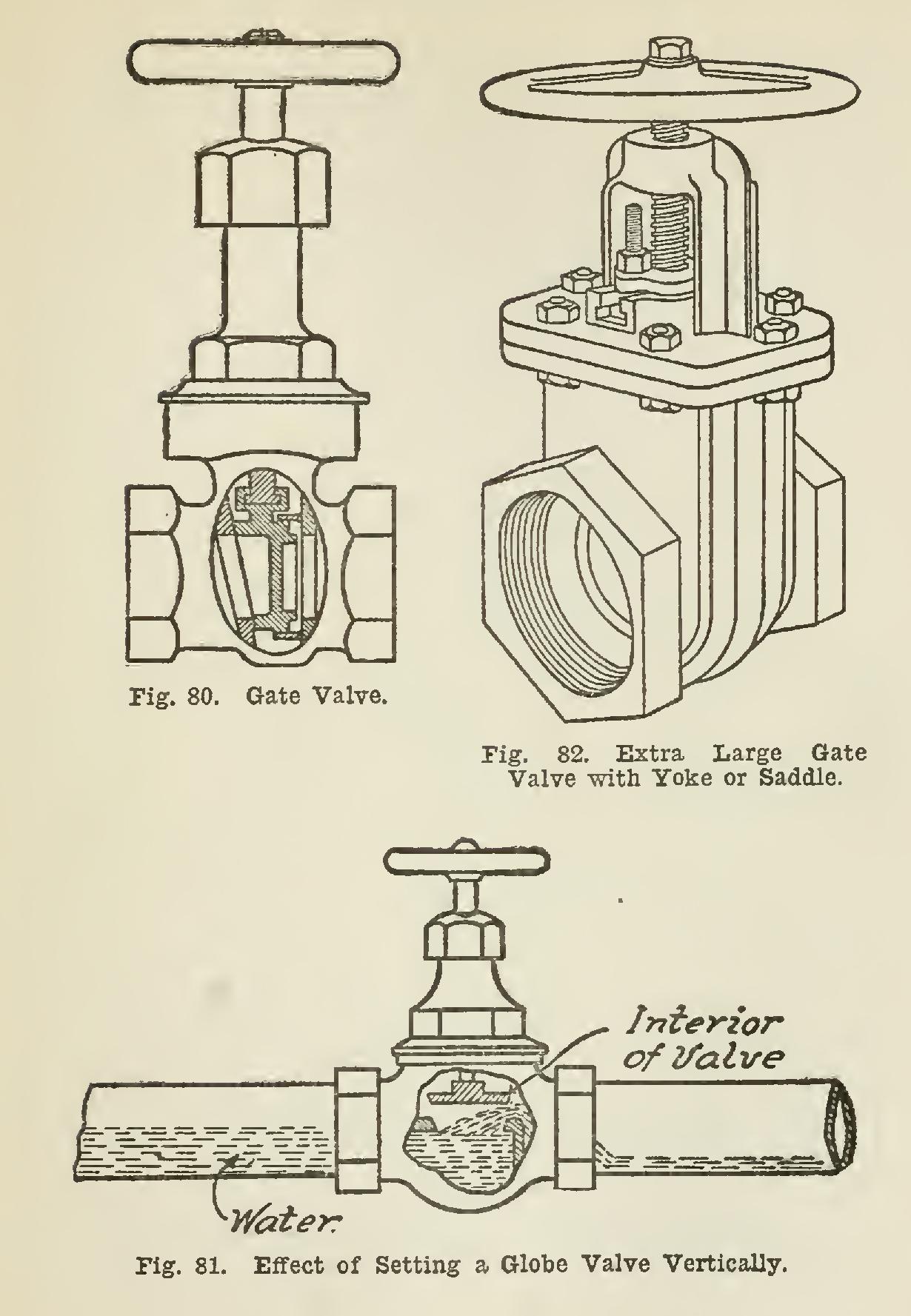
With the gate valve for either steam or hot water, a free opening through the valve is se cured, as will be noticed from the interior view, Fig. 80. Small globe and gate valves are usually made of brass; and sizes above 2-inch or ordinarily of iron, in some cases with brass trim mings. Extra large valves are constructed with a yoke or saddle, as illustrated in Fig. 82, which provision adds greater strength and insures ease of operation.

Radiator Valves. For
use on radiators or units of heating surface, the universal types of valves are the steam radiator valve, Fig. 83, and the hot-water radiator valve, Fig. 84. The former is of the angle type, and is usually pro vided with a union connection to facilitate join ing with the radiator. The latter is also a form of angle valve, being termed a "quick-opening" valve from the fact that one-half turn of the stem either opens the port through the sleeve or closes it in like manner. This valve, too, is supplied with a union connection.
Radiator valves, steam and hot water, are produced in a great multiplicity of designs, all of them, however, being intended to accomplish the purposes above set forth.
Check-Valves. When it is necessary that the supply of steam or water should flow always in one direction only, a form of valve known as a check-valve is placed on the piping in order to prevent any reverse circulation of the steam or water. Such appliances are manufactured in a variety of designs, the most common forms of which are illustrated in Fig. 85.
Air-Valves. It is essential to free all parts bf the heating system, including the various units of radiation, of the air which constantly accumulates in the upper portions of all surfaces of hot-water radiators, or which pockets in the piping owing to the fact that it is lighter than the water in circulation. In steam radiators or pipes, the air will settle toward the bottom of such surfaces, inasmuch as the accumulation is heavier than the supply of steam.
There are numberless forms of valves manu factured for the purpose of releasing air from heating systems. Some are styled positive, re quiring the operation by hand of a wheel, or of a stern with a key, in order to open or close the valve. Others are automatic in their operation, opening by contraction when cold or when the steam is removed from contact with them, and closing by expansion when the supply again reaches the valve.