Why a Pump Works
cylinder, air and valve
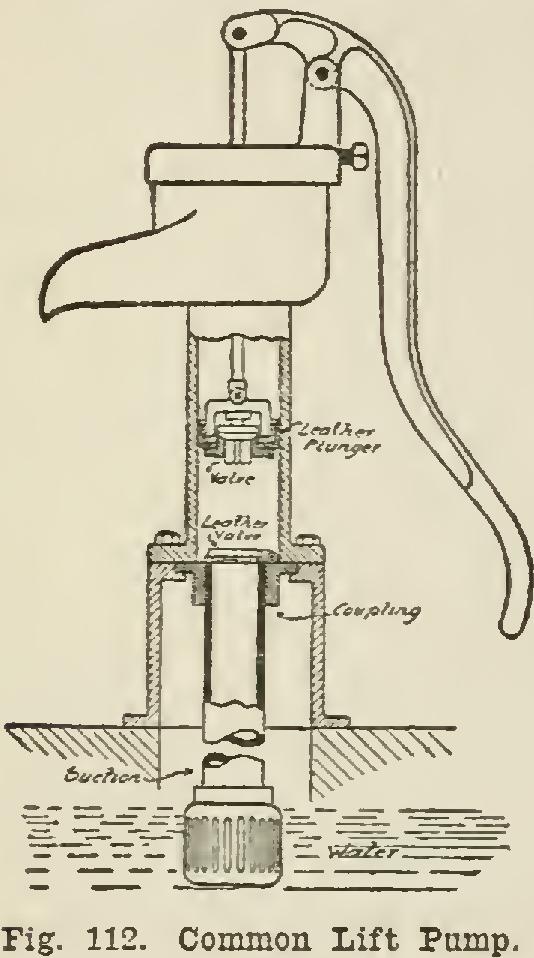
WHY A PUMP WORKS The common lift-pump, shown M Fig. 112. has long been known, and has been used exten sively since its construction. Its general ap pearance and method of operation are no doubt familiar to all readers of this treatise. But why does it work ? The hollow cylinder contains a valve at the bottom, which opens inward like a trap door. Into this cylinder a piston is fitted closely; and this piston is supplied with a valve, opening in the same direction as the one in the bottom of the cylinder. The pipe extending from the bot tom of the cylinder down to and into the water below, is called the suction pipe. When the piston is lifted by means of the piston-rod, which is attached to the handle, the upper valve, known as the outlet valve, remains closed, being weighted down by the pressure of the atmos phere, which is usually figured as being equal to 15 pounds to the square inch. Lifting the piston creates a partial vacuum in the cylinder which causes the inlet valve to open and the same pressure of the atmosphere causes air from the suction pipe to enter the cylinder. By re versing the handle, and pushing the piston down into the cylinder, the air, being compressed, closes the lower or inlet valve, and forces the upper valve open, which allows the air within the cylinder to escape through the hole in the piston. At the end of the stroke, the air which
was contained in the cylinder has been pushed out through the piston and above it, and this air is lifted out of the pump by the next upward stroke. A few strokes will remove the remain ing air from the suction pipe; and the pressure of the atmosphere upon the surface of the water below the pump causes the latter to follow the air up the pipe and into the cylinder. The ac tion of the water in passing through the pump is precisely the same as has been described with the air. All pumps, whether force or lift, whether vertical or horizontal, and whether for pumping liquids or fluids, operate upon the prin ciple of removing the air contained in the cylin der and allowing the pressure of the atmosphere to replace it with the material which is being pumped.