Child Training
children, parents, ready, nerve, muscles, chance and exercise
All normal healthy children are busy, are affection ate, and are curious. When their busyness, affec tions, or curiosity lead them astray they should not be severely punished. Instead, their mistakes should be explained and if possible they should be given a chance to make up for them.
How Little People Discover Their World The campaign to " Make more children worth while" helps parents to understand that children must be physically busy, emotionally sensitive, and intel lectually active. For these are the three important natural kinds of behaving. Each shows itself in many different ways. All together they are called non learned behavior. No one has to teach children these ways of behaving. Parents should watch for them to give them a chance to develop. Without them no baby growing into childhood could ever learn to do or to feel or to know anything. This would be true even though the wisest persons in the world were the baby's parents and teachers.
So when the tiny baby throws his hands about, kicks up his feet, and makes strange noises with his voice his parents must not stop him. Later they must let him shake his rattle, open and shut a convenient box or drawers a dozen times or more.
He is doing these things because he has inherited a general instinct to physical activity. All of their own accord some muscles and their controlling nerve cen ters are ready for exercise. Some energy stored up in the child's nervous system because of good food and restful sleep is trying to find its way out in movements.
A young professor's wife did not know this. That is why she told her son that he must not climb the stairs, that he would fall and hurt himself. But some of the boy's muscles and nerve centers were just ready for that new and hard behavior, so he kept on trying.
Now he didn't fall, so he didn't hurt himself ; and he wasn't at all disobedient as his mother sometimes thought. There was another professor's wife who was wiser. When her babies were ready to climb stairs, she seated herself near by with her sewing. She cau tioned the children to be careful, she praised them and laughed with them when they were successful. Each of her children mastered stair climbing in half-a-day without tumbles and bumps.
Learning to be "Self-Helpful" There are parents and nurses who do not interfere with the ways in which babies must satisfy natural muscle and nerve hunger. Instead they train their
children to be physically independent and self-helpful.
That is the reason Jane at 3% years could put on, without help, her tights, her tall buckled overshoes, her sweater, her coat with its buttonholes in a blind flap, her cap and her mittens when ready to play out doors. That is why Mary Louise at four offered to take home the small kindergarten doll, find some scraps of cloth, needles, thread, and pins to make a dress for it. Mary Louise's eyes sparkled and her face was wreathed in smiles when she brought back the doll she had dressed all alone. But Margaret, who was five, didn't have shining eyes and a smiling 'ace when she brought back the other little doll. Her mother had carefully made a neat romper suit which .acted longer than the dress made by Mary Louise.
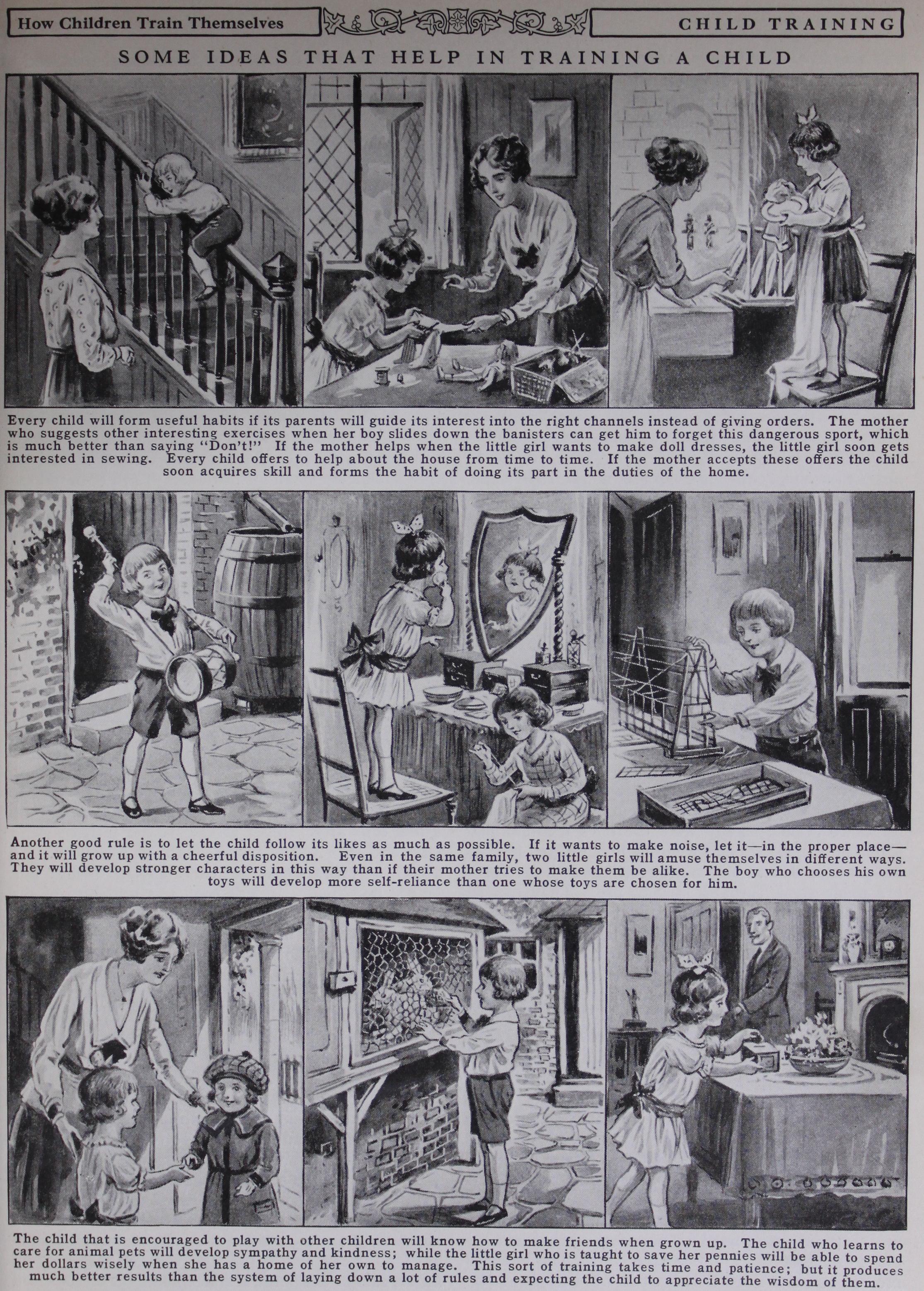
But Margaret's muscles and nerve centers and
feelings Ind ideas were all robbed of a chance for the exercise or which they hungered.
This mother is no longer taking such opportunities iway from Margaret, for the kindergartner and the ioctor explained to her the reason of Margaret's slow ways and her cheerless face.
How Much These Busybodies Learn! Every child has a right to the training in the home that makes him able to dc things well by correct use of his body, arms, and legs in games and work and by use of the common tools of the house, the garden, and the carpenter's bench. More and more psychologists and teachers are saying that the most successful education in the first nine years of every child's life is that which comes through using his instincts to physical activity; through the use, at the right time, of muscles and nerves in some valuable exercise.
Your child, our children, will sometimes wish not to follow exactly in our footsteps. Friction can and should be avoided by considering whether our ways are the only right ways. The chances are that in the beginning our children will want to do differently about \ Try minor things. They must find after trying their ways that they were mistaken, or—and this sometimes happens—we, the parents, may find that we were wrong.