The Federal Budget Fiscal 1959
THE FEDERAL BUDGET FISCAL 1959 U.S. Bureau of the Budget To the Congress of the United States: The budget for the fiscal year 1959 which I am transmitting with this message reflects the swiftly moving character of the time in which we live. It is clearly a time of growing opportunity as technology and science almost daily open wholly new vistas to all mankind. Yet it is also a time of growing danger. The progress of the Soviets in long-range missiles and other offensive weapons, together with their continuing rejection of a workable disarmament, compels us to increase certain of our defense activities which we have only recently expanded many fold.
We know that we are sturdy today in the many strengths that keep the peace. This budget reflects our determination to remain so in the future.
This budget reflects another determination—that of adhering to those principles of governmental and fiscal soundness that have always guided this administration—economy in expenditures, efficiency in operations, promotion of growth and stability in a free-enterprise economy, a vigorous Federal-State system, concern for human well-being, priority of national security over lesser needs, revenues adequate to cover expenditures and permit debt reduction during periods of high business activity, and revision and reduction of taxes when possible.
To meet the responsibilities imposed on us by world conditions and by the fiscal principles to which we adhere, the budget for 1959 contains recommendations to provide: (1) An immediate increase for 1958 of $1.3 billion in spending authority for the Department of Defense, and a further increase of $2.5 billion in 1959 over 1958, to be applied principally to accelerate missile procurement, to strengthen our nuclear retaliatory power, and to spur military research and development programs; (2) A resulting increase of $2.8 billion in estimated 1959 expenditures over 1957 for missiles, nuclear armed or powered ships, atomic energy, research and development, science and education, plus a further provision of $0.5 billion for defense purposes, if needed; in addition, authority to transfer up to $2 billion between military appropriations, in order to take prompt advantage of new developments; (3) A decrease of $1.5 billion in 1959 expenditures below 1957 for other
military arms and equipment and aircraft of declining importance, in favor of the newer weapons; (4) Curtailments, revisions, or eliminations of certain present civil programs, and deferments of previously recommended new programs, in order to restrain nonmilitary spending in 1959 and to provide the basis for budgetary savings of several billion dollars annually within a few years; (5) Continuation of present tax rates to help achieve a balanced budget in 1959.
I believe that this budget adequately provides for our Federal responsibilities in the year ahead.
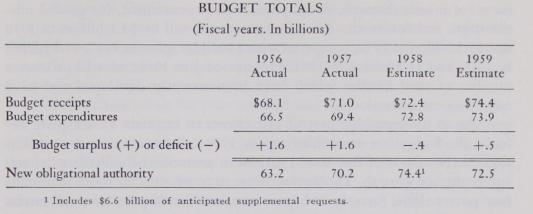
The estimated budget totals for the current fiscal year and for the fiscal year 1959 are compared with actual results of earlier years in the following table: Defense, Science, and the Budget. Americans are determined to maintain our ability to deter war and to repel and decisively counter any possible attack. Today we possess military superiority over any potential aggressor or aggressors. Every American should clearly understand that the vast defense programs undertaken during the past several years have greatly advanced our military preparedness and developed and harnessed impressive new scientific achievements. We have sharply increased the numbers of scientists and engineers assigned to top priority defense programs. We have expanded many fold the expenditures for the development of missiles, both defensive and counteroffensive. We have accelerated development of advanced guidance systems, new fuels, and heat-resistant materials. We have greatly enlarged our network of warning devices and communications.
Our longer-range ballistic missile development, in particular, has long had the highest national priority. The result is striking. Whereas in 1953 we spent only $1 million on these programs, we spent $1 billion in 1957 and will spend more in 1958 and still more in 1959.