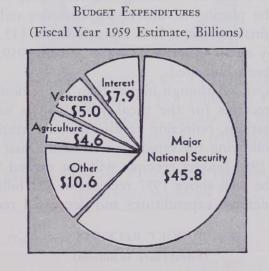
The Federal Budget Fiscal 1959
Our defenses are strong today, both as a deterrent to war and for use as a crushing response to any attack. Now our concern is for the future. Certain elements of our defense program have reached the point where they can be further accelerated. I will transmit to the Congress, immediately, a supplemental appropriation request of $1.3 billion for the Department of Defense for the fiscal year 1958. Further increases in new obligational authority are requested for the fiscal year 1959. The recommended authority for the military functions of the Department of Defense is $39.1 billion, which is $0.6 billion more than was requested in last year's budget for 1958 and $3.8 billion more than the amount the Congress has thus far enacted for 1958. Spending for military functions of the Department of Defense in 1959 is estimated to total $39.8 billion.
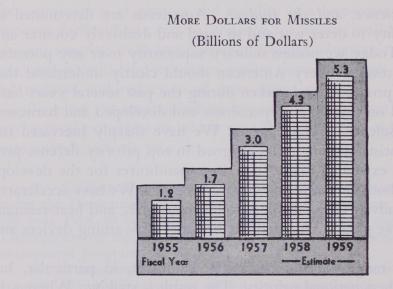
The development of longer-range ballistic missiles, construction of missile sites and detection systems, and other missile programs including guided missile ships will be substantially augmented. The total expenditures for missile research, development and procurement, for guided missile ships, and for missile-related construction will be $4.3 billion in 1958 and $5.3 billion in 1959, compared with $3 billion spent in 1957, $1.7 billion in 1956, and $1.2 billion in 1955. Commencing in 1958, we will procure a number of new missiles which have been recently developed and have now become operational.
As an indispensable part of our efforts to maintain an adequate defense, the budget recommendations for 1959 call for continued contributions to the efforts of free world nations to promote the collective defense and economic growth. The Soviet threat to freedom is far more than military power alone. Poverty and ignorance, and the despair, fear, and unrest that flow from them, have always been enemies to liberty. The Communists well know this and unceasingly exploit these factors to extend their influence and control. This Soviet economic assault on freedom is rapidly growing. Conquest by this route is no less menacing to us and other free nations than conquest by military force. We must, accordingly, vigorously advance our programs to assist other peoples in their efforts to remove poverty and ignorance. As we succeed in these military and economic efforts, our own freedom and security are strengthened, and the prospects for peace are improved.
Scientific and research efforts throughout the Nation must be expanded. This is a task not only for the Government but also for private
industry, foundations, and educational institutions. The Government, on its part, will increase its efforts in this area. Supplemental appropriations for 1958 will be requested for the National Advisory Committee for Aeronautics and the National Science Foundation, as well as the Department of Defense. For 1959, new programs to promote education in science are being recommended and basic research activities are being generally expanded.
Changes in Emphasis. Total Government expenditures (1) for all procurement to equip our forces and those of our allies with weapons, ships, planes, and missiles, (2) for atomic energy, and (3) for all scientific research and education will be approximately $21.1 billion in 1958 and $21.6 billion in 1959, compared with $20.5 billion in 1957.
Within these totals for procurement and science, we have gradually but substantially changed our emphasis. This administration's continuing attention in recent years to new concepts of defense is shown by the fact that more than 75% of the total funds for procurement in the 1959 budget and 1958 supplemental requests is programed for new types of equipment which had not been developed in the fiscal year 1955 or were not being bought in production quantities in that year—the first full year following the Korean conflict. In 1953, missiles alone took less than 2 cents of each dollar spent for major procurement; in 1957, missiles took about 15 cents of every procurement dollar, and in 1959 will take about 24 cents.
The greatly increased firepower of modern weapons and the continuing increase in efficiency permit a further reduction in the numbers of military personnel. Procurement of older types of weapons and equipment is also being reduced. Other defense expenditures will be reduced by closing installations that are outmoded or are of limited use, and by tightening maintenance standards, procurement practices, and supply management.