The National Debt Characteristics
THE NATIONAL DEBT CHARACTERISTICS By W. Randolph Burgess The first chart shows what we are dealing with, the public debt, running back to 1916. It went up in World War I as high as $26 billion, and then was reduced by 1930 to $16 billion; then during the depression it worked up to $48 billion, just before the outbreak of World War II.
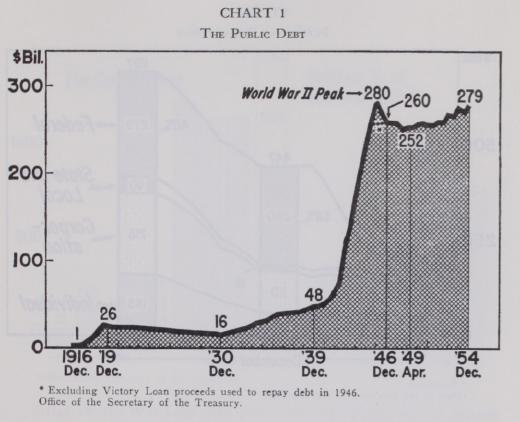
In World War II the debt shot up to $280 billion. That top figure in a sense was a bookkeeping operation, because you will recall that in the Victory loan of 1945 we borrowed more than proved to be necessary. We did not know that war expenditures were going to taper off so quickly, and so there was $20 billion left on deposit with the banks which was used in 1946 to scale down the debt, so that a figure of $260 billion would be a fairer figure of what it really cost us in terms of the national debt.
The first debt reduction due to budgetary surpluses took place in 1947, 1948, and 1949, and they reduced the debt by $8 billion to $252 billion.
Then came the Korean war, and the $27 billion increase since 1949 represents the Korean war and the efforts to meet the cold war. So we are left at the present time with a debt of close to $279 billion.
Now, there is a way of putting the debt in its setting, and it is interesting to relate the Federal debt to our other debts of the people.
Back in 1939, we had a total debt structure of $208 billion, and the $48 billion of Federal debt was at that time 23 percent of the entire debt structure. The state and local debt was $20 billion, corporation debt $89 billion, and individual debt $51 billion, as shown in chart 2.
By the end of the war the Federal debt had swelled up to $260 billion, using that adjusted figure, which was 58 percent of the total debt structure in December 1946. During the war the other segments of the debt were held back because of shortage of goods and inability to start building operations, and so on.
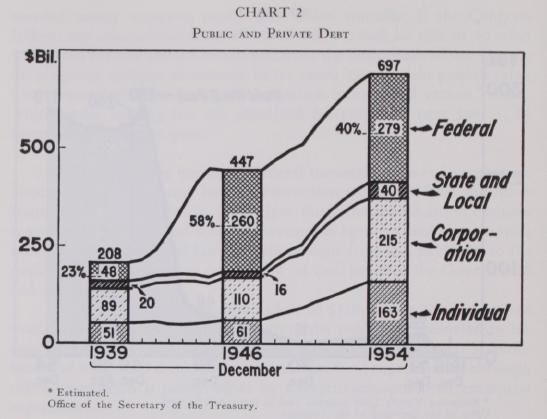
Now, since that time, the Federal debt has risen, as indicated here, to $279 billion, which is now 40 percent of the total debt structure; that is, as the other sections have risen, the Federal debt becomes a smaller proportion of the whole debt structure. These others have gone up pretty
smartly. The State and local debt is expanding. Of course, that includes these road programs which are in a sense self-liquidating; and then corporation debt has doubled since just after the war, and individual debt has risen much more than that; it includes consumer credit, of course, and the big item is mortgages.
Now, once again in the way of showing the problem of the burden of the debt, the left-hand side of chart 3 shows the debt per capita of the population. Before World War I that was only $12. At the end of that war it had risen to $245. It went down to $130; it was $363 before we entered World War II, and it went up to $1,832 by December 1946. Then it shrank, partly due to payoffs and partly due to the growth of the population, to $1,690, and it is fair to say that since 1949, the increase in the population and the increase in the debt have more or less kept pace with each other, so that the per capita debt is about the same.
Now, a rather more cheerful way of looking at it—we ought to seize on any aspect of the debt that we can that is cheerful—is to relate the debt to the national income.
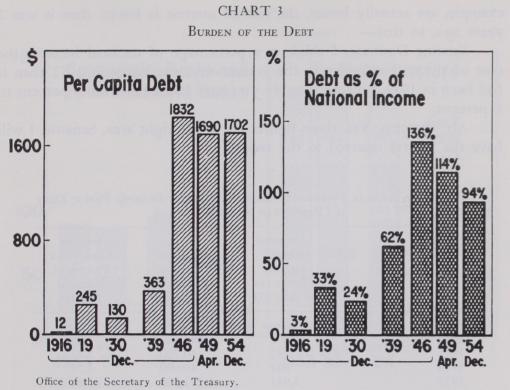
After World War I the debt was 33 percent of the national income.
Before we entered World War II, it was 62 percent, and it rose so that it was larger than the national income, 136 percent; it was reduced by 1949 to 114 percent; because income was growing and there was some debt retirement.
The debt has come down now to 94 percent of national income.
That is due to 2 causes, 1 of which is not so good. That is inflation. Inflation has increased the national income in terms of dollars, so that a part of the adjustment of the debt to national income is due to inflation, so that it has caused in a sense the kind of evil you want to try to avoid.