Brick Chimney Construction a
flue and smoke
Flues are built round, square, and obrequired to connect the smoke-pipe of the heater. This opening should conform in size to the smoke connection on the heater. As stated above, all manufacturers of furnaces, steam boilers, and hot-water heaters are careful to indicate the size of smoke connection best adapted to the use of a certain size of heater, and this specified size should never be reduced.
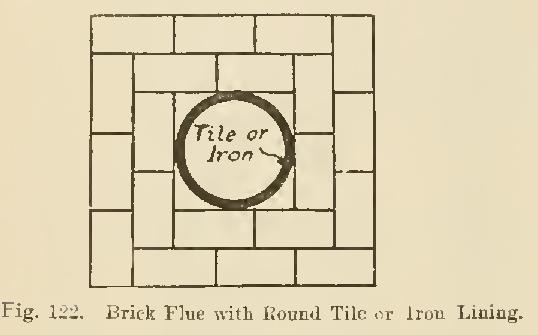
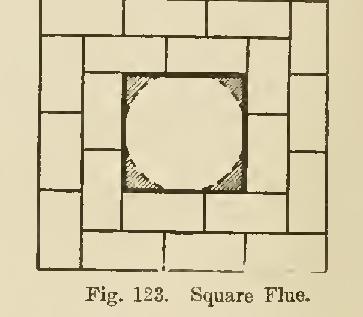
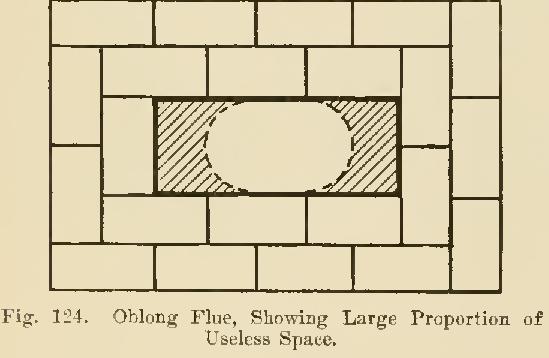
The flue should start but a few inches below the smoke-pipe opening, the part of the chimney beneath being constructed solid up to this point. Smoke, in ascending a flue, travels in a spiral form against the pressure of the atmosphere, and will not rise until the air in the flue is sufficiently lightened by exlong; and the degree of efficiency of the three different styles is indicated in the order named. A brick flue with a round tile or iron lining, as illustrated in Fig. 122, is, without doubt, the best that can be procured, as the heated gases and smoke occupy its full area. The next best type is the square flue, illustrated in Fig. 123. The dotted line indicates the area of the flue reserved by the smoke and gases, the shaded portion denoting the dead air-space. The illustration of the oblong flue, Fig. 124, shows these features also; and the reader will note the increased proportion of useless air-space in this type. This condition may he carried to such an extreme—as, for instance, with a flue 4 by 16 inches —that the amount of dead air-space will equal or even exceed that portion of the flue which is active surface, with the result that a down draft is produced, causing friction by mingling with the opposing current of air, and rendering the flue practically useless. A clear opening of an 8 by 8-inch flue, with an area of 64 square inches, would be far better and more efficient than a flue with an opening 4 by 24 inches, although the latter would have an area of 96 square inches, or a capacity more than one-third greater.
A chimney erected through the center of a building is more efficient than one built in an outside wall, because it is surrounded by heated or warm rooms which in a large measure prevent the condensation of the smoke, the cooling of the gases, and the precipitation of soot. When constructed
in an outside wall, the side of the chimney-flue exposed to the air should be at least 8 inches in thickness. In an outside chimney, the condensation of the smoke and gases from certain grades of coal will frequently cause the sulphur and creosote ingredients to run down the chimney into the smoke-pipe, by this action causing its rapid destruction. These products of combustion leave a dry deposit, which hardens to the consistency of iron, clogging the dampers in the smokepipe or in the smoke-hood of the heater.
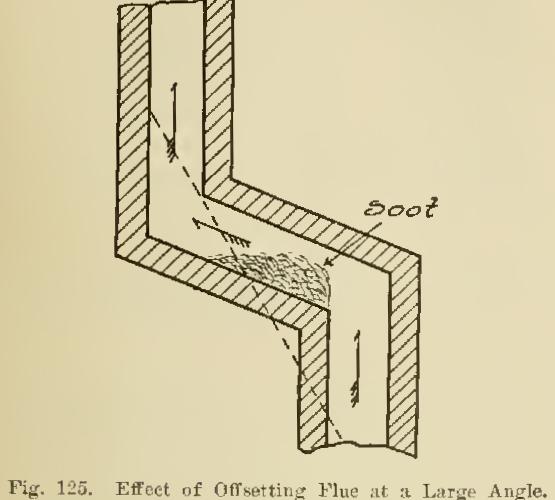
Offsetting of chimney flues should, if possible, invariably be avoided. If conditions, however, make such a construction absolutely necessary, the angle of the offset should be as sharp as possible, otherwise the soot and ashes will form a deposit in the offset and clog up the flue. Fig. 125 illustrates this, and shows by dotted line how offset should have been made.
Height in a flue simply governs velocity, having no effect whatever on the area, which should be sufficient for the work demanded of it. A chimney in a building of two or more stories has sufficient height to be suitable for all purposes. It should extend above the building to such a distance that adjacent structures or roofs will not interfere with its working, or cause a possible clown draft by reason of the wind blowing over the roof and down through the chimney.
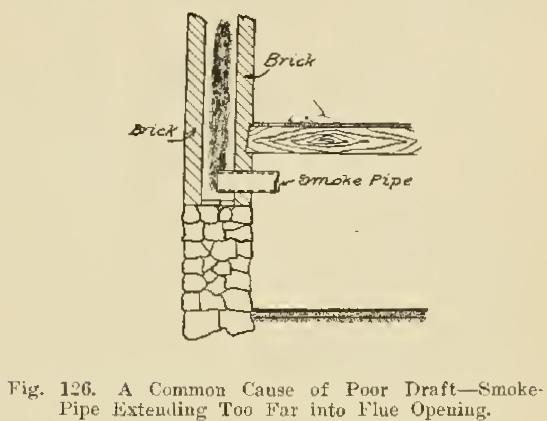
Trouble with the draft in a heating system may be due to any one of the following causes: 1. Obstructions in flue, such as extensions of bricks or timbers, or an extension of smoke-pipe too far into flue opening, as shown in Fig. 126.
2. Loose or open clean-out doors at base of chimney. B. Height insufficient to dear surrounding obstructions to draft.
4. Insufficient area for work demanded of floe.
5. Au enlarged or contracted chimney at some point in its length. A Hue is only as large as the area at ita smallest portion.
6. Tens or more moke•pipes from different apparatus connected to some chimney, one working against another.
7. Offsets at too great an angle—that Is, too flat.
8. Loose division walls between flues one of which is used for the heater.