Brick Chimney Construction a
wall and loss
These are the causes of some of the difficulties commonly experienced with chimneys, and their enumeration should prove a valuable aid in locating any possible trouble. As a guide to follow in the proper construction of a chimney, Table XXX). is given, which shows the proper sizes of brick and tile flues for different-sized buildings. The dimensions of tile given are commercial sizes. The capacities scheduled have been found in practice to be entirely sufficient for ordinary work, and can be safely relied upon to render proper results.
Brick Quality and Heating Plant Efficiency. It has been calculated that the average room, with doors and windows shut, will change its air at least once an hour through ordinary airleakage. In winter-time and the cold weather of the early spring and late fall, the whole house resembles the room in that it affords by leakage constant opportunity for heat losses. Thousands of heat-emits are lost each hour by way of the walls, windows, floors, ceilings, and fireplace.
The wall heat-loss is quite imporant, and the choice of the material of which the wall is constructed should be made wisely. There is not nmch difference, in loss of heat, between a well-built wooden wall well papered and clapboarded, a waterproofed concrete wall, a stone wall, a properly constructed stucco wall, a brick-veneered wall, and a wall composed of properly laid hard building brick. There is not so much difference between any or all of these as there can be found between two brick walls. We have seen that a fine, hard brick will not absorb more than 5 per cent moisture, and that what is known as a good brick will not take up more than 10 per cent. Inferior brick will absorb from 25 to 40 per cent of their weight in water.
The reader must bear in mind that water is the greatest absorber of heat known; that one heat-unit is the amount of heat required to raise one pound of water one degree of temperature, and that same amount of heat will raise five pounds of dry masonry one degree. Let the masonry absorb from 15 to 30 per cent of moisture, and it will be readily understood that the heating plant will be called upon to work overtime to keep the house warm and dry during wet and chilly weather. Short-sighted home-builders will pay a high price for a face-brick front, and will then endeavor to clip off a few dollars by buying the cheapest brick possible for the sides and the rear of the building. Fully 70 per cent of the wall
exposure of the house is in this way constructed of an absorbent brickwork, with its attendant liabilities to mortar-joint defects. The weakest wall surface of this kind is often the one that has the most unfavorable wind and weather exposure.
Table XXXII, compiled by E. R. Pierce, in his "Practical Manual of Steam and Hot-Water Heating," offers for consideration some interesting figures on heat loss through brick walls.
This loss is noted when there is no wind. To give the reader some conception of wind effect on heat loss, in a brief paragraph we shall note the wind velocity and corresponding heat loss in B. T. U. per sq. ft. per hour on a onebrick wall, with a loss of 25, as shown in the table. With a wind-velocity of 2 miles per hr., the loss is increased to 25.5; 5 miles, 26.25; 10 miles, 27.50; average winter wind with velocity of miles per hr., loss is 28.12; 15 miles, 28.75; 20 miles, 30.00; 30 miles, 32.50. Thus it may be calculated that with a 2-brick wall and 125 sq. ft. of exposed surface, there will be a loss of 2,390 B. T. U. per hour from the wall.
A few dollars saved in the purchase of brick of inferior quality, or through neglect in noting the absorptive quality of the brick selected, will be attended later by fuel-expense and lack of comfort. Buy good brick. They pay dividends.
Bricknogging. To prevent the passage of vermin and also to offer resistance to fire, it is often specified that a course of brick shall be built in at the bottom of the story and also at half the height, resting on the bridging. This brickwork in wooden partitions is known as bricknogging. The brick must not be wider than the studs or the lathing will not nail on straight. The bricknogging should be built from the top of the partition to the top of the joist when the joist rests on the partition.
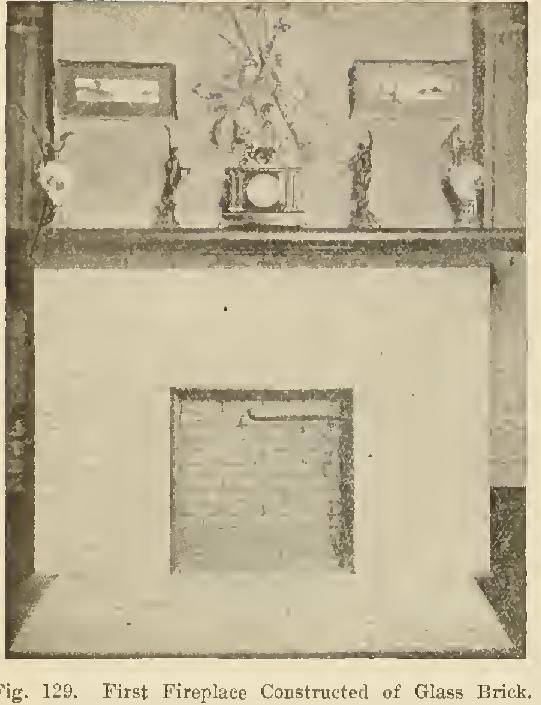
Glass Brick. A combination of glass and concrete has recently been developed for construction work, in the shape of brick consisting of glass molded in various hollow shapes, or of glass facings with concrete backing.