Brick Construction
bond and wall
BRICK CONSTRUCTION Brick structures are made by imbedding the brick in mortar made of lime or cement and sand. The mortar is used for two purposes: it serves to cement the bricks together so that they act as a unit, and it also acts as a cushion to distribute the pressure.
If ordinary mortar of lime and sand be used, that will be the weakest part of the brick wall, and the joints should be kept thin, not over inch in good work. If Portland cement mortar be used, it may be as strong as the brick, but in this ease economy usually prompts the builder to make thin joints.
Laying the Brick. Brick are usually quite porous, and, if laid dry, will extract much of the water from the mortar. The effect of this is to weaken the mortar; and so the practice is to wet the brick before they are laid. It is common practice to specify that the brick are to be laid with a shove joint. This means that the mortar is to be spread on first, then the brick is laid lightly in it, and shoved diagonally back from the face and up against the adjacent brick. This manner of laying forces the mortar into the irregularities of the brick, and increases the adhesion between the two substances.
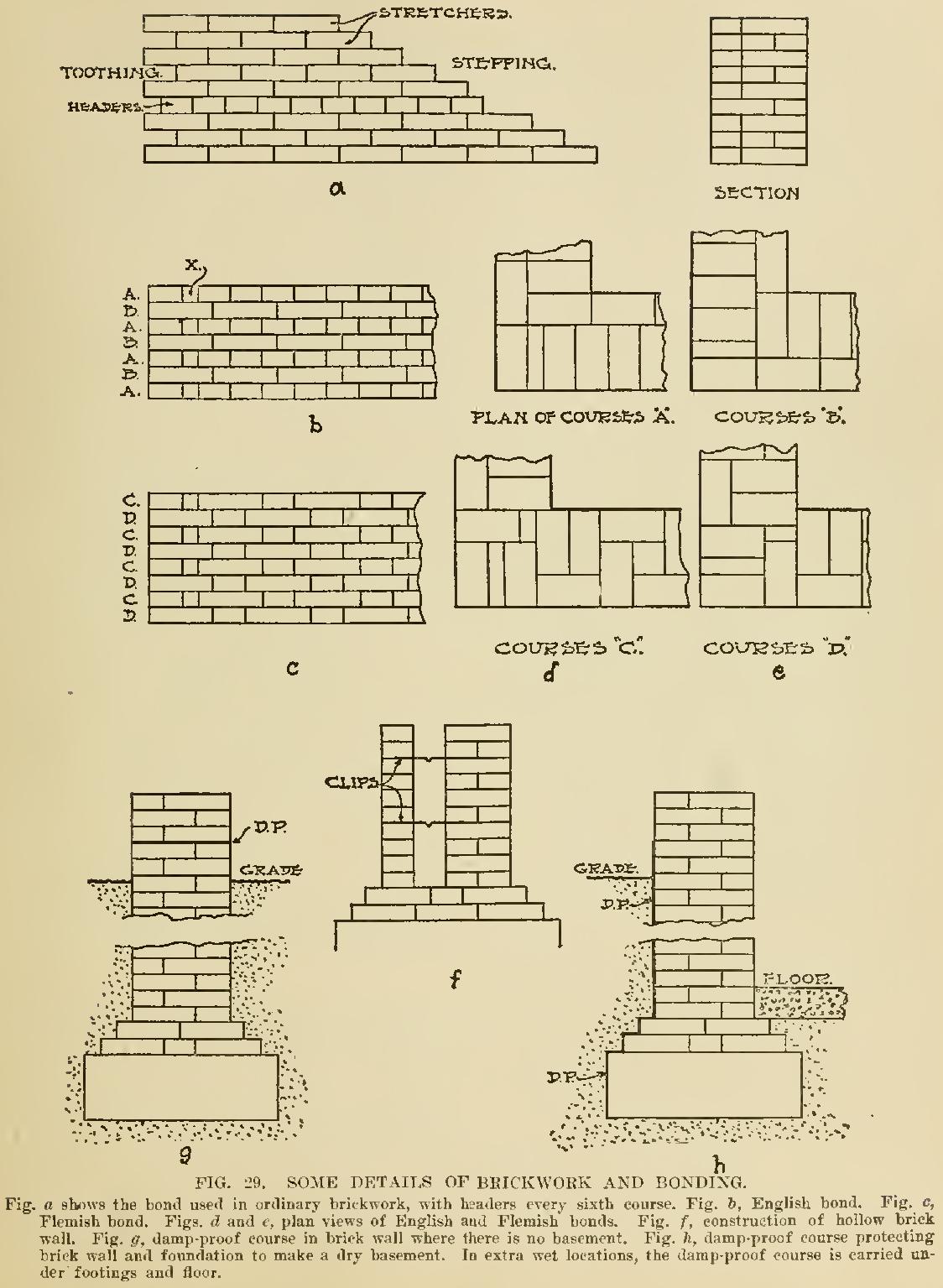
Bond. By this term in brickwork is meant the arrangement of the brick so that each one tends to transfer vertical pressure to two or more below in such a way that no single tier of brick acts alone. By bonding, all parts of the wall are tied together by the weight imposed on the bricks; and an effective distribution of a concentrated weight is thus made over an ever-increasing area. This is accomplished by means of headers and stretchers, as in stone masonry. It is generally accepted that a perfect bond in brickwork cau be secured where two headers plus one mortar joint equal one stretcher.
The two styles of bond in most common use are the English and the Flemish bond.
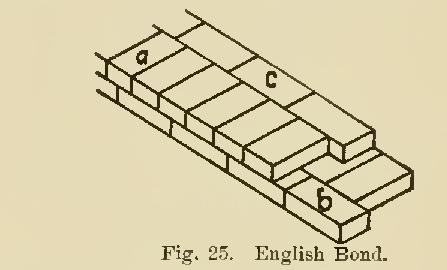
English Bond. This manner of laying is shown in Fig. 25, where all the bricks in the face of the course a are headers. In the face of the course below, all are stretchers. It is usual to have one row
of headers to every half-dozen rows or so of stretchers, although the true bond of this type has them in alternate layers. This method is really known as the common bond, but has taken the name "English bond" because of its similarity of header and stretcher arrangement. The common bond effects considerable economy, as the true English bond is wasteful of face brick without showing a definitely needed gain of strength. With alternating courses of headers and stretchers, one-half the face of the wall will be headers—a decided waste of face-brick value. The arrangement of the bricks in the hack, as at c, depends upon the thickness of the wall. A piece of brick of less than full section in the face or in the interior of the wall, used to fill in where a whole brick would be too large, is called a bat. As it is not always possible to build a wall of entire bricks, bats are used to make the face appearance uniform. The joints in the header courses must he made thinner than the others to preserve the proper spacing, since there are more of them.
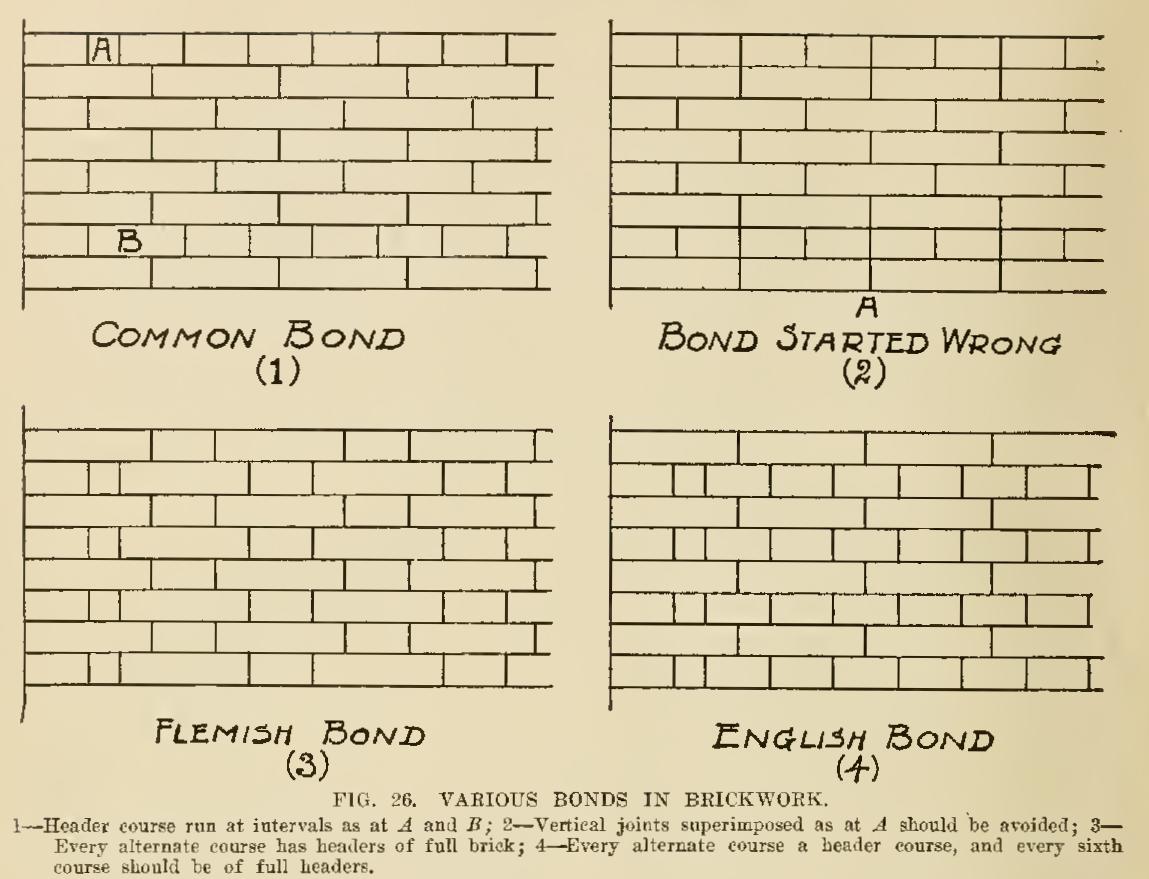
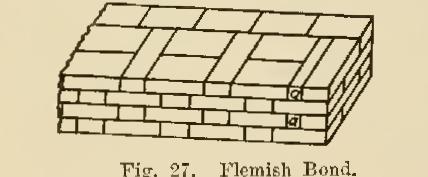
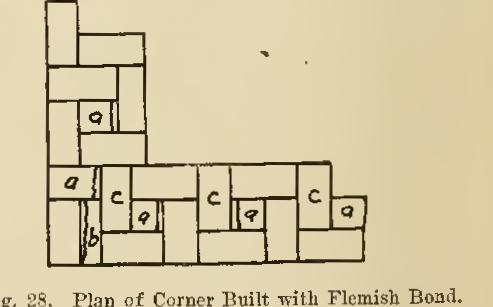
Flemish Bond. This bond makes a very strong wall, and the face presents a particularly pleasing effect. The bond is formed by alternate headers and stretchers in each course, and forms a definite pattern in the joints by disposing of the vertical joints in a way which has a pleasing effect to the eve, This bond is considered more difficult and costs more to lay than the "English," but it is in common use. Figs. 27 and 28 show a wall laid up in this manner. Here, again, the thickness of the wall and the frequency of the corners determine the arrangement of the bats to make the face regular. Occasionally both sides of the wall are faces ou which the appearance must be that of alternate headers and stretchers. Many apparent headers are only bats, even in walls of good workmanship; and the real headers are not necessarily of full cross-section.