Cost of Brickwork
wall and bricks
COST OF BRICKWORK Although attention has been called to the fact that the cost of bricks and brickwork will vary in different localities, the following prices may be used for rough estimates: Brick, common, $6.00 to $10.00 per cubic yard. Cost of lime mortar per cubic yard of brickwork, about GO cents; of cement mortar, $1.00 to $2.00.
On the basis of $7.25 per thousand for red brick, $2.50 per barrel for cement, $1.25 per barrel for lime, $1.25 per cubic yard for sand, assuming a mason at 65 cents per hour, with help at 371/2 cents per hour, to lay 1,200 bricks in 8 hours, a brick wall 13 inches thick will cost about 40 cents per superficial foot. With pressed-brick face, the cost will be about 50 cents per superficial foot.
For close figuring, the methods given below in detail should be followed: Methods of Measuring Brickwork The methods of measuring brickwork in walls and in construction work vary with different contractors and in different parts of the country. Many use a rough rule of measuring around the walls, multiplying this measurement by the height, and then multiplying by the number of bricks contained in a square foot of wall of the thickness to lie used. They make no allowance for windows, doors, or openings of any kind, of an area less than about 80 square feet, since they claim that the labor necessary around such openings will offset the saving in the bricks which are not used.
As a means of compensating for this seemingly large estimate on the amount of brickwork, seine contractors do not allow extras for arches, pilasters, etc.
If deductions are made for openings larger than 80 square feet, contractors using the above method generally measure the width as 2 feet less than the actual width. A rule among some contractors is to figure all walls as solid, and then make an allowance for mortar.
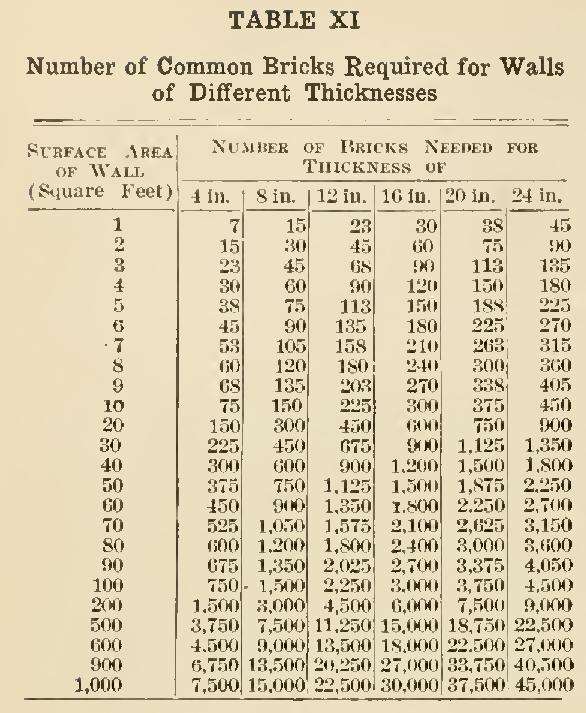
Another method in common use—and one which seems to be a little more rational and conservative while not claiming to be exact—is to measure the actual wall surface, deducting all openings over 2 feet square, measuring the corners only once for lffick walls, and then multiplying by for a 4-inch wall; by 15 for an 8- or 9-inch wall; by for a 12- or 13-inch wall; by 30 for a 16- or 18-inch wall; by 38 for a 20inch wall; and by 45 for a 24-inch wall.
The results of such a procedure will give the approximate number of "eastern" bricks in the wall. Deduct about 1/3 the number if "western" bricks are used. Table XI may be used to advantage in figuring by this method.
In the Western States the terms wall measure and kiln count are often heard. "Wall measure" is simply a common trade rule and is not exact. Amounts of brickwork are calculated by the arbitrary rule of bricks per sq. ft. of wall surface for a 12-ineh wall just referred to and as shown in Table XI. This method is often insisted upon by workmen as the basis for computing labor in laying brickwork. Contractors often use this method of estimating number of bricks in figuring cost of brickwork, and then do not figure for cost of mortar; allowing the extra number of bricks figured over the number actually needed for the wall, to take the place of the cost of the mortar and possibly a part of the labor. If bricks were ordered by this rule, there would be a greater number than needed for the work.
"Kiln count" means the actual number of bricks needed for the work, or the number to be purchased. If kiln count is used, mortar will have to be figured separately, as no allowance is made. The size of brick should always be specified in figuring. For standard bricks, 21/2", 17 is the number usually estimated as occupying 1 square foot of 12-inch wall when joints are thick, that is, between and 1 inch.
Sometimes the actual wall contents are measured in cubic yards of volume, and the following plan used. For common brick inches in size, allow 500 bricks to a cubic yard of wall when mortar joints are used. In work where thin joints are used as, for example, in fronts, where a inch joint may be uscd—it is better to figure on about 580 bricks for a cubic yard of wall.