Cost of Brickwork
bricks and wall
Hollow walls are generally figured as solid.
Arches are figured from the spring; and pillars or columns may be figured as a wall of length equal to the width and height of the pillar and of thickness equal to the third dimension of same.
When stonework, such as sills, caps, etc., is set by the brickmason, no deduction is made for same in figuring brickwork for walls. The same conditions apply to ashlar work when placed by the bricklayers.
An allowance of 5 or 6 per cant should be made on all figured amounts of brickwork to make up for loss and breakage. A common rule in fancy bricklaying is to add 50 per cent to the figured number of bricks, or allow bricks for each one actually estimated.
A method of measuring footings together with walls is to add the width of the projections of the footing on each side of the wall to the height of the wall,' and figure as indicated above for an ordinary wall.
In figuring the number of bricks needed for piers of considerable size, and where the bulk of the mortar used in the joints will prove a considerable factor, it would be safer to figure the cubic contents of the pier in cubic feet, and divide by 27 to reduce to cubic yards. Then apply the rule of 500 brinks to a cubic yard as already given.
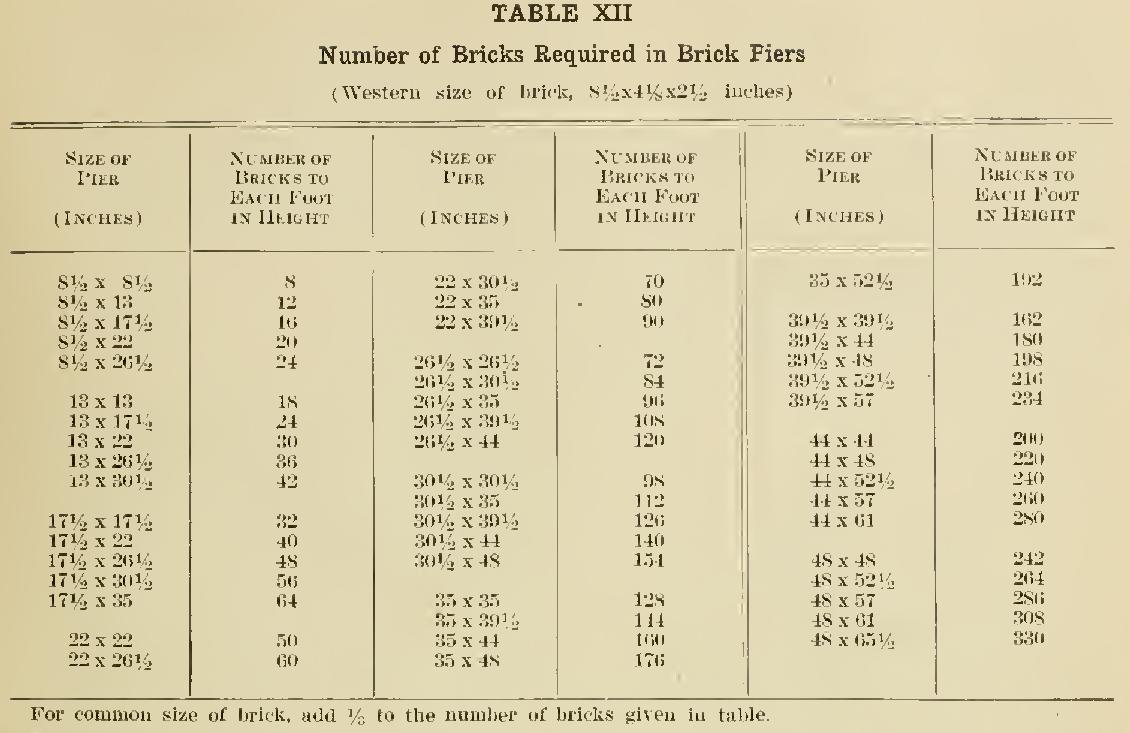
If western brick are used, Table XII will be of service in determining the number of bricks needed. If common bricks are to be used, inches in size, add 1/3 to the number given in the table for a given size of pier.
The space occupied by 1,000 bricks when carefully stacked, is about 56 cubic feet; while old bricks, when cleaned and stacked loosely, occupy about 72 cubic feet per 1,000.
It is often estimated that a bricklayer's hod will hold about 20 bricks, or about 100 pounds weight. This type of hod is generally about 8 inches on a side and 20 to 22 inches in length.
A mortar hod which is about 12 inches on a side by 22 inches long will hold about 1/30 of a cubic yard of mortar.
Number of Bricks in a Wall. Table XI will be of service in determining the number of common bricks X inches in size which are needed for walls of ordinary thickness.
For example, supposing that we wish to find from the table the number of bricks in a wall 125 feet long, 15 feet high, and 12 inches thick. This wall contains 125 x15-1,875 square feet.
For 1,000 square feet of 12-invb wall, the table gives 22,500 bricks For 600 square feet 12,500 bricks For 200 square feet 4,500 bricks For 70 square feet 1,575 bricks For 5 square 113 bricks Total 1,075 square feet requires total of 42,188 bricks This same method can be applied to any size of wall, by simply breaking up the total number of square feet in the wall into parts which are given in the table, and then adding these parts for the final result. This final result is in what is called "wall measure," and not actual number of bricks.
Tt should be noticed hi using this table that the thicknesses of wall are given in multiples of 4 inchds, or the width of one brick. By adding the thickness for mortar ioints it can be readily seen as to what column so-called 13-inch walls, walls, etc., will fall under.
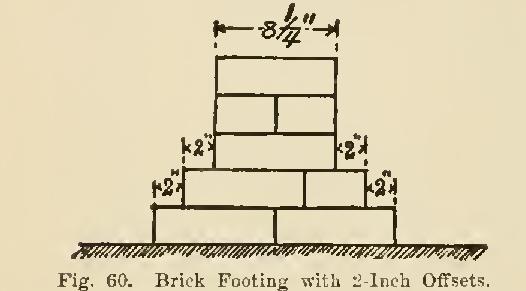
For actual number, or "kiln count," multiply this number by 17, and divide by Footings. These are wide courses placed at the base of a wall to distribute the pressure over a greater area of ground. The usual practice is to make the lowest footing course twice the width of the wall it is to support. Offsets of in. in each superimposed course are then made till the main wallthickness is obtained. Where walls are two or more brick in thickness, the bottom courses of the footings are frequently doubled. The best practice requires the laying of headers in footings as far as possible, and any stretchers used should he laid near the center of the wall. If the soil is soft and compressible, wider footings should be used. Where the loads are extra heavy, it is recommended that each projecting course be made double, with headers on the top course and stretchers at the bottom. The brick used should be the hardest and strongest the market affords; and special care should be given to the jointing, which should be of cement or hydraulic lime.