Cost of Brickwork
bricks and flue
Number of Bricks in Footings. When the "standard" size of bricks, X4 X inches, are used in frontings with offsets of 2 inches for each course used, Table XIII, based upon the calculation here shown, may be used.
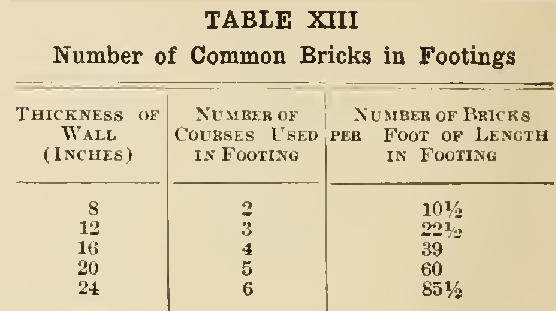
Fig. 60 shows an 8-inch wall resting upon a footing consisting of 2 courses of brick laid with offsets of 2 inches. There are 31/2 bricks shown when looking at the end of this footing. If we stood around on the side of the footing, we would see the ends of 3 bricks 4 inches wide for each foot length of side of footing. Multiplying the number of bricks shown in the end view by the number shown per foot of length in the side view, we would have: x 3=10V., bricks per foot length of footing. With other thicknesses of wall, thicker footings are needed; but the same plan for finding number of bricks per foot length of footing may be used. For sizes of brick other than that on which Table XIII is based X the figures there. given will be varied to some extent.
Bricks Required for a Chimney. If it is desired to obtain a fairly close estimate as to the number of bricks necessary for a plain one of the methods described below may be used.
If it is figured that 5 courses of brick laid in a chimney will make 1 foot of height, taking into account the thickness of the mortar joints, and that 5 bricks in a course will make a flue 4X8 inches, then 5 x 5=25 bricks would be necessary for 1 foot of height of a chimney with a 4x8-inch flue.
For a flue 8x8 inches, 6 bricks would be needed in each course, or 30 bricks for 1 foot of height.
For a flue 8x12 inches, 7 bricks would be needed in each course, or 35 bricks for 1 foot of height.
For a flue 12x12 inches, 8 bricks would be needed in each course, or 40 bricks for 1 foot of height.
By remembering the size of a common brick, and with the aid of a sketch of the cross-section of the flue desired, no matter whether it is a single-, double-, or triple-flue chimney, the above method of figuring the number of bricks needed for any chimney, square or oblong in section, may be used. The method of procedure consists in finding the number of bricks necessary to enclose the area desired, and then multiplying by 5 to get the number of bricks per foot of height of chimney.
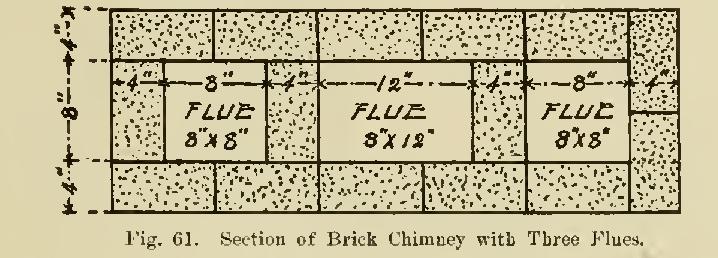
For example, suppose it is desired to find the number of bricks needed for a plain chimney 25 feet high and having 2 flues 8x8 inches and 1 flue 8x12 inches.
Lay out a diagram like Fig. 61, and we find that 15 bricks are needed for a course. Then, 15X 5=75, the number of bricks needed per foot of height of chimney, figuring 5 courses of brickwork per foot of length. And, 75X5=1,875 bricks, the approximate total of bricks needed for the chimney.
If fancy designs are used, a special allowance must be made for the same, depending wholly upon the design desired.
A simple method of figuring for single flues is as follows: Find the number of cubic feet in the chimney by multiplying the area (in square feet) of cross-section of the chimney, considered as solid, by the height in feet: and subtract the contents of the flues as indicated in the following: For an 8-inch flue, subtract one-half the length of the flue in feet.
For a 1:2-inch flue, subtract the length of the flue in feet.
For an 18-inch flue, subtract times the length of the flue in feet.
For a 24-inch flue, subtract four times the length of the flue in feet.
Multiply this answer by and the result will be the number of bricks required.
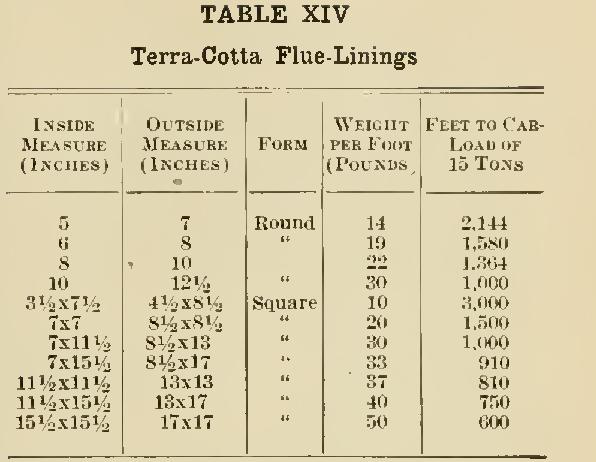
Table XIV gives sizes and weights of common sizes of terra-cotta flue-linings.