The Cytoplasm
cell and substance
THE CYTOPLASM It has long been recognized that in the unicellular forms the cytoplasmic substance is often differentiated into two well-marked zones ; viz. an inner medullary substance or endoplasm in which the nucleus lies, and an outer cortical substance or exoplasm (ectoplasm) from which the more differentiated products of the cytoplasm, such as cilia, trichocysts, and membrane, take their origin. Indications of a similar differentiation are often shown in the tissue-cells of higher plants and though it may take the form of a polar differentiation of the cell-substance, or may be wholly wanting. Whether the distinction is of fundamental importance remains to be seen ; but it appears to be a general rule that the nucleus is surrounded by protoplasm of relatively slight differentiation, while the more highly differentiated products of cell-activity are laid down in the more peripheral region of the cell, either in the cortical zone or at one end of the This fact is full of meaning, not only because it is an expression of the adaptation of the cell to its external environment, but also because of its bearing on the problems of For if, as we shall see reason to conclude in Chapter VII., the nucleus be immediately concerned with synthetic metabolism, we should expect to find the immediate and less differentiated products of its action in its neighbourhood, and on the whole the facts bear out this view.
This fact was first pointed out in the tissue-cells of animals by Kupffer ('75), and its importance has since been urged by Waldeyer, Reinke, and others. The cortical layer is by Kupffer termed paraplasm, by Pfeffer hyaloplasm, by Pringsheim the Hautschieht. The medullary zone is termed by Kupffer, protoplasm, sensu sfrictu ; by Strasburger A'rnerplasma, by Nageli paint/arm.
2 Cf. p. 38.
a See Kupffer ('90), pp. The most pressing of all questions regarding the cytoplasmic structure is whether the sponge-like, fibrillar, or alveolar appearance is a normal condition existing during life. There are many cases, especially among plant-cells, in which the most careful examination has thus far failed to reveal the presence of a reticulum, the cytoplasm appearing, even under the highest powers and after the most Fig. 13.— Ciliated cells, showing cytoplasmic fibrilke terminating in a zone of peripheral
microsomes to which the cilia are attached. [ENGELMANN.) A. From intestinal epithelium of Anodonta. B. From gill of Anodonia. C. D. Intestinal epithelium of Cyclas.
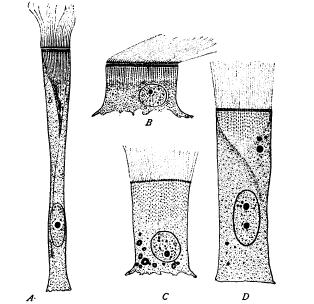
careful treatment, merely as a finely granular substance. This and the additional fact that the cytoplasm may show active streaming and flowing movements, has led some authors, especially among botanists, to regard the reticulum as non-essential and as being, when present, a secondary differentiation of the cytoplasmic substance specially developed for the performance of particular functions. It has been shown, moreover, that structureless proteids, such as eggalbumin and other substances, when coagulated by various reagents, often show a structure closely similar to that of protoplasm as observed in microscopical sections. Butschli has made careful studies of such coagulation-phenomena which show that coagulated or dried albumin, starch-solutions, gelatin, gum arabic, and other substances show a fine aveolar structure scarcely to be distinguished from that which he believes to he the normal and typical structure of protoplasm. Fischer ('94, '95) has made still more extensive tests of solutions of albumin, peptone, and related substances, in various degrees of concentration, fixed and stained by a great variety of the reagents ordinarily used for the demonstration of cell-structures. The result was to produce a marvellously close simulacrum of the appearances observed in the cell, reticulated and fibrillar structures being produced that often consist of rows of granules closely similar in every respect to those described by Altmann and other students of the cell. After impregnating pith with peptone-solution and then hardening, sectioning, and staining, the cells may even contain a central nucleus-like mass suspended in a network of anastomosing threads that extend in every direction outward to the walls, and give a remarkable likeness of a normal cell.