Conjugation in Unicellular Forms
nuclei and micronuclei
The more essential phenomena occurring during conjugation are as follows. The Infusoria possess two kinds of nuclei, a large macronucleus and one or more small micronuclei. During conjugation the macronucleus degenerates and disappears, and the micronucleus alone is concerned in the essential part of the process. The latter divides several times, one of the products, the germ-nucleus, conjugating with a corresponding germ-nucleus from the other individual, while the others degenerate as " corpuscules de rebut." The dual nucleus thus formed, which corresponds with the cleavagenucleus of the ovum, then gives rise by division to both macronuclei and micronuclei of the offspring of the conjugating animals (Fig. 8i).
These facts may be illustrated by the conjugation of Paramercium caudatum, which possesses a single macronucleus and micronucleus, and in which conjugation is temporary and fertilization mutual. The two animals become united by their ventral sides and the macronucleus of each begins to degenerate, while the micronucleus divides twice to form four spindle-shaped bodies (Fig. 82, A, B). Three of these degenerate, forming the " corpuscules de rebut," which play no further part. The fourth divides into two, one of which, the "female pronucleus," remains in the body, while the other, or "male pronucleus," passes into the other animal and fuses with the female A. Micronuclei preparing for their first division. B. Second division. C. Third division • three polar bodies or " corpuscules de rebut," and one dividing germ-nucleus in each animal. D. Exchange of the germ-nuclei. E. The same, enlarged. F. Fusion of the germ-nuclei. G. The same, enlarged. H. Cleavage-nucleus (c), preparing for the first division. 1. The cleavagenucleus has divided twice. 7. After three divisions of the cleavage-nucleus; macronucleus breaking up. K. Four of the nuclei enlarging to form new micronuclei. The first fission soon takes place.
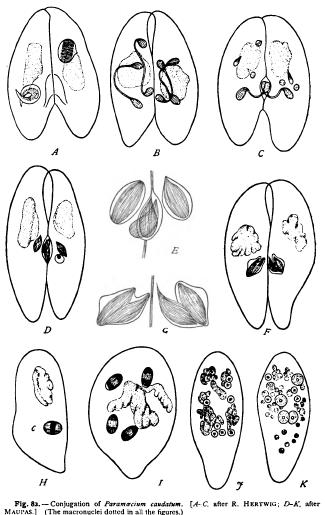
pronucleus (Fig. 82, C—H). Each animal now contains a cleavagenucleus equally derived from both the conjugating animals, and the latter soon separate. The cleavage-nucleus in each divides three times successively, and of the eight resulting bodies four become macronuclei and four micronuclei (Fig. 82, H—K). By two succeeding fissions the four macronuclei are then distributed, one to each of the four resulting individuals. In some other species the micronuclei are equally distributed in like manner, but in P. caudatum the process is more complicated, since three of them degenerate, and the fourth divides twice to produce four new micronuclei. In either case at the close of the process each of the conjugating individuals has given rise to four descendants, each containing a macronucleus and micronucleus derived from the cleavage-nucleus.
From this time forward fission follows fission in the usual manner, both nuclei dividing at each fission, until, after many generations, conjugation recurs.
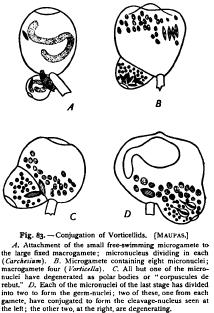
Essentially similar facts have been observed by Richard Hertwig and Maupas in a large number of forms. In cases of permanent conjugation, as in Vorticella, where a smaller microgameteunites with a larger macrogamete, the process is essentially the same, though the details are still more complex. Here the germ-nucleus derived from each gamete is in the macrogamete one-fourth and in the microgametc one-eighth of the original micronucleus (Fig. 83). Each germnucleus divides into two, as usual, but one of the products of each degenerates, and the two remaining pronuclei conjugate to form a cleavage-nucleus.
The facts just described show a very close parallel to those observed in the maturation and fertilization of the egg. In both cases there is a union of two similar nuclei to form a cleavage-nucleus or its equivalent, equally derived from both gametes, and this is the progenitor of all the nuclei of the daughter-cells arising by subsequent divisions. In both cases, moreover (if we confine the comparison to the egg) the original nucleus does not conjugate with its fellow until it has by division produced a number of other nuclei all but one of which degenerate. Maupas does not hesitate to compare these degenerating nuclei or " corpuscules de rebut " with the polar bodies (p. 175), and it is a remarkable coincidence that their number, like that of the polar bodies, is often three, though this is not always the case.
A remarkable peculiarity in the conjugation of the Infusoria A. Union of the gametes, apposition of the nuclei. B. Complete fusion of the gametes. Above and below the apposed nuclei are the centrosomes. C. Cleavage-spindle, consisting of two separate halves.
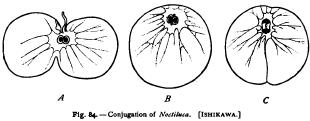
is the fact that the germ-nuclei unite when in the form of spindles or mitotic figures. These spindles consist of achromatic fibres, or " archoplasm," and chromosomes, but no asters or undoubted centrosomes have been thus far seen in them. During union the spindles join side by side (Fig. 82, G), and this gives good reason to believe that the chromatin of the two gametes is equally distributed to the daughter-nuclei as in Metazoa. In the conjugation of some other Protozoa the nuclei unite while in the resting state ; but very little is known of the process save in the cystofiagellate Noctiluca, which has been studied with some care by Cienkowsky and Ishikawa (Fig. 84). Here the conjugating animals completely fuse, but the nuclei are merely apposed and give rise each to onehalf of the mitotic figure. At either pole of the spindle is a centrosome, the origin of which remains undetermined.