The Ovum
nucleoli and germinal
THE OVUM The animal egg (Figs. 42, 43 A) is a huge spheroidal cell, sometimes naked, but more commonly surrounded by one or more membranes which may be perforated by a minute opening, the micropyle, through which the spermatozoon enters (Fig. 45). It contains an enormous nucleus known as the germinal vesicle, within which is a very conspicuous nucleolus known to the earlier observers as the germinal spot. In many eggs the latter is single, but in other forms many nucleoli are present, and they are sometimes of more than one kind, as in tissue-cells.' In its very early stages the ovum contains a centrosome, but this afterwards disappears from view, and as a rule cannot be discovered until the final stages of maturation (at or near the time of fertilization). It is then found to lie just outside the germinal vesicle on the side nearest the eggperiphery where the polar bodies are subsequently formed After extrusion of the polar bodies (p. 131) the egg-centrosome as a rule degenerates and disappears. The egg thus loses the power of division which is afterwards restored during fertilization through the introduction of a new centrosome by the spermatozoon. In parthenogenetic eggs, on the other hand, the egg-centrosome persists, and the egg accordingly retains the power of division without fertilization. The disappearance of the egg-centrosome would, therefore, seem to be in some manner a provision to necessitate fertilization and thus to guard against parthenogenesis.
The egg-cytoplasm almost always contains a certain amount of nutritive matter, the yolk or deutoplasm, in the form of solid spheres or other bodies suspended in the meshes of the reticulum and varying greatly in different cases in respect to amount, distribution, form, and chemical composition.
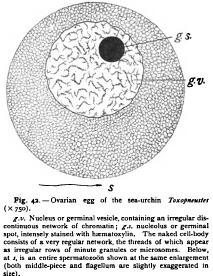
The nucleus or germinal vesicle occupies at first a central or nearly central position, though it shows in some cases a distinct eccentricity even in its earliest stages. As the growth of the egg proceeds, the eccentricity often becomes more marked, and the nucleus may thus come to lie very near the periphery. In some cases, however, the peripheral movement of the germinal vesicle occurs only a very short time before the final stages of maturation, which may coincide with the time of fertilization. Its form is typically that of a spherical sac, surrounded by a very distinct membrane (Fig. 42); but during the growth of the egg it may become irregular or even amceboid (Fig. 58), and, as Korschelt has shown in the case of insect-eggs, may move through the cytoplasm towards the source of food. Its structure is on the whole that of a typical cell-nucleus, but is subject to very great variation, not only in different animals, but also in different stages of ovarian growth. Sometimes, as in the echinoderm ovum, the chromatin forms a beautiful and regular reticulum consisting of numerous chromatin-granules suspended in a network of linin (Fig. 42).
In other cases, no true reticular stage exists, the nucleus containing throughout the whole period of its growth the separate daughter-chromosomes of the preceding division (copepods, selachians, amphibia),I and these chromosomes may undergo the most extraordinary changes of form, bulk, and staining-reaction during the growth of the It is a very interesting and important fact that during the growth and maturation of the ovum a large part of the chromatin of the germinal vesicle may be lost, either by passing out bodily into the cytoplasm, by conversion into supernumerary or accessory nucleoli which finally degenerate, or by being cast out and degenerating at the time the polar bodies are formed (p. 177).
The nucleolus of the egg-cell is here, as elsewhere, a variable quantity and is still imperfectly understood. The nucleoli are of two different kinds, either or both of which may be present. One of these, the so-called principal nucleolus, is a rounded, usually single body, staining intensely with the same dyes that colour the chromatin, and often containing one or more vacuoles. This is typically shown in the echinoderm egg, in the eggs of many annelids, mollusks, and coelenterates, in some crustacea, in mammals, and in some other cases. From its staining-reaction this type of nucleolus appears to correspond in a chemical sense not with the " true nucleoli " of tissue-cells, but with the net-knots or karyosomes, such as the nucleoli of nerve-cells and of many gland-cells and epithelial cells. The second form comprises the so-called "accessory nucleoli," which stain less intensely, are often numerous, and perhaps correspond with the true nucleoli of tissue-cells. As growth proceeds, they usually increase in size and number, and may finally become very numerous, in which case they often occupy a peripheral position in the germinal vesicle. This is typically shown in amphibia and selachians, where there are a large number of nucleoli, which are at first scattered irregularly through the germinal vesicle but at a certain period migrate towards the periphery. In some of the mollusks and crustacea both forms coexist ; but even closely related species may differ in this regard. Thus, in Cyclops brevicornis, according to Hacker, the very young ovum contains a single intensely chromatic nucleolus ; at a later period a number of paler accessory nucleoli appear; and still later the principal nucleolus disappears, leaving only the accessory ones. In C strennus, on the other hand, there is throughout but a single nucleolus. In some of the mollusks and annelids the " germinal spot " is double, consisting of a deeply staining principal nucleolus and a paler accessory nucleolus lying beside it, as in Cyclas and in Vereis (Fig. 43).