The Ovum
membrane and vitelline
3.
The Egg-envelopes The egg-envelopes fall under three categories. These are : (a) The vitelline membrane, secreted by the ovum itself.
(b) The chorion, formed outside the ovum by the activity of the maternal follicle-cells.
(c) Accessory envelopes, secreted by the walls of the oviduct or other maternal structures after the ovum has left the ovary.
Only the first of these properly belongs to the ovum, the second and third being purely maternal products. There are some eggs, such as those of certain coelenterates (e.g. Rcnilla), that are naked throughout their whole development. In many others, of which the sea-urchin is a type, the fresh-laid egg is naked but forms a vitelline membrane almost instantaneously after the spermatozoon touches In other forms (insects, birds) the vitelline membrane may be present before fertilization, and in such cases the egg is often surrounded by a chorion as well. The latter is usually very thick and firm and may have a shell-like consistency, its surface sometimes showing various peculiar markings, prominences, or sculptured patterns characteristic of the species The accessory envelopes are too varied to be more than touched upon here. They include not only the products of the oviduct or uterus, such as the albumin, shell-membrane, and shell of birds and reptiles, the gelatinous mass investing amphibian ova, the capsules of molluscan ova and the like, but also nutritive fluids and capsules secreted by the external surface of the body, as in leeches and earthworms.
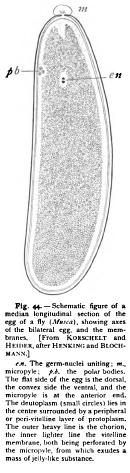
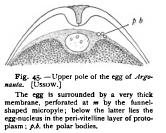
When the egg is surrounded by a membrane before fertilization it is often perforated by one or more openings known as micropyles, through which the spermatozoa make their entrance (Figs. 44, 45). Where there is but one micropyle, it is usually situated very near the upper or anterior pole (fishes, many insects), but it may be at the opposite pole (some insects and mollusks), or even on the side (insects). In many insects there is a group of half a dozen or more micropyles near the upper pole of the egg, and perhaps correlated with this is the fact that several spermatozoa enter the egg, though only one is concerned with the actual process of fertilization.
The plant ovum, which is usually known as the oosphere (Figs. 46, 80), shows the same general features as that of animals, being a relatively large, quiescent, rounded cell containing a large nucleus. It never, however, attains the dimensions or the complexity of structure shown in many animal eggs, since it always remains attached to the maternal structures, by which it is provided with food and invested with protective envelopes. It is therefore naked, as a rule, and is not heavily laden with reserve food-matters such as the deutoplasm of animal ova. A vitelline membrane is, however, often formed soon after fertilization, as in echinoderms. The most interesting feature 1 That the vitelline membrane does not pre-exist seems to he established by the fact that egg-fragments likewise surround themselves with a membrane when fertilized. (HEwrwm).
2 In some cases, according to Wheeler, the insect-egg has only a chorion, the vitelline membrane being absent.
of the plant-ovum is the fact that it often contains plastids (leucoplasts or chromatophores) which, by their division, give rise to those of the embryonic cells. These sometimes have the form of typical chromatophores containing pyrenoids, as in Volvox and many other algae (Fig. 46). In the higher forms (archegoniate plants), according to the researches of Schmitz and Schimper, the egg contains numerous minute colourless " leucoplasts," which afterwards develop into green chromatophores or into the starch-building amyloplasts. This is a point of great theoretical interest; for the researches of Schmitz, Schimper, and others have rendered it highly probable that these plastids are persistent morphological bodies that arise only by the division of pre-existing bodies of the same kind, and hence may be traced continuously from one generation to another through the germ-cells. In the lower plants (algae) they may occur in both germcells ; in the higher forms they are found in the female alone and in such cases the plastids of the embryonic body are of purely maternal origin.