The Ovum
yolk and nucleoli
The physiological meaning of the nucleoli is still involved in doubt. Many cases are, however, certainly known in which the nucleolus plays no part in the later development of the nucleus, being cast out or degenerating in situ at the time the polar bodies are formed. It is, for example, cast out bodily in the medusa ./Equorea (Hacker) and in various annelids and echinoderms, afterwards lying for some time as a " metanucleus " in the egg-cytoplasm before degenerating. In many cases — for example in amphibia, in selachians, in many crustacea, annelids, and echinoderms — the chromosomes are formed in the germinal vesicle independently of the nucleoli (Fig. 96), which degenerate in situ when the membrane of the germinal vesicle disappears. The evidence is, therefore, very strong that the nucleoli do not contribute to the formation of the chromosomes, and that their substance represents passive material which is of no further direct use. There is, furthermore, strong evidence that the nucleoli of both kinds are directly or indirectly derived from the chromatin. Hence we can hardly doubt the conclusion of Hacker, that the nucleoli of the germ-cells are accumulations of by-products of the nuclear action, derived from the chromatin either by direct transformation of its substance, or as chemical cleavage-products or secretions.' It will be shown in I Hicker regards the principal nucleolus as a more highly differentiated modification of the accessory nucleolus, and regards it as a pulsating excretory organ comparable with the contractile vacuoles of Protozoa.
Chapter V. that in some cases a large part of the chromatic reticulum is cast out, and degenerates at the time the polar bodies are formed. It would seem that the nucleoli may likewise represent a portion of the unused chromatin, more closely aggregated and more or less modified in a chemical sense.
2.
The Cytoplasm The egg-cytoplasm varies greatly in appearance with the variations of the deutoplasm. In such eggs as those of the echinoderm (Fig. 42), which have little or no deutoplasm, the cytoplasm forms a regular reticulum, which is perhaps to be interpreted as an alveolar structure. Its meshes consist of closely set intensely staining granules or microsomes embedded in a clearer groundsubstance. The latter, which fills the spaces of the network, is apparently homogeneous, and contrasts sharply with the microsomes in staining capacity. In eggs containing yolk the deutoplasmspheres or granules are laid down between the meshes of the network ; and if they are very abundant the latter may be very greatly reduced, the cytoplasm assuming a pseudo-alveolar structure (Fig. 43), much as in plant-cells laden with reserve starch. In many cases a peripheral layer of the ovum, known as the cortical or perivitelline layer, is free from deutoplasm-spheres, though it is continuous with the protoplasmic network in which the latter lie (Fig. 43). Upon fertilization, or sometimes before, this layer may disappear by a peripheral movement of the yolk, as appears to be the case in Nereis.In other cases the peri-vitelline substance rapidly flows towards the point at which the spermatozoan enters, where a protoplasmic germinal disc is then formed ; for example, in many fish-eggs.
The character of the yolk varies so widely that it can here be considered only in very general terms. The deutoplasm-bodies are commonly spherical, but often show a more or less distinctly rhomboidal or crystalloid form as in amphibia and many fishes, and in such cases they may sometimes be split up into parallel lamellae known as yolkplates. Their chemical composition varies widely, judging by the staining-reactions ; but we have very little definite knowledge on this subject, and have to rely mainly on the results of analysis of the total yolk, which in the hen's egg is thus shown to consist largely of proteids, nucleo-albumins, and a variety of related substances which are often associated with fatty substances and small quantities of carbohydrates (glucose, etc.). In some cases the deutoplasm-spheres stain intensely with nuclear dyes, such as haematoxylin; e.g. in many worms and mollusks ; in other cases they show a greater affinity for plasma-stains, as in many fishes and amphibia and in the annelid A. Before fertilization. The large germinal vesicle occupies a nearly central position. It contains a network of chromatin in which are seen five small darker bodies ; these are the quadruple chromosome-groups, or tetrads, in process of formation (not all of them are shown) ; these alone persist in later stages, the principal mass of the network being lost ; g.r. double germinal spot, consisting of a chromatic and an achromatic sphere. This egg is heavily laden with yolk, in the form of clear deutoplasm-spheres (d) and fat-drops uniformly distributed through the cytoplasm. The peripheral layer of cytoplasm (peri-vitelline layer) is free from deutoplasm. Outside this the membrane. B. The egg some time after fertilization and about to divide. The deutoplasm is now concentrated in the lower hemisphere, and the peri-vitelline layer has disappeared. Above are the two polar bodies (p.b.). Below them lies the mitotic figure, the chromosomes dividing.
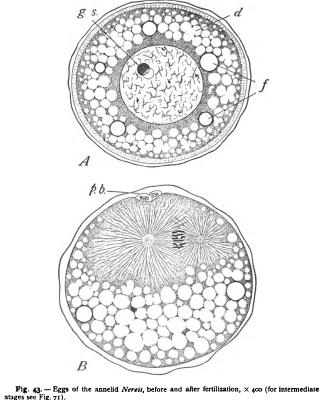
Nereis (Fig. 43). Often associated with the proper deutoplasmspheres are drops of oil, either scattered through the yolk (Fig. 43) or united to form a single large drop, as in many pelagic fish-eggs.
The deutoplasm is as a rule heavier than the protoplasm ; and in such cases, if the yolk is accumulated in one hemisphere, the egg assumes a constant position with respect to gravity, the egg-axis standing vertically with the animal pole turned upward, as in the frog, the bird, and many other cases. There are, however, many cases in which the egg may lie in any position. When fat-drops are present they usually lie in the vegetative hemisphere, and since they are lighter than the other constituents they usually cause the egg to lie with the animal pole turned downwards, as is the case with some annelids (Nereis) and many pelagic fish-eggs.