On the Nature and Causes of Differentiation
cytoplasmic and development
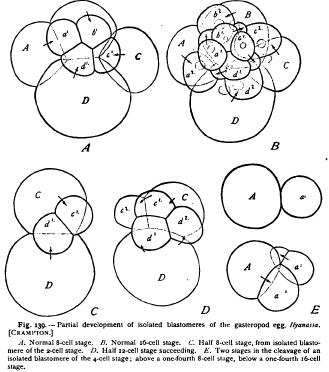
Meanwhile, and subsequently, however, facts were determined that threw doubts on the hypothesis of cytoplasmic isotropy and led Driesch to a profound modification of his views, and in a measure rehabilitated the theory of cytoplasmic localization. Whitman, Morgan, and Driesch himself showed that the cytoplasm of the echinoderm egg is not strictly isotropic, as Hertwig assumed ; for the ovum possesses a polarity predetermined before cleavage begins, as proved by the fact that a group of small cells or micromeres always arises at a certain point which may be precisely located before cleavage by reference to the eccentricity of the first cleavagenucleus.' Experiments on the eggs of other animals proved that the predetermination of the cytoplasmic regions may be more extensive. In the egg of the ctenophore, for example, Driesch and Morgan ('95), confirming the earlier observations of Chun, proved that an isolated blastomere of the two- or four-cell stage gives rise not to a whole dwarf body, but to a half- or quarter-body, as Roux had observed in the (Fig. 135, A—D). But, more than this, these experimenters made the interesting discovery that if a part of the cytoplasm of an unsegmented ctenophore-egg were removed, the remainder gave rise to an incomplete larva, showing certain defects which represent the portions removed (Fig. 138, E, F). Again, Crampton found that in case of the marine gasteropod Ilyanassa, isolated blastomeres of two-cell or four-cell stages segmented exactly as if forming part of an entire embryo and gave rise to fragments of a larva, not to complete dwarfs, as in the echinoderm (Fig. 139).
These results demonstrate that the ovum may show a high degree of cytoplasmic localization and that in such cases cleavage may be in fact a mosaic-work, as Roux maintained in case of the frog. But they also show that the localization, and the resulting mosaic-like cleavage, is not determined by specific differences in the nuclei ; for in the ctenophore the fragment of an unsegmented egg, though containing an entire nucleus, gives rise to a defective larva, and in Nereis the nuclei may be shifted about at will without altering the development. And if the germinal localization is not directly determined by the nuclei it must here be determined by a pre-organization of the cytoplasmic substance. How is this result to be reconciled with the experiments on Amphioxus and the echinoderms, and with the more general conclusion that the ultimate determining causes of differentiation are to be sought in the nucleus ? The difficulty at once disappears when we recall that development and differentiation do not in any proper sense first begin with the cleavage of the ovum, but long before this, during its ovarian history. The primary differentiations thus established in the cytoplasm form the immediate conditions to which the later development must conform; and the difference between Amphioxus on the one hand, and the snail or ctenophore on the other, simply means, I think, that the initial differentiation is less extensive or less firmly established in the one than in the other.
We thus arrive at the central point of my own conception of development, and of Driesch's later views, which were developed in a most able and suggestive though somewhat abstruse manner in his Analytische Theorie der organischen Entwicklung ('94), and slightly modified in a later paper published jointly with Morgan ('95, 2). The gist of Driesch's theory is as follows. All the nuclei are equivalent, and all contain the same idioplasm equally distributed to them by mitotic division. Through the influence of this idioplasm the cytoplasm of the egg, or of the blastomeres derived from it, undergoes specific and progressive changes, each change reacting upon the nucleus and thus inciting a new change. These changes differ in different regions of the egg because of pre-existing differences, chemical and physical, in the cytoplasmic structure ; and these form the conditions (" Formbildungsfaktoren ") under which the idioplasm operates. Some of these conditions are purely mechanical, such as the shape of the ovum, the distribution of deutoplasm, and the like. Others, and probably the more important, are far more subtle, such as the distribution of different chemical substances in the cytoplasm, and the unknown polarities of the cytoplasmic molecules.
A nearly related conception was developed with admirable clearness by Oscar Hertwig ('94) nearly at the same time. Both Driesch and Hertwig thus retreated in a measure towards the theory of germinal localization in the cytoplasm, which both had at first rejected ; but only to a middle ground which lies between the two extremes of the strict predestination theory and the theory of cytoplasmic isotropy. For these writers now maintain that the initial cytoplasmic localization of the formative conditions is of limited extent and determines only the earlier steps of development. With each forward step new conditions (chemical differentiations and the like) are established which form the basis for the ensuing change, and so on in ever-increasing complexity. This view is substantially the same as that which I have myself urged in several earlier works, and I have pointed out how it enables us to reconcile the apparent contradiction between the partial development of isolated blastomeres of such forms as the ctenophore, on the one hand, with the total development of such forms as Amphioxus or the echinoderm, on the other. In the latter case we may suppose the cytoplasmic differentiation to be but feebly established at the beginning, and the blastomeres remain for a time in a plastic state, which enables them on isolation to revert to the condition of the original entire ovum. In the former case the initial differentiation is more extensive or more rigidly fixed, so. that the development of the blastomere is from the beginning hemmed in by the cytoplasmic conditions, and its powers are correspondingly limited. In such cases the cleavage may exhibit more or less of a mosaic-like character, and the theory of cytoplasmic localization acquires a real meaning and value.