Social Prosperity
consumption, surplus, increased, commodities, increase, changes, utility, resources, produce and individual
These two tendencies toward the socializing of consumption, i.e., the increase of those forms of consumption that involve some benefit to others than the one who selects and pays for the commodity ; and cooperation in consump tion, i.e., the increase of those forms of consump tion that rest upon the willingness of man to co operate with others in a common expenditure, are tendencies which mark the more advanced stages of social progress. It should be pointed out that but very little consumption belongs as yet in either of these two classes. Individual instances, like those cited, are not rare, but the greater part of our consumption is unfortu nately selfish, exclusive, and unsocial. The loss to society from this source is very great ; or, to state the same fact in the more hopeful way, the possibilities of increasing the social surplus, and hence the general prosperity, from this source, are very great.
If it be true that the individual consumer may greatly increase the utility of the com modities which he consumes by such combina tions as produce harmonious effects, there is here a further means by which the social sur plus may be increased. The special field cov ered by the application of this principle to social surplus is the large field of socially con sumed commodities, — not merely the streets, sidewalks, street-cars, railways, hotels, theatres, etc., but also such commodities as the news paper, the lecture, and the gas and water supply, the common peculiarity of all being that they are desired by a large number of people at about the same time and in about the same form. The formation of complements among these commodities is no less marked than in individual consumption. To the increase of the social surplus in this way must be added the increase of utility secured by the individual consumer from the complements which he forms. The increase of prosperity from wiser and more economical consumption has in many directions greater possibilities than have yet been recognized, and many of these lie within the scope of this principle : that the utility of a group may be enhanced by such change in its composition as shall displace discord by har mony, and produce a more perfect synthesis.
Many of the modifications of consumption which are pronounced by the economist to be desirable changes are so because the direct effect of the changes upon the feelings is such as to produce greater sensations of pleasure. More intense wants are satisfied with a given effort after the change than it was possible to satisfy before. Other changes in consumption are deemed desirable, not because they produce such direct effect, but because of peculiar con ditions attached to the productive resources or agencies. The social surplus may be increased by such modifications of consumption as permit a fuller utilization of resources already some what drawn upon, and the utilization of new resources. This principle, though not of greater significance in the long run than the principles already developed, is of even greater immediate importance for the American economist, since there are here enormous resources which remain undeveloped, not because there is a lack of labor or capital to develop them, but because demand is not of such a character as to warrant the new product being brought to the markets.
The woollen cloth with rough finish which re cently became popular for business and even for professional suits, is made from the longer and somewhat coarser wool which can be pro duced in this country. It is no less durable and no less attractive, when people have become accustomed to its appearance, than the smoother finish of the woollens which were formerly ex clusively worn. The increased consumption of this less expensive cloth becomes therefore a good example of the creation of utilities by simple changes in consumption. When those changes are far-reaching and affect a whole country they may increase materially the social surplus. The extent to which the general well being may be increased by economies of con sumption is seldom realized more vividly than by those who observe closely the changes in consumption in periods of general depression. Changes in consumption become the means of preventing much positive hardship. Commodi ties are made to " go farther," that is to say, their utilities are increased. But if similar economies were practised in more prosperous times, the social surplus would be permanently increased. All changes which act upon general well-being by making commodities "go farther" than they previously did, act upon the social surplus by increasing the total utilities of the commodities produced.
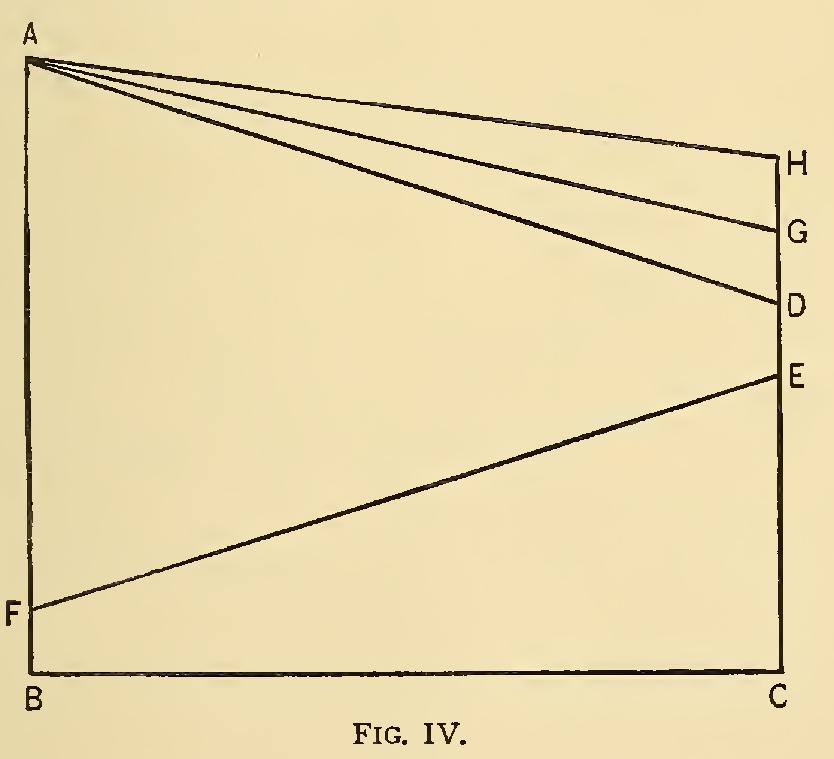
An increase of the social surplus in any of the ways already described is indicated by the modifications of Figure III. shown in Figure IV. Starting with the conditions as they exist at the beginning of the working day, the area ABCD may be increased by anything which increases the utility of the commodities consumed. The cost line retains its position, but utilities, instead of diminishing rapidly from AB to DC, remain more nearly equal, the marginal commodity ris ing on the first improvement in consumption from DC to GC, and later to HC. The surplus utility of the last commodity increases from DE to GE, and then to HE. The effect of this in crease of the surplus, though the fact is not shown in Figure IV., would undoubtedly be to extend the line BC. That is, the increased sur plus would become an increased incentive to production, and more commodities would be produced. The gain, therefore, from improve ments of the kind which have been noted is not fully shown when only the increased surplus on the commodities consumed is pointed out. The relative surplus on the additional commodities produced would not be greater, because costs would continue to increase, but the absolute surplus would be thereby increased.