Social Prosperity
division, labor, organization, commodities, line, production, surplus, industry, extension and increase
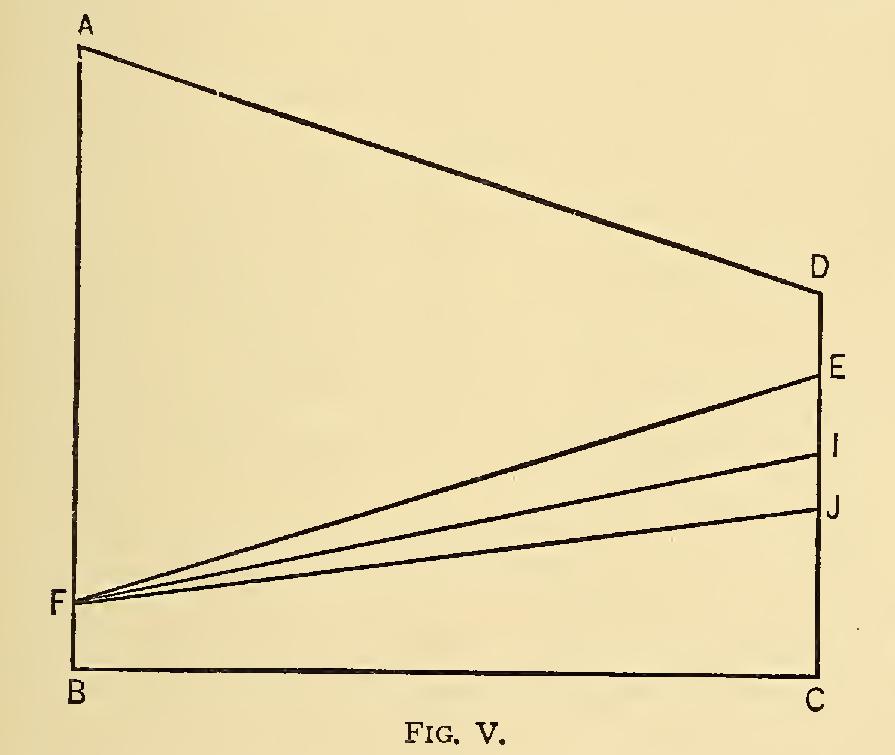
But this surplus area may be increased in the manner indicated in Figure V. Total utilities remain unchanged, but costs are reduced. Anything which checks the tendency toward the increase of costs operates as directly on the increase of the surplus as do the forces which check the tendency toward diminishing the utilities. Beginning with conditions repre sented by the area FBCE, identical with the area described by the same letters in Figures II., III., and IV., the cost line can be forced down by improvements in the productive pro cesses to FI, and finally to FJ. By each of these changes the area representing surplus utilities is increased. The surplus on the last commodity produced grows greater and is rep resented by the distances, DE, DI, and DJ, at the different stages. These changes would also have an effect upon the number of com modities produced. The increased incentives introduced by the reduction of costs lead to further production, and the line BC is ex tended. The limit of extension for this line is the place at which the cost line and the utility line would intersect. D and E may coincide, but the line EC cannot be of greater length than the line DC. That is to say, a commodity will not be produced if its utility is not at least equal to its cost.
It is not necessary to discuss in detail all the various forces which operate to increase social surplus by reducing costs, because, though they logically demand attention at this place, some of them are sufficiently well known to be re garded as commonplace. They are nevertheless of sufficient importance to require brief mention. Most prominent among these various phases of industrial progress is the extension of the prin ciple of the division of labor. This is preemi nently a principle which springs from social relations. The chief advantage of the division of labor is that each producer may devote him self to the particular tasks for which he is fitted by nature and training. Since under the divis ion of labor one does not consume the products of his own labor, but exchanges those products for the commodities which he desires, he may disregard his consumption when deciding to what occupation he shall devote himself. So much would follow upon a mere division of trades, by which is meant the separation of pro ducers into those who produce farm products, those who produce shoes, those who produce clothing, etc., etc.
There is, however, a further division of em ployments within these separate branches of industry. In a large manufacturing establish ment the different processes in the production of a commodity are, under a more minute division of labor, assigned to different classes of work men. No one produces an entire commodity which he can exchange for the commodities needed for his own consumption, but each re ceives certain raw materials or certain partly finished commodities, performs on them certain operations for which he is especially trained, and passes them on to another producer who does likewise. In a stove factory, for in stance, one man must spend his time in grinding the " edges " used in ornamentation. The work
is monotonous, yet, compared with other occu pations, the work of edge-grinder demands con siderable skill and offers considerable variety of bodily exercise. Industrially, a division of labor as minute as the market for the product will permit is a gain — offset at times, however, by physical injury to the individual worker. Greater skill, precision, and speed are gained when the number of operations which the laborer is com pelled to learn is made as small as possible. Work is distributed in accordance with the endowments of the laborer, and the acquire ment of a high degree of skill is made possible. By the extension of the division of labor the social cost of producing a given quantity of commodities is reduced.
The territorial division of labor is advanta geous, but it rests upon a somewhat different basis. Each part of the earth is better suited to the production of some commodities than to the production of others, and if in each dis trict attention is paid to the peculiar qualities of that district, and there is corresponding increase of exchange, the total cost of producing the commodities desired will be lower than if it is attempted to produce commodities where the natural conditions are unfavorable. Every judi cious extension of the territorial division of labor, whether between countries or between different sections of the same country, tends to reduce costs.
By the organization of industry is meant not merely the separation of producers into trades and into minute portions of trades, but, further, the bringing together of the various productive agencies in such a way that they become really operative and efficient. It is the name applied to a series of positive actions. A farmer, by years of saving, succeeds in getting control of a certain amount of capital, or he borrows from some one who has saved it the capital he needs ; selects a farm suitable to the crop which he ex pects to raise, and within reach of his market ; he employs the necessary laborers, he purchases the necessary implements, he chooses the seed that is to be planted, he directs how much labor shall be put on each field, how many times the corn shall be ploughed, what fences shall be built, when the crop shall be harvested, where it shall be offered for sale, in a word, he izes industry. With the extension of the division of employments the organization becomes more complex, but the division and the organization are not identical. The organization may be very highly developed in industries which, from their nature, do not allow a minute division of labor, and the organization may be very weak at cer tain points, though a thorough division of labor has been introduced. Those improvements in the organization of industry which prevent mis applications of capital or energy materially reduce the costs of production. As the organiza tion of industry becomes more intricate it be comes at times more sensitive, and a reduction of costs may often be secured by such changes in the forms of organization as shall secure more perfect insurance against loss.