Social Prosperity
industrial, progress, increase, capital, utilities and society
Improvements in transportation lower costs by permitting an extension of the territorial division of labor, by permitting laborers to get easier access to new productive resources, and in other obvious ways. Few other mechanical discoveries have lightened the costs of production to so great a degree as the improved of transportation which have come into general use during the pres ent century.
The increase of capital at the disposal of society greatly facilitates production. Costs are reduced when capital is inherited, the quantity of capital being increased by the accumulations of successive generations. The growth of the saving instincts makes the accumulation of capital continually easier in a progressive society. Each generation adds to the stock of relatively imperishable goods, and each generation becomes more able to retain the utilities of perishable goods by con tinued reproduction. The effect of this growth of utilities is particularly noticeable in the case of land. Each generation, under good methods of cultivation, makes the land more productive than it found it. Permanent im provements are made, the rotation of crops suited to particular lands is discovered, methods of fertilizing are improved, the growth of population steadily enhances the utility of particular tracts. In these ways the ductivity of land is increased, that is, the quantity of labor required to produce a given number of commodities is reduced. Both the increase of capital and the increase of the productivity of land are powerful agencies in the reduction of social costs.
By changes in the distribution of popula tion which shall prevent unnecessary trans portation and manufacture ; by invention of new processes ; by the hereditary transmission of industrial qualities originally acquired, it may be, at great cost; by improved methods of education and industrial training; and finally by the growth of such moral qualities as love of home and country, industriousness, and energy, — by all these, and other means that will occur to the reader, the costs of producing the commodities which are de manded by society are very much reduced.
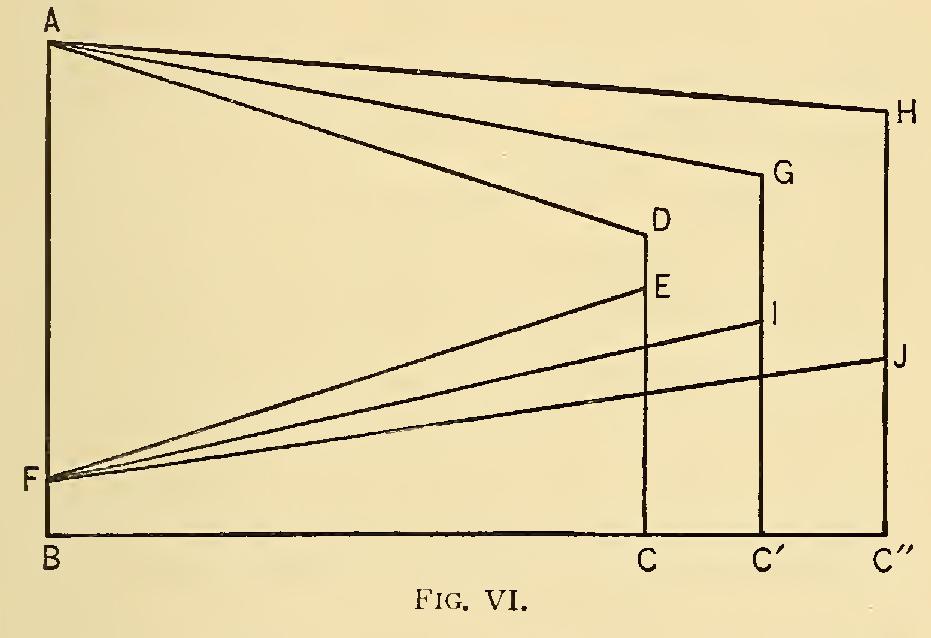
These two kinds of progress, which have been distinguished as social and industrial, are in reality closely combined, and interact upon each other. Wise changes in consump tion directly increase utilities, but they also influence industrial progress favorably. Figure VI. exhibits the modifications of the social surplus area necessary to indicate the union of social and industrial progress. Both the line AD and the line FE tend toward the horizontal, the one forced upward at D by social progress, the other forced downward at E by industrial progress. The area AFED is enlarged at the second stage of progress to AFIG, and at the third stage to AFJH. Prosperity is increased by the twofold pro cess of increasing utilities and decreasing costs. The line BC is extended to BC', and then to EC'', because under the new incentives more commodities are produced. The total costs, after production is thus extended, are greater than before, but the relative costs are much less because of the increase of utilities, and the surplus utility on each commodity is made greater. The inducement of society to produce lies in the amount of this surplus ; and in the increase brought about by the joint action of the two sets of tendencies, grouped under the very general terms indus trial and social progress, are to be found the springs of that irresistible impulse to intense industrial activity which is so characteristic of modern society.