I the White Oak Group
It is a happy circumstance for Californians and for all people who visit "the Land of the Setting Sun" that this valley oak is scorned by all lumbermen. The tree is practically worthless for timber, therefore gigantic individual trees stand scattered or grouped in the spacious valleys of western California, helping to make a landscape that cannot be duplicated this side of England. Indeed, Vancouver, journeying around the world in 1792, was astounded at the park-like Santa Clara Valley, set round with mountains, diversified with hills and intervales, covered with a carpet of verdure, and adorned with majestic oaks. Writing home of this landscape untouched by the hand of man, he says; "It required only to be adorned with the neat habitations of an industrious people to produce a scene not inferior to the most studied effect of taste in the disposal of grounds." The California white oak is the largest and most graceful of the Western oaks. Its branches end in long shoots that are pendulous like those of the weeping willow. The trunk branches near the ground and rises and spreads out like a great fan. A British elm often has the same habit—our American elm, some times. The dome is broader even than that of our Eastern white oak. The twigs are willowy at first, but there is a surprising tortuousness acquired with added years. The limbs are gnarled in the most complex way. "Picturesqueness gone mad" well characterises the expression of the tree in its bare winter aspect.
"The Sir Joseph Hooker Oak," too feet high, 7 feet in diam eter of trunk and 15o feet in spread of dome, on General Bidwell's farm in Butte County, California, was named after the great English botanist on the occasion of his visit with Asa Gray in 1877.
The tree is always broader than it is high, and bears a pro fusion of acorns of extraordinary length. These resemble the acorns of Quercus alba in other respects. The Digger Indians store them for winter use, and depend upon them as the source of their bread. They are roasted and hulled, then ground into a coarse meal, which is made into loaves and baked in rude ovens in the sand.
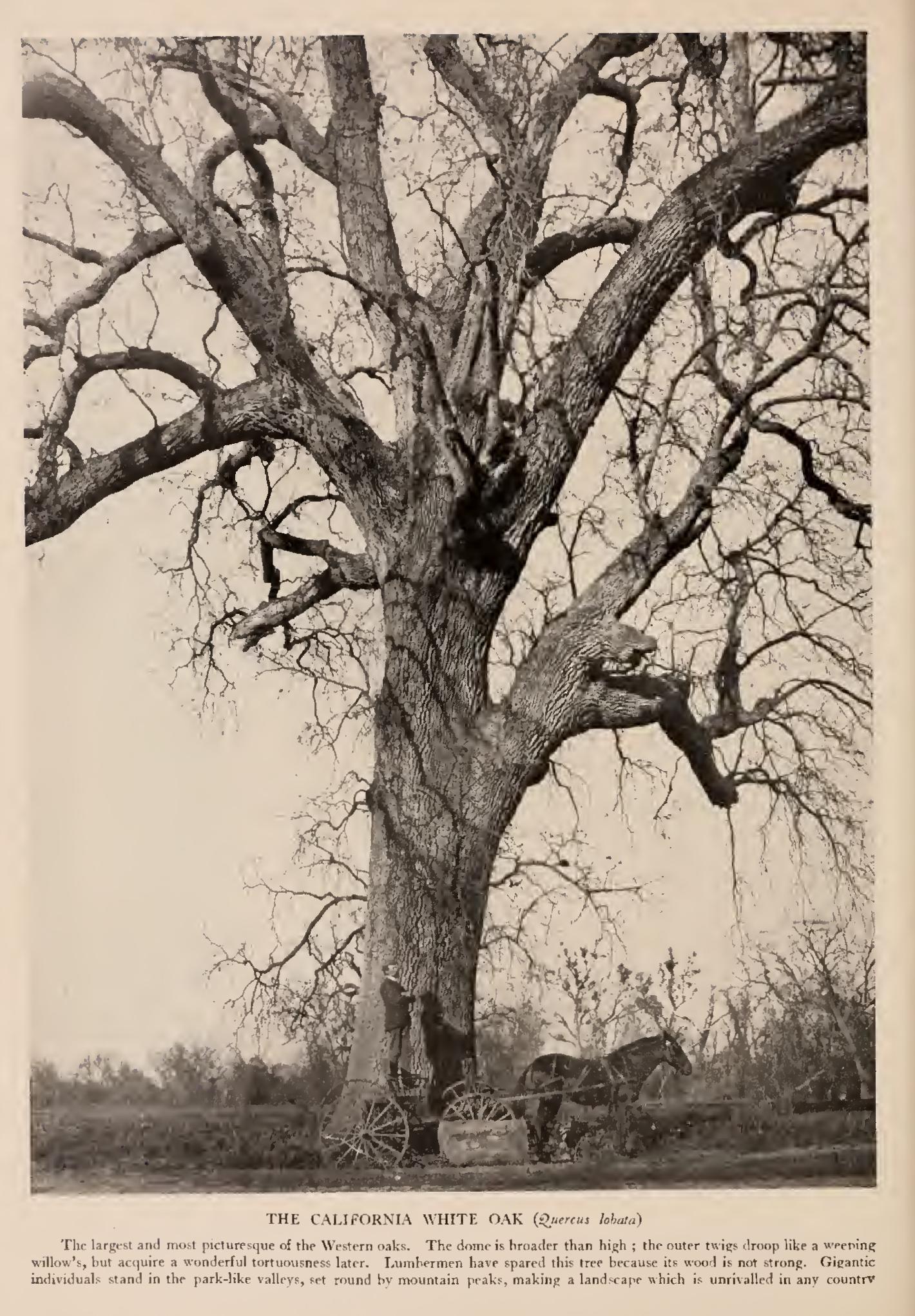
The leaves of Quercus lobata are of the true white oak type, with squarish lobes and pale linings. They vary in size and form, some being almost cut in two like those of the bur oak.
Attempts to introduce this tree into cultivation outside of its own range have proved unsuccessful. It is believed that the climate of Australia might be agreeable to the species, which is too exacting in its demands to thrive in Europe or in Eastern America.
Pacific Post Oak, Oregon White Oak (Quercus Garryana, Hook.)—Large tree (or a shrub) 6o to too feet high, with stout erect or spreading branches forming a compact head. Bark orange brown or greyish, with shallow fissures and broad ridges; twigs rufous, hairy. Wood light yellowish brown, hard, firm, strong, tough. Buds large, pointed, coated with red fuzz. Leaves obovate or oblong, 4 to 6 inches long, coarsely 7 to 9-lobed, with shallow sinuses and blunt lobes, leathery, dark green, shining, with pale or orange-brown hairy lining and conspicuous veins. Flowers: staminate in hairy catkins; sessile, solitary.
Acorns annual, -I tot inch long, pointed, in shallow, fuzzy cup with small, thin, loose scales. Preferred habitat, dry, gravelly slopes. Distribution, Vancouver Island and the valley of the lower Fraser River, along coast valleys to Santa Cruz Mountains. Best and most abundant in western Oregon and Washington.
Shrubby on mountains. Uses: The most important timber oak on the west coast. Wood of young trees especially tough and valuable. Used in construction of ships, buildings, vehicles, agricultural implements, barrels and in finer cabinet work; excellent fuel.
This oak has leaves and rusty twigs that bear a striking resemblance to the post oak of our Eastern coast barrens. The bark, however, is pale grey, and often broken into squares by transverse fissures. The acorns are quite distinctive, being large, often over art inch long, nearly twice as long as wide, and set in a small cup, often shallow as that of Quercus rubra.
Upon the mountain slopes this oak .s scrubby in growth, but in the rich loam of the lower valley land it is a lofty tree, which often loses its lower limbs by the crowding of young conifers about it. The crown expands, the outer branches become pendulous, and the tree assumes the shape of a tall Etruscan vase —a common form of our American elms.
The whiteness of the wood makes it popular for the interior finish of houses, as well as for the coarser staple uses to which white oak is devoted. Its fault is checking as it dries. It takes two years to season properly.
Robert Douglas, the great botanical explorer, named this tree in honour of Nicholas Garry, secretary of the Hudson Bay Company, in recognition of the courtesies and substantial aid rendered by him to scientists studying the flora of the Northwest.
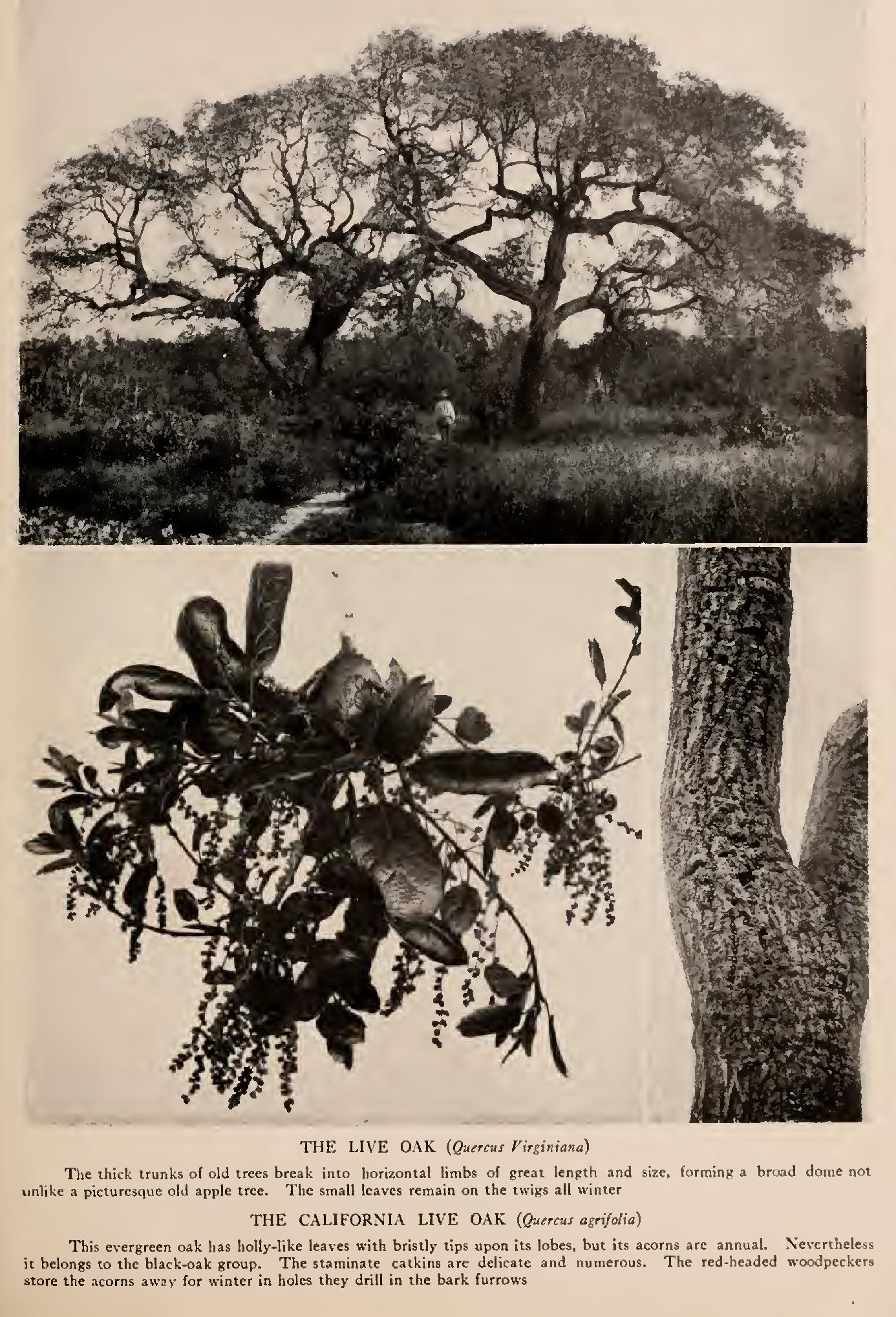
Live Oak (Quercus 1/irginiana, Mill.)—Evergreen tree, 5o to 75 feet high, with thick trunk and horizontal limbs of great length forming a low, spreading dome, like an old apple tree. Often shrubby. Bark reddish brown, scaly, with shallow fissures; twigs rigid, slim, hoary at first. Wood light brown or yellow (sap wood nearly white), close grained, lustrous, compact with hardly distinguishable annual rings, heavy, tough, strong, durable, easy to split, hard to work. Buds globose, brownish, small. Leaves evergreen, leathery, elliptical or oblanceolate, entire, rarely wavy margined, and spiny tipped above the middle, 2 to 5 inches long, dark green above, paler beneath, brownish yellow in late winter, falling when new leaves appear. Flowers in March, April; staminate in hairy catkins; pistillate 3 to 5-flowered on long spikes with bright red stigmas. Acorns annual, brown, stalked, pointed, t inch long, in thin cup with tapering base and small, closely appressed scales; nut sweet, to, of it embraced by the cup. Preferred habitat, dry sandy soil near the coast. Dis tribution, islands and coast from Virginia to Florida, west to Mexico, and in Lower California. Uses: Superb avenue and ornamental tree in the South. Grows rapidly and is easily transplanted. Lumber better in all respects than that of Quercus alba, even.