I the White Oak Group
The evergreen live oak of the South is one of the handsomest of all our native trees in cultivation. Specimen trees in New Orleans, Charleston and other cities certainly challenge the observer to mention a more perfect example of all that is to b desired in tree form. The dome is low, but exceedingly broad, often spreading to twice its height and more. The trunk breaks near the base into horizontal limbs of incredible length and size. It seems as if the weight of these great arms must split the trunk, especially under the force of the wind. But the fibre of the wood is equal to resisting the strain put upon it.
The leaves are not as showy and beautiful in form as many Northern oaks. They are plain dull green beneath, lustrous above, and they last all winter until the new leaves appear in the spring. The acorns are dainty and dark brown, set in a hoary long stemmed, top-shaped cup. They are a profuse crop, and very sweet and pleasant to taste. The Indians gathered them "to thicken their venison-soop" with, and also cooked them in other ways. "They likewise draw an Oil, very pleasant and whole some, little inferior to that of almonds." So wrote Mark Catesby, a century and a half ago.
Live-oak timber ranks highest among the white oaks. Ship building depended upon it in this country until the era of steel construction. Reservation of tracts of these trees in western Florida for the use of the navy was made in the early days. "Knees of oak" still brace the sides of vessels, if they can be obtained. The beauty of the wood when polished would make it in great demand for furniture and for decorative purposes, except that it is extremely difficult to work, and it splits easily when nailed. The short trunk prevents the getting out of timbers of large size.
As an avenue and shade tree the live oak deserves especial attention. It grows rapidly and is easily transplanted. It is not particular as to soils. The trees are becoming scarce in the wild. They should be saved for the landscape's sake and planting should go steadily on. To our Northern poet, the'se trees "Stand like Druids of old, with voices sad and prophetic; Stand like harpers hoar, with beards that rest on their bosoms." Live oaks without their draperies of moss would lose much of their charm. However, there is a great difference of opinion as to the beauty of the moss. It generally looks well in a picture, but some people think its grey straggling clusters give the oaks an unkempt and uncomfortable look, as if a parasite were choking its host.
The Durand Oak (Quercus breviloba, Sarg.) is a Southern,
blue-leaved white oak, 8o to 90 feet high, with bark and leaf linings as silvery as its California cousin's. These leaves, which are leathery and scarcely 3 inches long, have indistinctly wavy margins, and tend to broaden at the tip, ending in three lobes. An ovate nut of moderate size sits in a thin saucer with hairy scales.
In the bayou region of the South, and on the dry prairies of Alabama it is a fine, tall tree, with lumber equal to the best white oak; but west of the middle of Texas it decreases in size and becomes an almost evergreen shrub which is worthless except for fuel. It grows in thickets on sterile bluffs, even across the Mexican border.
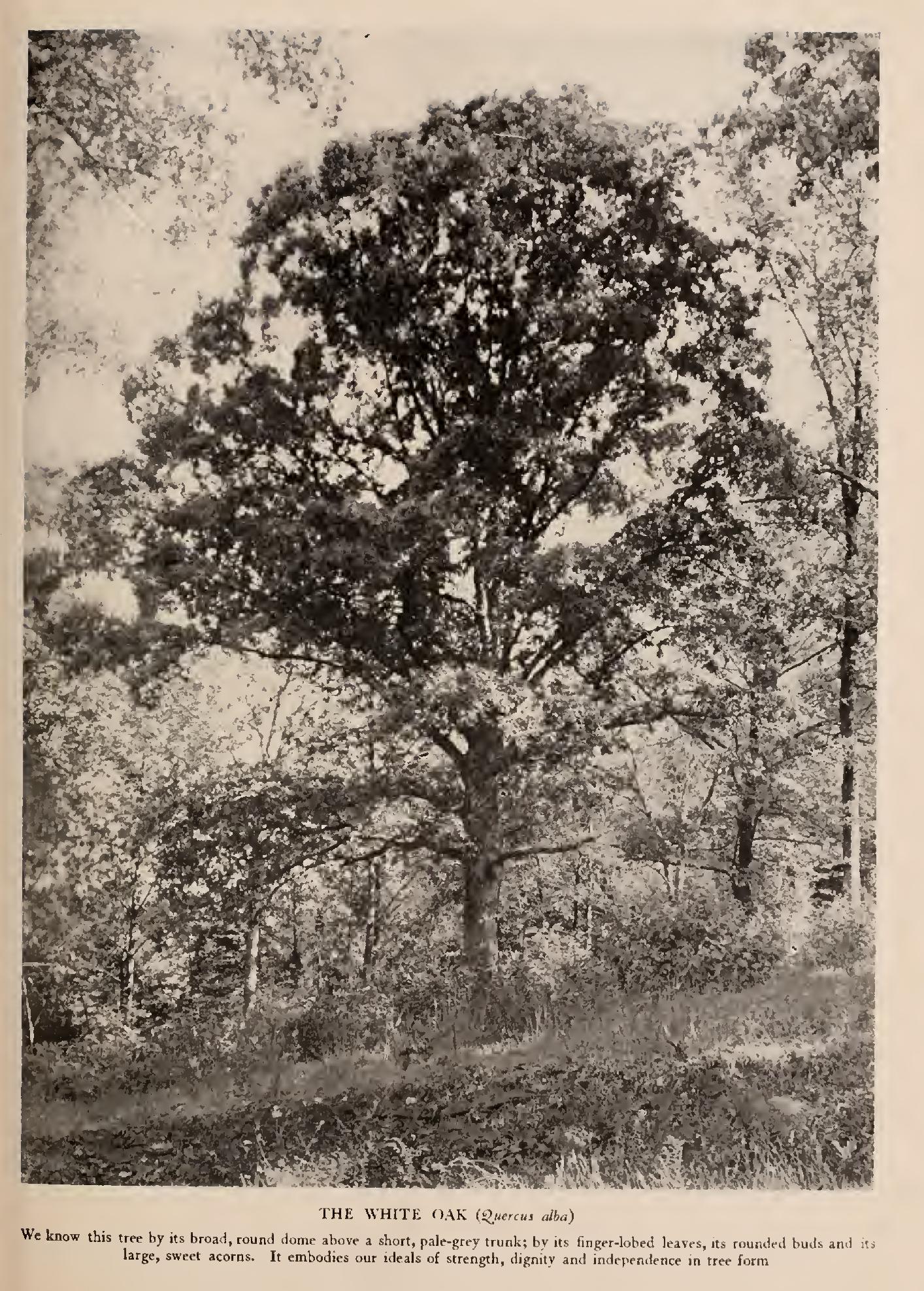
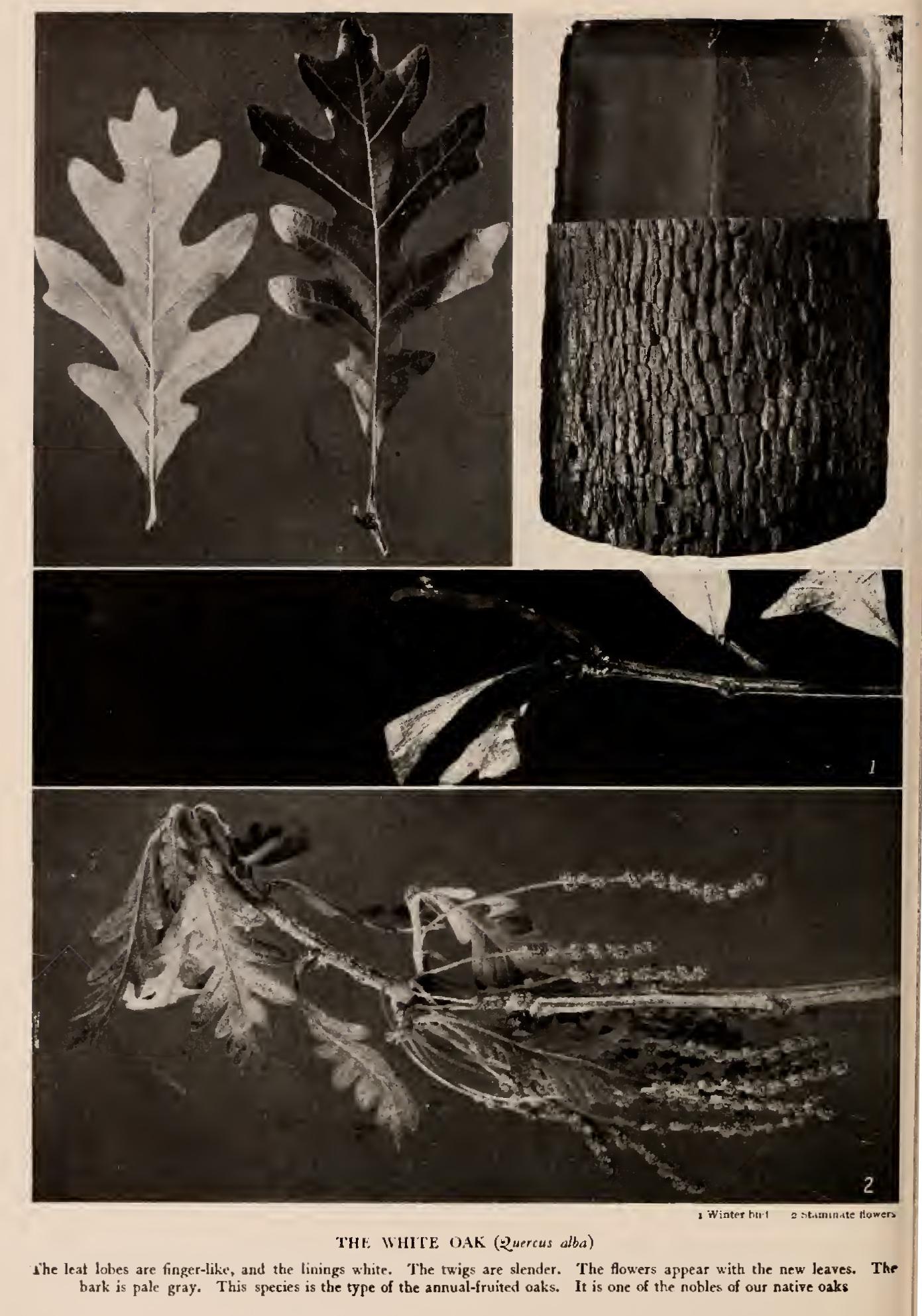
White Oak (Quercus alba, Linn.)—A large tree, 6o to 15o feet high, 3 to 8 feet in trunk diameter, tall in the forest, low and broad domed in the open fields. Bark pale grey, broken into small, thin plates. Wood tough, strong, heavy, hard, durable, light brown, with prominent medullary rays. Buds short, round, smooth, clustered at tip of twigs. Leaves alternate, 5 to 9 inches long, obovate or oblong in outline, with 7 to 9 rounded or finger shaped lobes with deep, rounded sinuses between; petioles stout; colour red at first, with white silky lining, then bright green above, paler beneath; in autumn deep red, pale purplish beneath. Flowers in May, with half-grown leaves; staminate catkins, hairy, 21 to 3 inches long, yellow; pistillate, 1 to 2 on short stems, stamens bright red. Acorns annual, on short or long stems; cup shallow, thin, with closely appressed scales; nut of long, shiny, brown, tot inch long, sweet, edible. Preferred habitat, rich, well drained soil. Distribution, southern Maine to Florida; west to Minnesota, Kansas and Texas. Uses: A lumber tree of highest rank. Its bark is used in tanneries in the making of leather. The wood is used in naval architecture, in house building and inside finishing, for furniture, agricultural implements, cooperage, railroad ties and fuel.
The white oak is the noblest tree of its race; king by common consent, in our forests of broad-leaved trees. It is the embodi ment of strength, dignity and independence. The Briton has but one native oak on which to spend his loyalty and devotion. We have fifty kinds—all American—but the white oak is chief among them all. In this opinion the lumberman and the tree lover generally concur, and each, as he gazes on a fine old tree, feels the smouldering fires of ancestral tree worship flame once more in his breast. There is something in Anglo-Saxon blood that remembers.