I the White Oak Group
We shall know the white oak in the winter woods by its pale grey bark, with shallow fissures and scaly ridges. It is a tall, narrow-headed tree where it is crowded among its forest neighbours. In the open it has a sturdy, low-branched trunk that flares into buttresses at the base and supports a rounded dome of great breadth and dignity. The mighty arms reach toward the horizon or the sky, breaking into tortuous limbs and these into dense thickets of twigs. Over these is the luxuriant thatch of fingered leaves, through whose narrow sinuses the light sifts so freely that even the inner framework of the dome bears leafy twigs. The characteristic arrangement of these leaves is a tuft of them on the end of a twig, spread out like the divisions of a horse-chestnut leaf.
In spring a shimmering veil of rose and silver covers the grey old tree. The edges are fringed with the yellow tassels of the staminate flowers. From the axils of the opening leaves the forked tongues of the pistillate flowers are thrust out into the pollen-laden air.
All summer the leaves are bright green with pale linings. In autumn the red comes back again with bluish tones that blend into beautiful vinous reds and violet purple. Gradually the colour fades out, but the leaves usually hang on until pushed off, even as late as the following April.
We shall find no acorns on white oak trees in winter, for they mature in a single season, and fall without delay. The crop is usually a light one, and it is hard to find acorns even under the tree. The sweet-flavoured nut is a favourite food of animals, wild and domestic. The Indians and the early colonists ate them.
These shrewd and provident ancestors of ours discovered also that this "ackorne" had other good qualities. "By boyling it long, it giveth an oyle which they keep to supple their joynts." They skimmed this oil from the water before they ate the acorns in the pot.
White-oak lumber is becoming rare and correspondingly high priced. Its quality is of the first order. Clear, quarter sawed oak exhibits a higher percentage of the "mirrors" (pith rays) than any other species. Its durability, hardness and fine colour are exceptional among oaks. So great is the demand for it in the finer decorative arts employing wood that it is going out of use in general construction where inferior woods can be sub stituted. Roots of white oak, sawed, planed and polished, present a wood of extraordinary beauty. It is pale yellow in colour,
tinged with olive, and shows a feathered grain of intricate and graceful pattern. The lustre of it is equal to that of mahogany or rosewood. Fifty years ago Nuttall cited an instance of an English cabinetmaker paying five pdunds sterling for the roots of a single tree, counting that furniture veneered with it would vie with the finest.
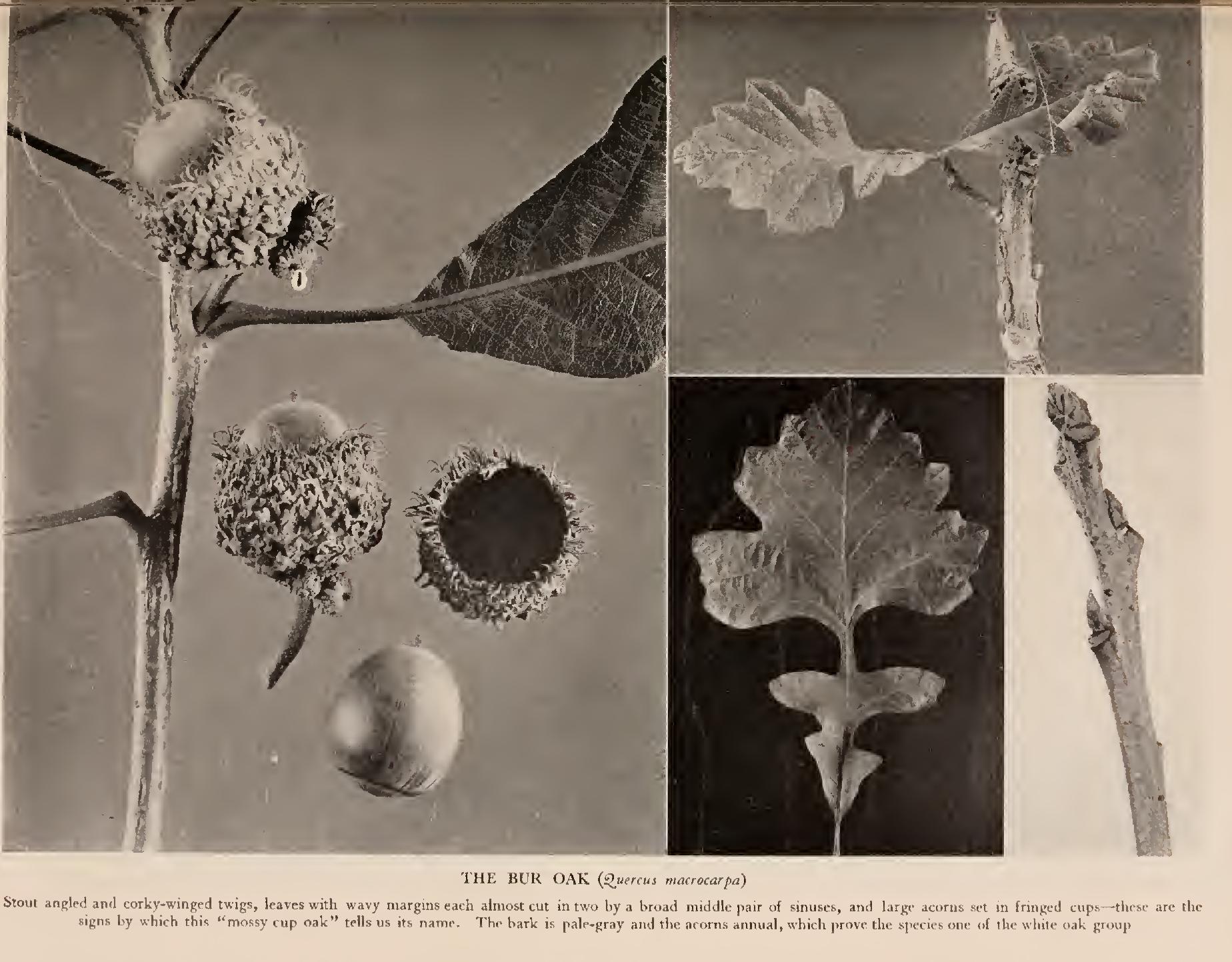
Bur or Oak (Quercus macrocarpa, Michx.)—A large tree, 75 to 16o feet high, with spreading branches, and irregular, round head. Bark greyish brown, deeply furrowed, becoming scaly; branches roughened with thick, corky ridges; twigs winged or smooth, stout, and pubescent at first. Wood brown, with paler sap wood, close grained, heavy, hard, durable in soil; medullary rays conspicuous. Buds small, blunt pointed, pubescent. Leaves obovate, alternate, 6 to 12 inches long, 3 to 6 inches wide, 5 to 7-lobed; sinuses rounded, shallow or deep, middle ones often wider, opposite and nearly reach the midrib; petioles short, grooved; summer colour lustrous dark green, with pale, or silvery pubescent lining; autumn colour yellow or brown. Flowers with half-grown leaves in May; staminate in hairy yellow catkins; pistillate, with hairy red scales and bright red stigmas. Acorns annual, to 2 inches long, ovoid, variable in size and shape, pubescent, in deep (rarely shallow) cup, brown, hairy, with loose scales and mossy fringe. Kernel white, sweet. Preferred habitat, rich, well-drained soil. Distribution, Nova Scotia to Montana; south to Pennsylvania, Tennessee and Texas. Uses: Same as Q. alba. Picturesque park tree. Easily transplanted when young.
The bur oak is a rugged-looking tree, more picturesque than its near relative, the white oak, which is conventional and sym metrical when it has its own way in growing. The bur oak flings out its antlered arms without regard for balance and sym metry, and casts off the bark of its shaggy limbs with utter indifference to any law of neatness. Broad corky wings are seen even on young twigs, and these are stout and curiously gnarled.
zoo The leaves are of unusual length and deeply cut into irregular fingers, or broader lobes. Often two opposite sinuses, wider than the rest, almost cut the leaf in two in the middle. Bright and shining above, these leaves are woolly lined and thick.