Ii Punctade
II. PUNCTADE Dotted Haw (Crakegus punctafa, Jacq.)—A broad, round headed tree, 20 to 3o feet high, with horizontal branches, and rigid twigs. Thorns straight, slim, 2 YO 3 inches long, brown or grey. Bark thin, dark brownish red, in long, plate-like scales, branches brown to pale grey; twigs pubescent at first, soon becoming smooth. Wood red-brown, hard, close-textured. Buds plump, small, scaly, shiny. Leaves obovate, acute or obtuse at apex, 2 to 3 inches long, narrowed to short petiole; sharply serrate, sometimes lobed, entire toward base; pubescent at first, smooth at maturity, except on veins below, leathery, grey-green, orange and scarlet in autumn. Veins prominent, depressed above. Flowers, May, when leaves are half grown, in thick, flat, many-flowered corymbs on pale tomentose stems; calyx hairy, corollas spreading, white, to inch across, stamens 20, with rose-coloured or yellow anthers, styles 2 to 5, hairy at base.
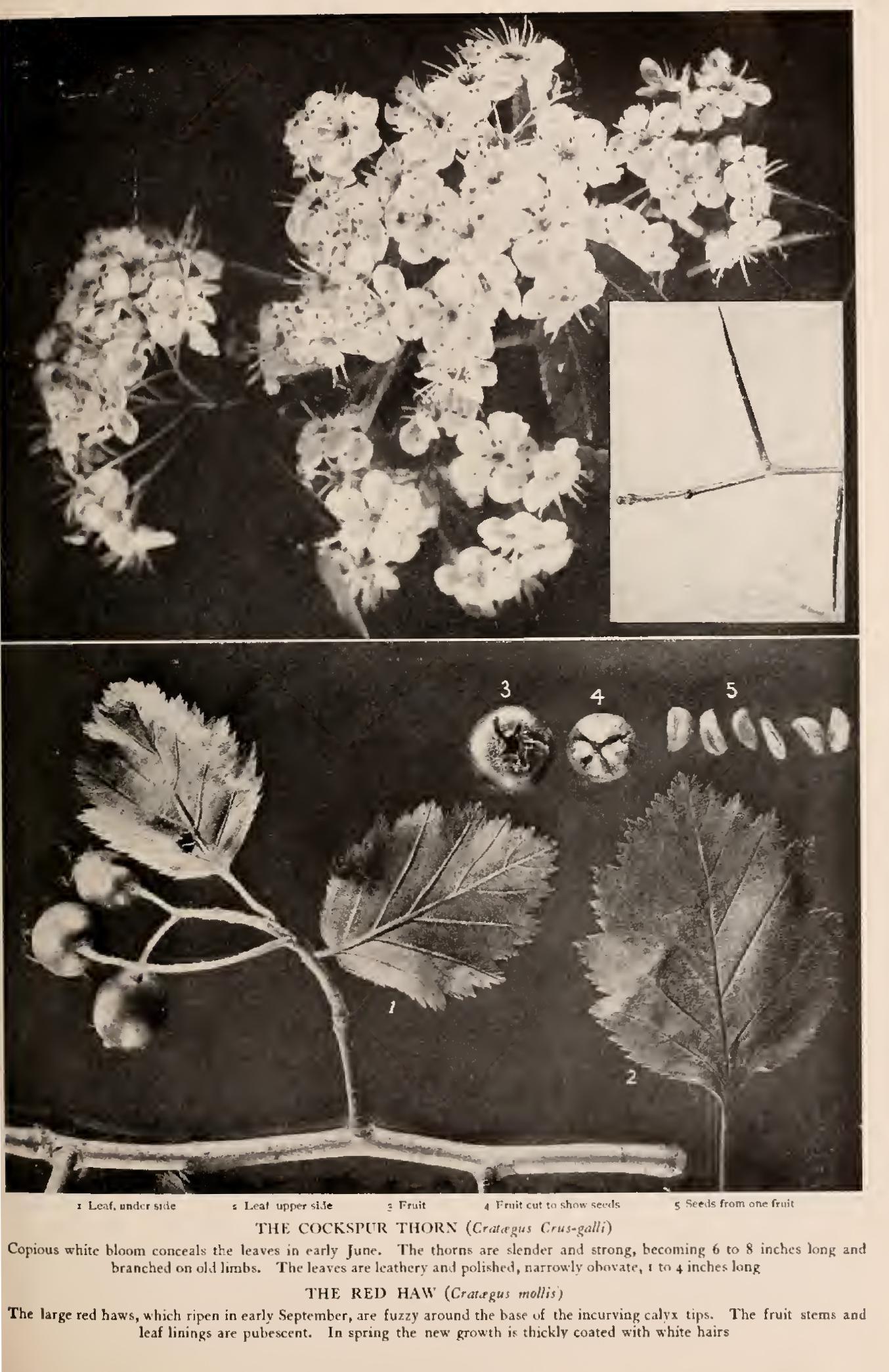
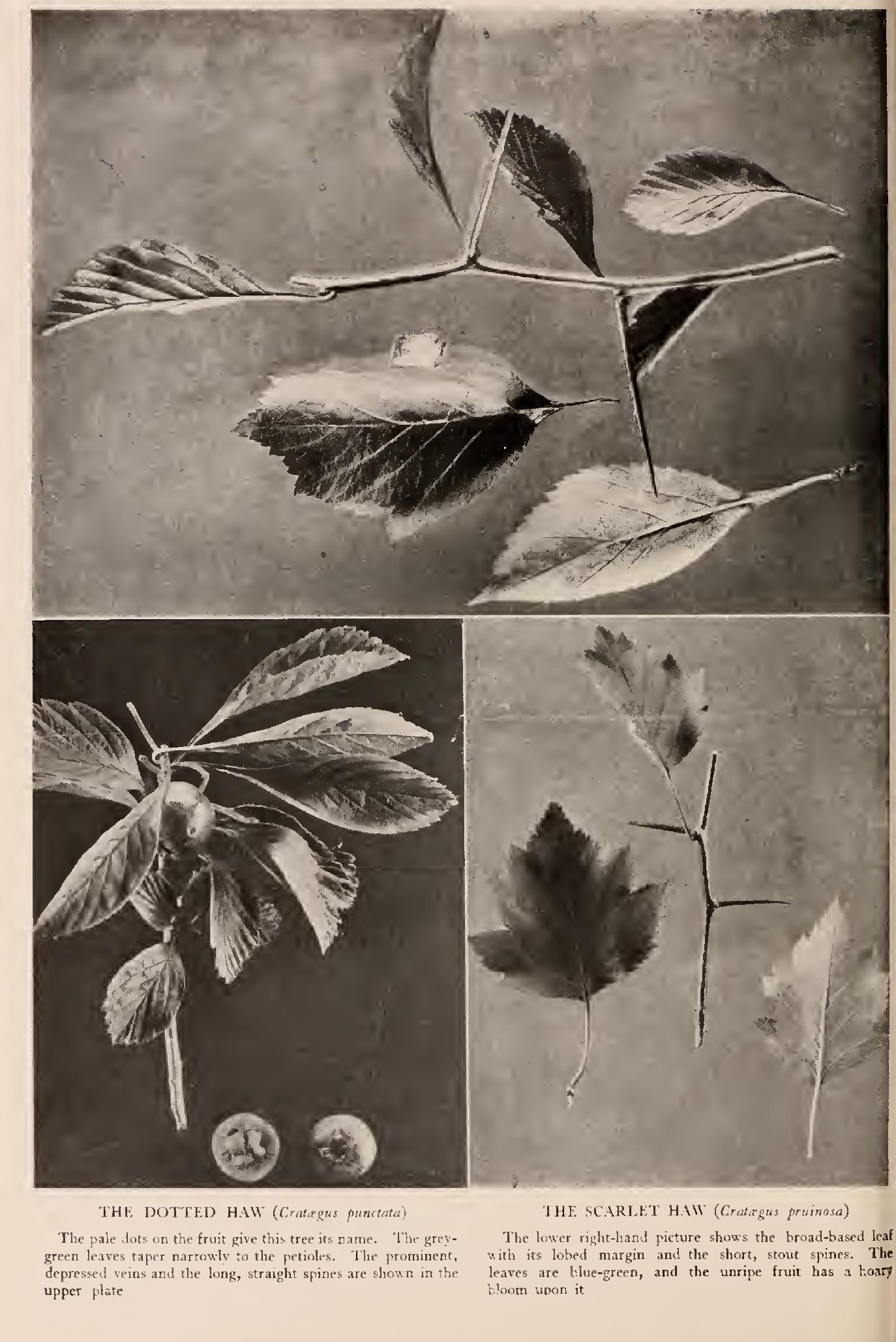
Fruit falls in October, short-oblong to sub-globose, to t inch long, yellow or red; marked by white dots; flesh thin, thy; calyx lobes flattened; nutlets 5, ridged on back. Preferred habitat, rich, moist upland soil. Farm thickets. Distribution, Quebec to Detroit; western New England, along mountains to northern Georgia, Tennessee and North Carolina; west to Ohio and Illinois. Uses: Valuable ornamental hawthorn.
The large, pale dots on the fruit of this haw give it its name, punctata. Very strangely, some trees produce yellow fruit, and have flowers with yellow anthers; while red is the rule in both anthers and fruit.
The dotted haw is a handsome, long-thorned tree, with obovate, strongly veined leaves, whose colour in autumn is like fire. The fruit is brilliant, too, hanging in full clusters long after the leaves drop.
Cratcegus collina, Chapm., which resembles C. punctata and C. Crus-galli in habit, has yellow-green foliage, and the dull red fruits are flattened globes, containing five grooved and ridged nutlets. Sometimes the branches are set with formidable, branched thorns, 6 inches long. It is quite common for the trunk to be corrugated and buttressed at the base.
This tree grows along the foothills from West Virginia to central Georgia, and west half way across Tennessee and Alabama. It reaches an altitude of 2,50o feet. It is an early species, bloom ing in April when the leaves are scarcely opening, and ripening its fruit in September% The flesh is yellow and thin, mealy and insipid.
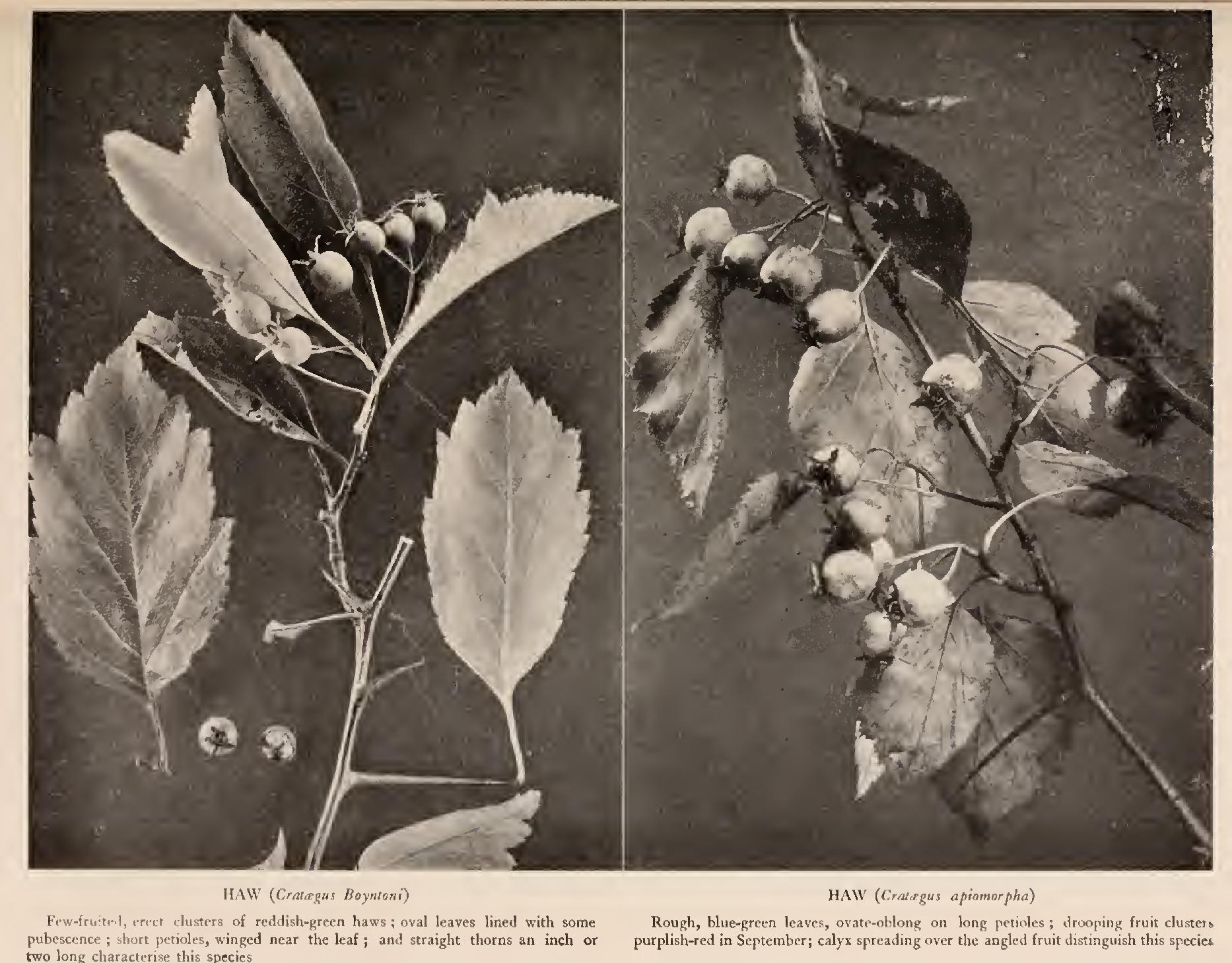
AESTIVALEs May, or Apple Haw (C. cestivalis, T. & G.)—A round headed, compact tree, with stout trunk, zo to 3o feet high. Thorns to if inches long, stout, sharp; often absent. Bark thin, fissured and broken into plate-like scales, dark reddish brown. Twigs rufous pubescent, soon becoming smooth and grey or brown. Wood heavy, Close grained, light brown, weak. Buds plump, small, scaly, brown. Leaves elliptical, irregularly wavy-toothed and serrate above the middle, entire and tapering to pubescent petiole; If to 2 inches long, dark green, leathery shining above, with rusty hairs on veins beneath. Flowers with the leaves in February or early March, 2 to 5 in simple corymbs, corolla I inch across, white; calyx tips ruddy; stamens 20 to 25, anthers large dark rose. Fruit, May, I to 3 in cluster, flattened globes, fragrant, pleasantly sub-acid, juicy, thick fleshed, calyx lobes large, curved back; nutlets 3 to 5, with deep grooves and ridges on back. Pre ferred habitat, moist, sandy soil. Distribution, Florida to Texas and Arkansas. Uses: Handsome tree for ornamental planting. Fruit sold in Louisiana markets, and made into preserves and jellies.
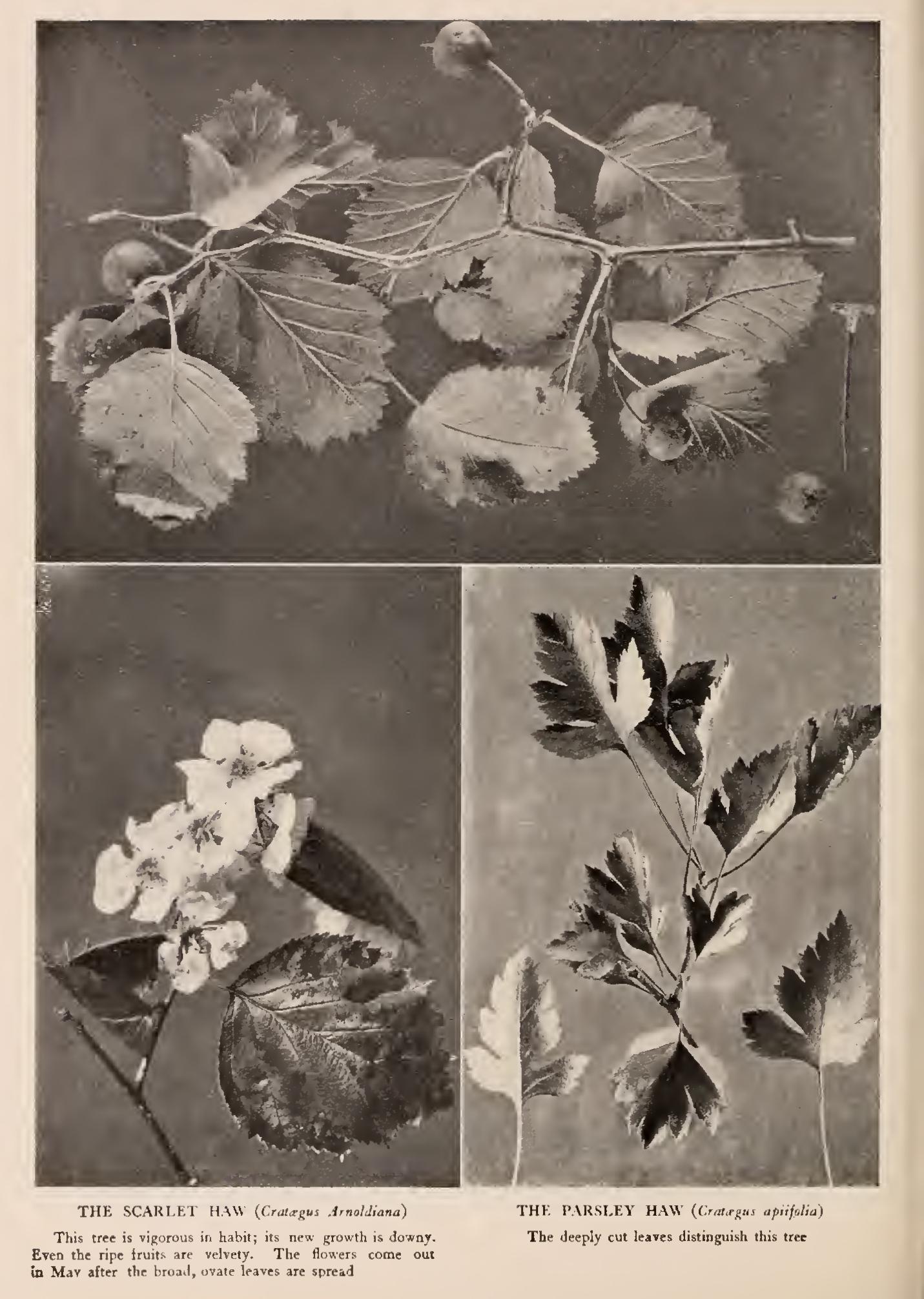
VIRIDEs Haw (C. viridis, Linn.)—A round-headed tree, zo to 35 feet, with tall, often fluted trunk, and spreading branches. Thorns slim, pale, under I inch long; usually wanting. Bark brown, ashy grey or orange, checked into plate-like scales. Leaves ovate or obovate, acute at apex and base, serrate and lobed above middle, usually entire below; dark green, lustrous above, pale and dull beneath, scarlet in autumn; veins strong; petioles slender. Flowers, March to May, with leaves, in smooth corymbs, white, 4 inch across, stamens zo, anthers yellow, styles 5. Fruit bright scarlet in pendant clusters, flattened globose, pea-size, thin, dry flesh; nutlets 5, scarcely ridged. Preferred habitat, low ground along streams. Distribution, Savannah River to western Florida, through Gulf States to eastern Texas; north to St. Louis; forms thickets in Louisiana. Uses: Valuable ornamental tree, for the brilliance of its autumn foliage and winter fruits.