Ii Punctade
The discovery of this handsome hawthorn, not long ago, growing wild within the gates of the Arnold Arboretum, was an event of considerable importance to horticulture; for this tree, laden with its large crimson fruit in August, is a wondrous sight. Added to their beauty, these fruits are juicy, and have a pleasant piquant flavour, for which they deserve especial mention.
In winter, the tree may be known by the remarkable zigzag of its ascending branches. In habit and foliage it is thrifty and handsome. The fruit ripens and begins to fall in August, but a goodly quantity remains to brighten the fading leaves well on into October.
The tree has been found growing wild near Medford, Massa chusetts, and is now often seen in cultivation about Boston.
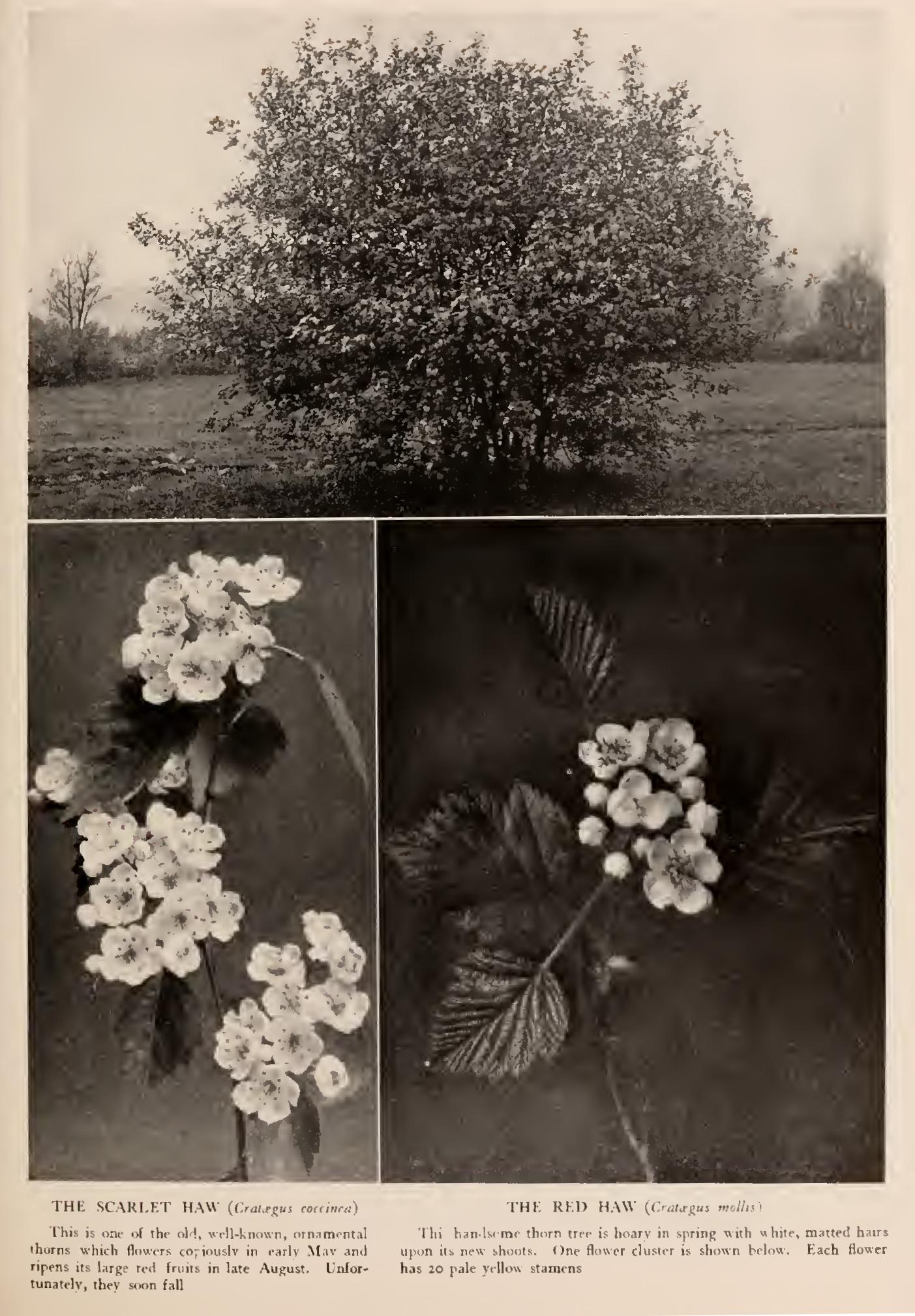
Red Haw (C. submollis, Sarg.)—Tree 20 to 25 feet high, with round, handsome head, branchlets slender. Thorns slender, curved, brown, shining, 2 to 3 inches long. Bark pale greyish brown, scaly; twigs, tomentose, branches orange brown. Leaves ovate, acute, with doubly serrate, pointed lobes above middle; base cuneate, serrate, becoming entire near slender, downy petiole; of to 31 inches long, almost as wide, pubescent at first, becoming smooth, except on veins beneath, and rough above. Flowers, May, in compound, pubescent corymbs, white, inch across, with lo stamens, anthers pale yellow, styles 3 to 5, tufted at base. Fruits ripe and falling in early September; in slender, copious clusters, lustrous orange red, pear shaped, with pale dots, I inch long, with prominent, erect calyx lobes; pedicels slender, velvety; nutlets 5, slightly ridged, in thin, mealy flesh. Preferred habitat, rich soil of woodland borders. Distribution, Quebec to Penobscot Valley in Maine; to eastern Massachusetts; also near Albany, New York.
This Eastern species was long considered identical with the preceding one. It is now distinguished by well-defined characters. It is not so densely downy as C. mills. The leaves are smaller, more deeply lobed, and usually wedge shaped at base. The fruits are smaller and pear shaped. The branchlets are orange 31t brown. The flowers have ten stamens; C. mollis has twenty. C submollis is one of the showiest and best species for ornamental purposes.
Scarlet Haw (C. Ellwangeriana, Sarg.)—A handsome tree, io to 20 feet high, with ascending branches, forming a round head. Thorns i to 2 inches long, stout; tree often unarmed.
Bark light grey, scaly; twigs green, with pale hairs. Leaves oval, acute, sharply serrate almost to base, with 4 to 5 acute lobes, rough above, paler beneath, light green, thin, 21 to 31 inches long; petioles pubescent, slender; veins strong. Flowers, May, in velvety-stemmed corymbs; calyx, hairy, with stalked glands; corollas i inch across, white; stamens 8 to io; anthers small, rose coloured. Fruits ripe and falling in September, on smooth stems, oblong, bright crimson, shining, t inch long, 1 inch wide, flesh thin, sour, juicy; nutlets 3 to 5, ridged. Preferred habitat, rich woodland soil. Distribution, about Rochester, New York. Uses: A handsome ornamental tree.
The preceding species is worthily named in honour of the founder of the Arboretum. Another distinguished patron of horticulture and forestry, George Ellwanger, is remembered in the name of this species. A single tree which stands in the Mount Hope Nurseries of Ellwanger & Barry, at Rochester, New York, has been for years the wonder and admiration of visitors and the pride of its owners. In the woods about Rochester this species is quite common. It is counted by Professor Sargent "one of the largest and most beautiful hawthorns in the Northern States." Flabellatae Red Haw (C. Holmesiana, Ashe.)—Tall tree, 20 to 3o feet high, with stout ascending branches; head irregular and open, or compact. Thorns thick, l to 2 inches long, scattered far apart. Bark grey or nearly white, scaly. Leaves oval or ovate, acute or acuminate, sharply lobed and doubly serrate; thick and firm, nearly smooth, distinctly yellow-green at maturity, ti, to 2 inches long, with strong midribs and long petioles. Flowers, May, cup shaped, / to inch across, in loose corymbs; stamens 5 to 8, anthers large, deep reddish purple. Fruits September, falling soon, crimson, oblong, / to inch long, with reddish, incurved calyx lobes; nutlets 3, distinctly ridged, flesh mealy, acid, dis agreeable. Preferred habitat, rich, moist hillsides. Distribution, Montreal to southern Ontario; coast of Maine, central and western Massachusetts, Rhode Island, western New York, eastern Pennsyl vania. Largest in Worcester County, Massachusetts. Uses: Handsome tree for ornamental planting.