Ii Punctade
BRACHYACANTHae Hog's Haw, Pomette Bleue (C. brachyacantha, Sarg. & Engelm.)—Tree 4o to 5o feet high, truck 18 to 20 inches in diameter, with handsome, compact head, of stout grey branches.
Thorns numerous, short, stout, curved, to inch long. Bark dark brown, deeply furrowed, scaly. Leaves lanceolate to rhom boidal, acute, serrate, sometimes distinctly lobed above middle, dark green, lustrous, firm, 1 to 2 inches long, on short petioles; stipules triangular, often i inch long. Flowers, May, inch across, in compound corymbs; petals orange colour as they fade; stamens 15 to 20. Fruits, August, falling soon, flattened globes, to inch in diameter, bright blue, with pale bloom; flesh thin; nutlets 3 to 5, faintly grooved on back. Preferred habitat, rich, moist soil of stream borders. Distribution, southern Arkansas to western Louisiana, and to the Sabine River valley in Texas. Uses: Handsome ornamental in south temperate regions; not hardy in Massachusetts.
This is the only blue-fruited haw in the world. This unique character alone must commend it to planters. The stout, curving thorns, the lustrous foliage, the abundant flowers, and the large blue fruit—all make this one of the best ornamental species. On the wet prairies of western Louisiana, this tree forms dense thickets which are quite the dominating feature of the woods.
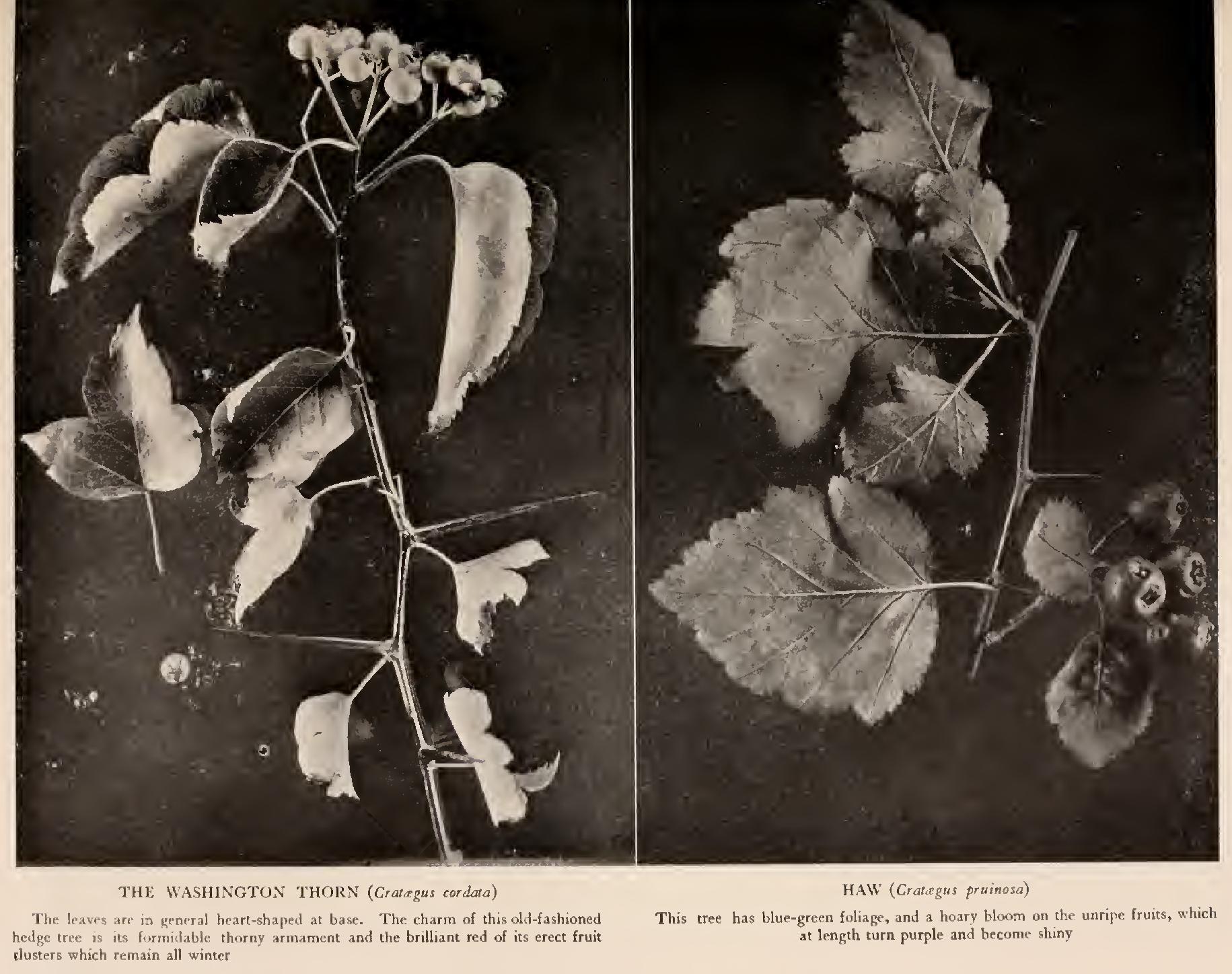
TOMENTOSae Pear Haw (C. tomentosa, Linn.)—A tree 15 to 20 feet high, forming a flat, wide head. Thorns scattered, slim, straight, i to 11 inches long; or wanting. Bark dark brown, furrowed; branches grey, twigs hoary tomentose, becoming dark orange colour. Leaves ovate, acute at apex and base, 2 to 5 inches long, shallowly lobed and coarsely serrate, thin, firm, grey-green, persistently tomentose below; petioles stout, winged; veins prominent; autumn colour orange and scarlet. Flowers, March to June, inch across, in broad, downy corymbs, ill-scented; stamens zo, anthers rose or yellow. Fruits, October, in erect, many-fruited clusters, persisting all winter, dull orange red, translucent, pear shaped, inch in diameter; flesh thick, sweet, juicy; nutlets 2 to 3, ridged on back; grooved on ventral face. Preferred habitat, low, rich soil. Distribution, Troy, New York, to eastern Pennsylvania, central Tennessee and northern Georgia; west to southern Minnesota and south to southeastern Kansas. Uses: Valuable ornamental for its brilliant autumnal colours and persistent fruits.
This is one of the most widely distributed of our native haws. It is cultivated to some extent, but not as it deserves. With the development of horticulture, it will get recognition from nurserymen and from the tree-planting fraternity in general.
Long-spine Haw (C. macracantha, Kcehne.)—Tree to to 15 feet high, or spreading shrub. Thorns numerous, curved, slender, 2.3/4. to 4 inches long, shining. Bark pale, close textured; branchlets reddish, lustrous. Leaves oval or obovate, 2 to 3 inches long, i to 2 inches wide, acute at both ends, shallowly lobed, and sharply serrate; dark green, often red when opening, leathery, lustrous in late summer; petioles short, red, stout. Flowers,
May, / inch across, in compound, velvety corymbs; stamens lo, anthers yellow. Fruits, September, falling before winter, in erect clusters, globular, pea size, hairy at tips, till ripe, then lustrous, crimson; flesh dry; nutlets 2 to 3, ridged on back, with irregular depressions on face. Preferred habitat, rich, uplands; limestone soil. Distribution, from Montreal region through New England south to eastern Pennsylvania; westward to northern Illinois and southern Wisconsin. Uses: For ornamental planting.
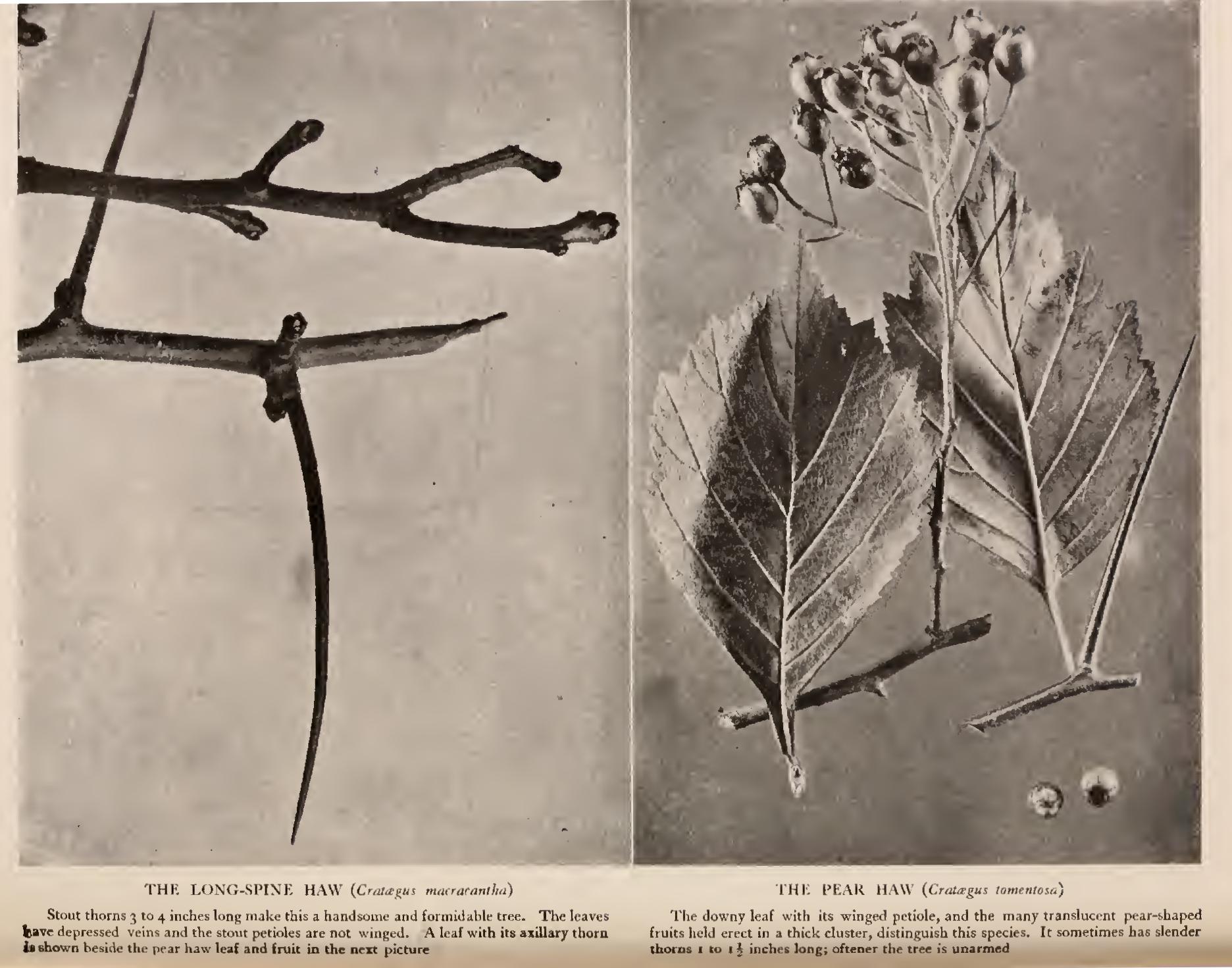
Its many very long thorns make this a strikingly ornamental tree. The leaves are handsome, and the fruits though small are blood red and conspicuous.
DOUGLASIANae Black Haw (C. Douglasii, Lindl.)—Round-headed tree, 3o to 4o feet high, or many-stemmed shrub, with slender, stiff twigs. Thorns stout, acute, / to t inch long, red, becoming grey. Bark red-brown in oblong, scaly plates. Wood hard, tough, heavy, rose coloured, with satiny grain. Buds blunt, inch long, scaly, shining, brown. Leaves obovate to oblong-ovate, acute, finely serrate, on irregular incised lobes; occasionally with two deep sinuses nearly cutting the blade in two; base tapering to short, stout petiole; smooth, dark green, leathery, paler beneath; to 4 inches long. Flowers, May, I to inch across, in leafy cymes; stamens 20, anthers pale, small; styles 2 to 5, short. Fruits black, ripe in August to September, soon falling, globose or oblong, in many-fruited clusters, lustrous, inch long; flesh thin, sweet; nutlets slightly grooved on back and front. Pre ferred habitat, moist soil of coast and stream borders. Distribution, coast of Puget Sound, Oregon, and California; east on mountains to Montana and Idaho, and south to Colorado and New Mexico. Occurs also in the upper peninsula of Michigan.
This black-fruited thorn tree of the West has been successfully introduced into cultivation in the Eastern States, and proves hardy along the Atlantic seaboard to Nova Scotia. It is well worth cultivating wherever it will grow.
The English Hawthorn (C. Oxyacantha, Linn.) is the best known Cratxgus in the world. grows wild in Asia and Europe.
and when it first came into cultivation no man knows. English men will tell you it has always formed the hedgerows of their snug little island, and the sweetness of the blossoms will be one of the last things to fade from the exile's memory. Snowy white, and pink and rose coloured, the "blossoming May turns the whole countryside into a garden, with linnets and skylarks filling the fields and lanes with music. "Oh! to be in England, now that April's there!" Browning's poetry is sometimes obscure, but here is a line that needs no explanatory note for any of his countrymen.
The leaf of the English hawthorn is deeply cut, like our parsley haw, in the type species. But this species we shall rarely see. It has been so long in cultivation that the improved horticultural varieties are legion. These are much in evidence in American gardens, where they are usually grown as single specimens, for their showy flowers and coral-red fruits.