Linn I Genus Ulmus
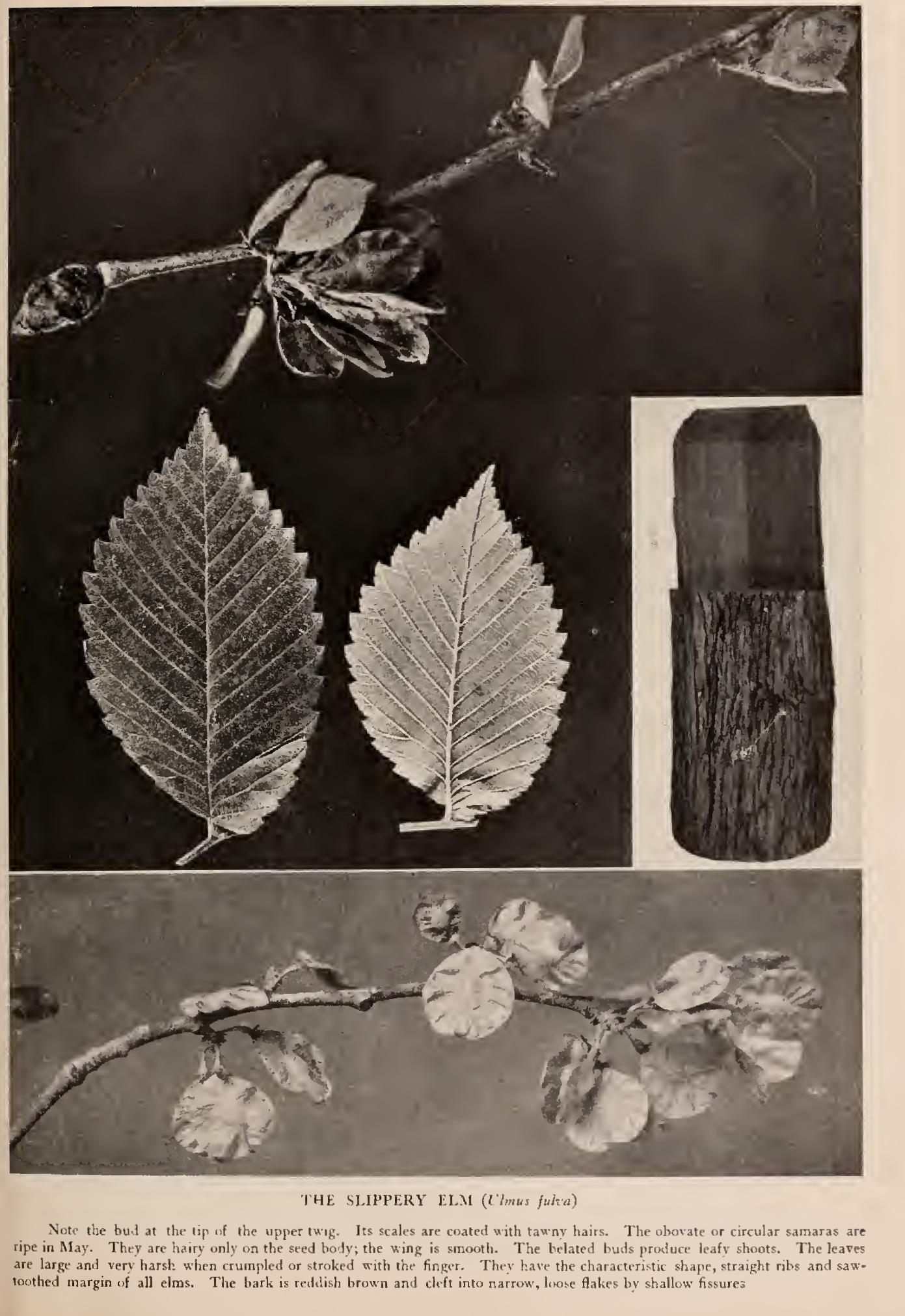
The slippery elm disregards the laws of symmetry. Each limb strikes out for itself. It is not unusual to find a tree quite one sided in form. Shoots 6 feet in length are often seen as the growth of a single season, where a broken limb gives an ambitious bud a chance. The roughness of its foliage to the touch is one of the striking characteristics of this tree. The leaves are covered with harsh, tubercular hairs, and the crumbling of a leaf grates most unpleasantly on the ear. Then, there is a tawny pubescence on young shoots, and especially on the bud scales of this elm. In winter this is the best distinguishing mark of the red elm. The large flower buds are below the pointed leaf buds on the youngest shoots.
The bark is brownish grey, and rough alike on trunk and branches. Everything, in fact, _about the slippery elm seems coarser than in its relatives. The leaves are often 8 to to inches long on vigorous shoots.
Under the bark is a mucilaginous, sweet substance that gives this elm its common name. What man lives who in the heydey of youth has not had the spring craze for slippery-elm bark, as surely as he had the chicken pox and the measles! The trees in every fence row show the wounds of many a jack-knife, for in the spring its cambium waxes thick and sweet and fragrant—to growing boys, a delectable substance that allayed both hunger and thirst. Fortunate for the longevity of the individual trees, the bark of the limbs is most easily stripped off, so,many a veteran supplies boys to-day, which served as well a former generation. The hark, dried and ground, mixed with milk, forms a valuable food for invalids. Poultices are made of it to relieve throat and chest troubles. It is also useful in allaying fevers and acute inflammatory disorders. This bark, first used as a home remedy, has now an established place on the apothecary's shelf, and is used by physicians of both schools. The problem of the supply is a serious one. The tree grows fast and vigorously if only the boys give it a chance. The trees are becoming scarcer each year.
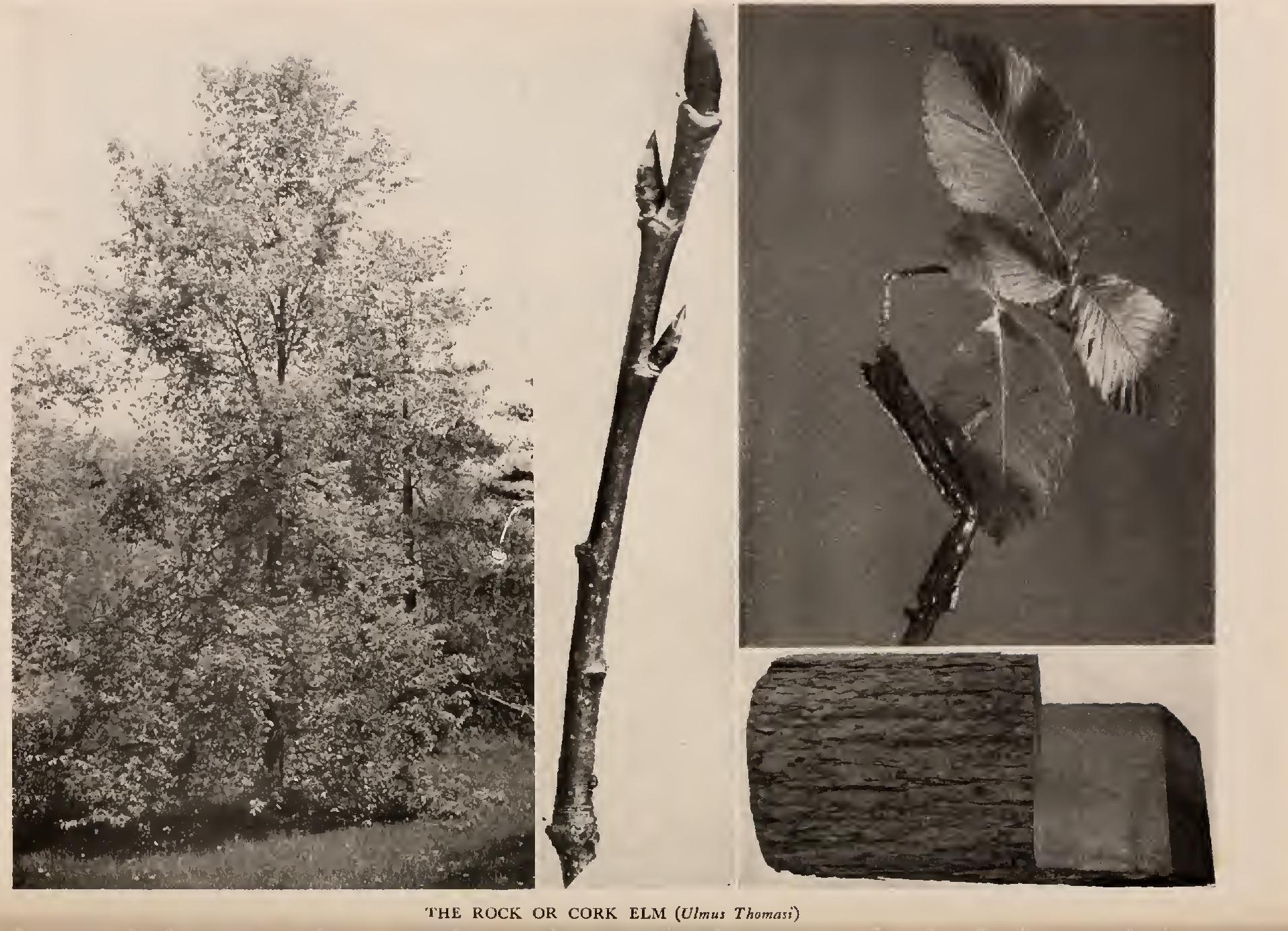
The Rock or Cork Elm (Ulmus Thomasi, Sarg.) has shaggy stout limbs like a bur oak's, and a rugged, stiff expression quite unusual in an elm. A look at the foliage is reassuring, for elm leaves vary but slightly in the different species. In spring the type of inflorescence is the best botanical character to depend upon.
The cork elm was discovered in the woods of western New York by David Thomas, who noted its corky bark and habit of bearing its flowers and fruit in racemes. He named the species
Ulmus racemosa, as was most reasonable. It was discovered later that this name had previously been applied to a European corky elm; whereupon the name of its discoverer was substituted.
"Rock elm" and "hickory elm" refer to the hardness of its wood. It has in greater degree the good qualities of white elm lumber, and is counted the best of all elms by the wheelwright. Compact, with interlacing fibres, there is spring, strength and toughness in this wood which adapts it for bridge timbers, heavy agricultural implements, wheel stocks, sills, railroad ties and axe handles.
The best trees, 6o to go feet high, with trunks 2 to 3 feet through, grow in dry soil in lower Ontario and Michigan. The species occurs also in scattered localities west to Nebraska and Tennessee, and east as far as Vermont.
The Winged Elm, or Wahoo (U. alata, Michx.), is not an important timber tree, though its wood is used in the localities where it grows. Its leaves and the two thin, corky blades that arise on the branches are dainty, as befits the smallest of the elm trees. There is none of the ruggedness of the cork elm in the appearance of this pretty, round-headed tree. It rarely grows over 4o feet high, and is distributed from Virginia to Florida, and west to Illinois and Texas. Its small, winged samaras are each prolonged into two prominent incurving hooks at the apex. They hang in pendulous racemes. The tree is occasionally planted for shade in Southern cities, but it is not hardy in the North. "Wahoo" seems to be a term rather indiscriminately applied to elm trees in sections of the South. "Mountain elm " and "small-leaved. elm" are significant popular names.
Two elms have leathery, almost evergreen leaves, and bloom very late in the summer. One, found in Georgia and Tennessee, was confused with U. Thomasi until its flowers were found opening in the axils of the season's leaves in the month of September! This discovery set it apart as a separate species, and it was named from its red-brown wood, the Red Elm (U. serotina), by Professor Sargent. The specific name means late.
The Cedar Elm (U. crassifolia, Nutt.), of Arkansas, Texas and Mississippi, blooms in August. Occasionally this tree reaches a height of 8o feet, with broad, spreading limbs and slender, pendulous branches. It is a beautiful, graceful tree; its tiny leaves, close set on the winged twigs, form a dense head of lustrous foliage. Occasionally a second crop of flowers appears in October.