Linn I Genus Ulmus
There seems to be no better reason for its common name than that it grows with cedars on the dry limestone hills of Texas. It is the common elm tree of that great state, and is sometimes planted as a shade tree. Its lumber is used for fencing and for wheel hubs, the better qualities being cut in the moist lowlands. In dryer situations it is scarcely worth cutting even for fuel.
z. Genus CELTIS, Linn.
The hackberries include fifty or sixty tropical and temperate zone species. Two are trees in North America, but future inves tigations may still further divide the group. They are trees of considerable value for shade and ornamental planting. Beside the two natives, three exotic species are in cultivation in the south, and a hardy Japanese species farther north. Of the former, one is from South Africa, one from the Mediterranean basin, and the third from China and Japan.
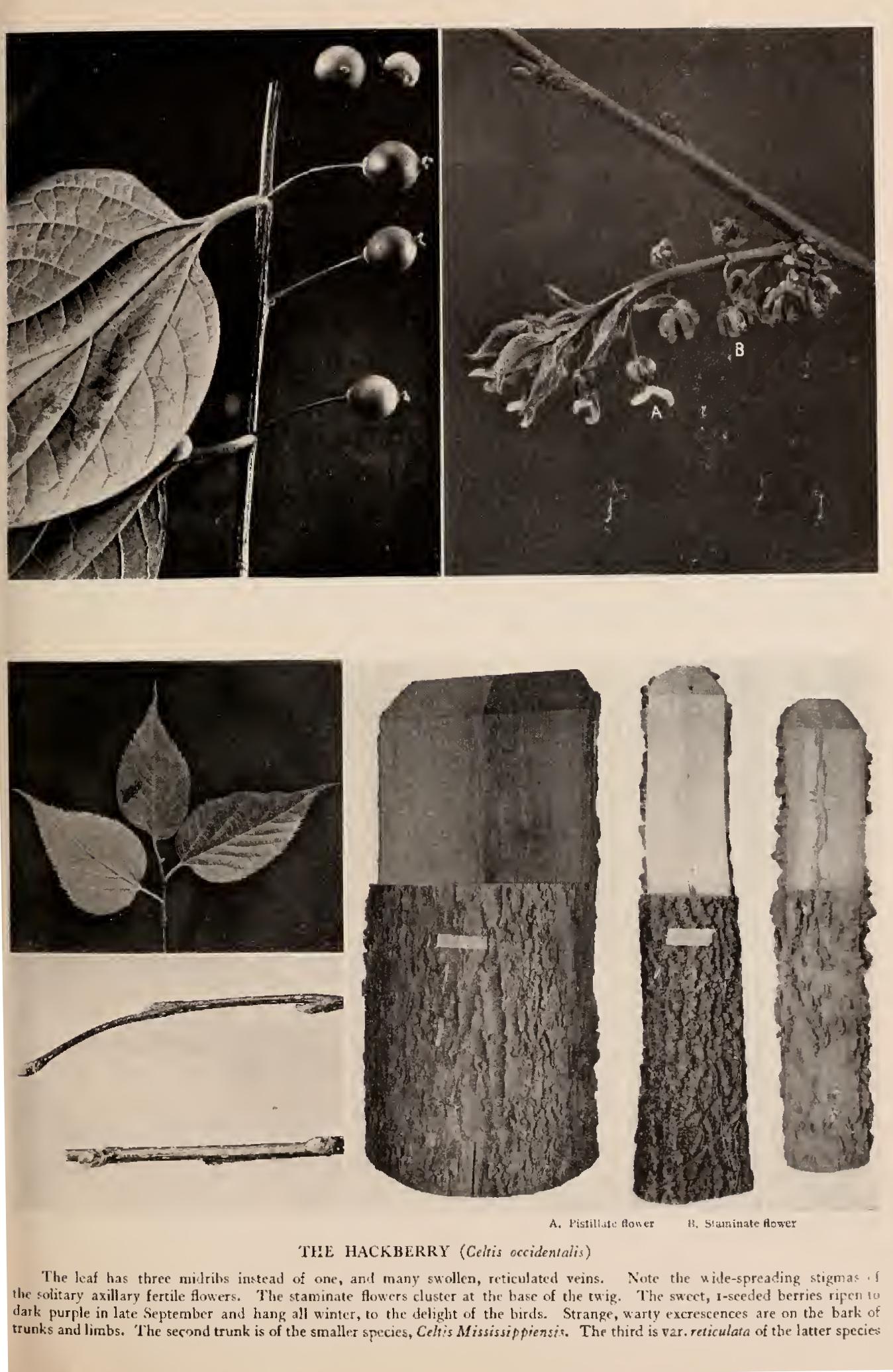
Hackberry, Nettle Tree, Sugar Berry (Celtis occidentalis, Linn.)—Tree, 5o to 125 feet, with slender trunk and round head, of very slender, bushy twigs and pendulous branches. Bark light brown or pale grey, broken into thick warts or scales by deep rows; branches often corrugated and warty. Wood light yellow, heavy, soft, coarse, weak. Buds axillary, never terminal; acute, ovate, small. Leaves simple, alternate, ovate, 21 to 4 inches long, often fulcate, oblique at base, serrate above widest part, entire below it; thin, deep green, with downy lining; 3-nerved, from slim petiole; autumn colour yellow. Flowers, May, moncecious, or mixed, greenish, axillary staminate, clustered at base of sea son's shoot; pistillate solitary, in axils of leaves, green, with spreading, 2-horned stigma. Fruits, September, oblong, thin, fleshed berry, to inch long, purple, sweet; hangs all winter. Preferred habitat, moist soil along streams or marshes. Distribu tion, Southern Canada west to Puget Sound; south to Florida, Tennessee, Missouri, Texas and New Mexico. Uses: Planted for shade and ornament. Wood used for cheap furniture and fencing.
It is easy to mistake the hackberry for an elm. The habit of the two trees leads the casual observer astray. It takes a second look to note the finer spray of the hackberry twigs, its more horizontal, less drooping branches. The warty bark is characteristic. The little axillary sugar berries are very different from elm samaras. There are few months in the year when fruits are not to be found, green or ripe, on the tree. They are the delight of birds throughout hard winters. A peculiarity of the foliage is the apparent division of the petiole into three ribs instead of a single midrib. Otherwise the leaf is elm-like, though smaller and brighter green than that of the American elm.
The hackberry is not familiarly known by people in the regions where it grows. Else it would be transplanted more com monly to adorn private premises and to shade village streets. There is no danger in digging up well-grown trees, for the roots are fibrous and shallow, and carry an abundance of soil with them.
The beauty of the hackberry's graceful crown is sometimes marred by a fungus which produces a thick tufting of twigs at the ends of branches. These are called "witches' brooms." Growths of similar appearance are produced by insects on other trees.
Celtis Mississippiensis, Bosc., is the warty-barked, round topped hackberry of the Ohio and Mississippi valleys; a graceful tree, and much like C. occidentalis, but smaller. Its leaves are narrow and entire on the margins. The warts of its bark are very noticeable. The berries are orange red. This tree is quite as worthy of cultivation as its larger relative, and the people of Texas know it. The chief virtue of this species as a shade tree is that its foliage hangs on, with little dimming of its brightness, to the very edge of winter.
The European nettle tree (C. Australis) is supposed to have been the famous lotus of classical literature. Homer tells of the lotus eaters, who, when they tasted the sweet fruit, straightway forgot their native land, or could not be persuaded to return.
This innocent little tree, against which this charge has never been proved, bears a better reputation for the qualities of its wood. It is as hard as box or holly, and looks like satinwood when pol ished. Figures of saints and other images are carved out of it. Hay forks are made of its supple limbs. Rocky, worthless land is set apart by law for the growing of these trees. A seven-acre tract in the south of France yielded, according to Landon, 6o,000 hay forks per annum, worth $5,000! Suckers from the roots, cut while small, make admirable ramrods, coach whip stocks, and walking sticks. Shafts and axle trees of carriages are made of the larger sticks; oars and hoops from these coppiced trees. This -tree is widely scattered, from northern Africa through Europe, and on to India, where it is a shade tree and is planted for its leaves, which furnish fodder for cattle.
3. Genus PLANERA, Gmel.
Planer Tree, Water Elm (Planera aquatica, Gmel.)—Small tree, 3o to 4o feet high, with short trunk and slender, crooked branches forming a low, round crown. Twigs reddish. Bark thin, scaly, grey; inner layers red. Wood light, soft, fine grained, brown. Buds small, ovoid, scaly. Leaves, February to March; dull green, paler beneath, 2-ranked, elm-like, 2 to 21 inches long, unilateral. Flowers with leaves, moncecious or polygamous, axillary, in fascicles, small. Fruit i-seeded drupe in dry, thin, horny, pericarp; seed shiny, black. Preferred habitat, inundated swamps. Distribution, North Carolina to Florida; west to Missouri and Texas. Rare.
This tree is interesting chiefly as a botanical remnant of its family. Several species of this genus once grew in Alaska and in the Rocky Mountains. Closely related forms are preserved in the tertiary rocks in Europe.