The Hickories
The pignut is unfortunate in its common name. A fine park and shade tree is under a severe handicap. For who would wish a "pignut" planted in his front yard? A "smooth hickory" will rather be chosen, every time—though it is the very same tree, H. glabra. In the early days pigs turned into the autumn woods crunched these hickory nuts which nutters, looking for shellbarks, scornfully left under the trees. The insipid meats were distasteful to human palates—fit only for pigs.
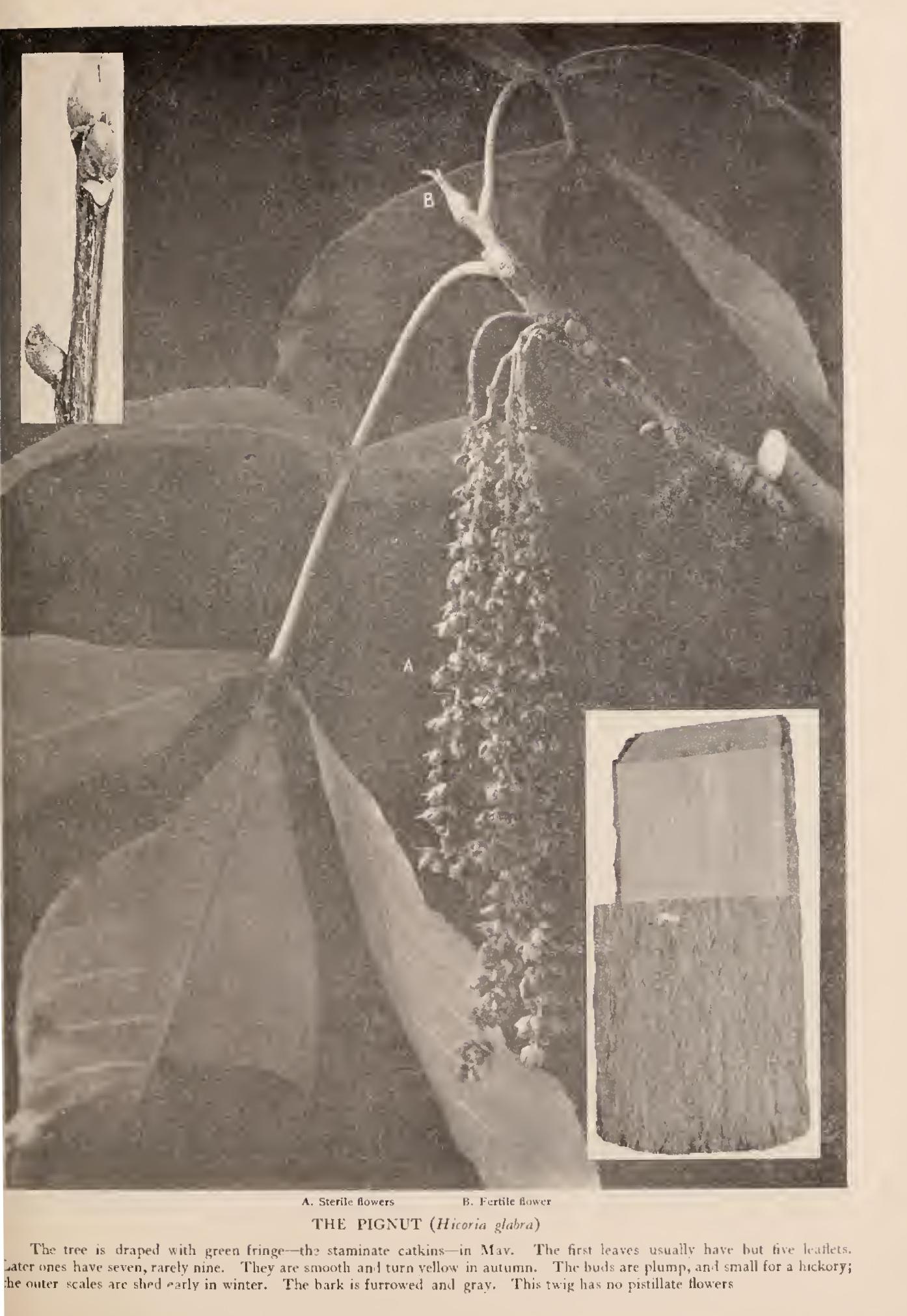
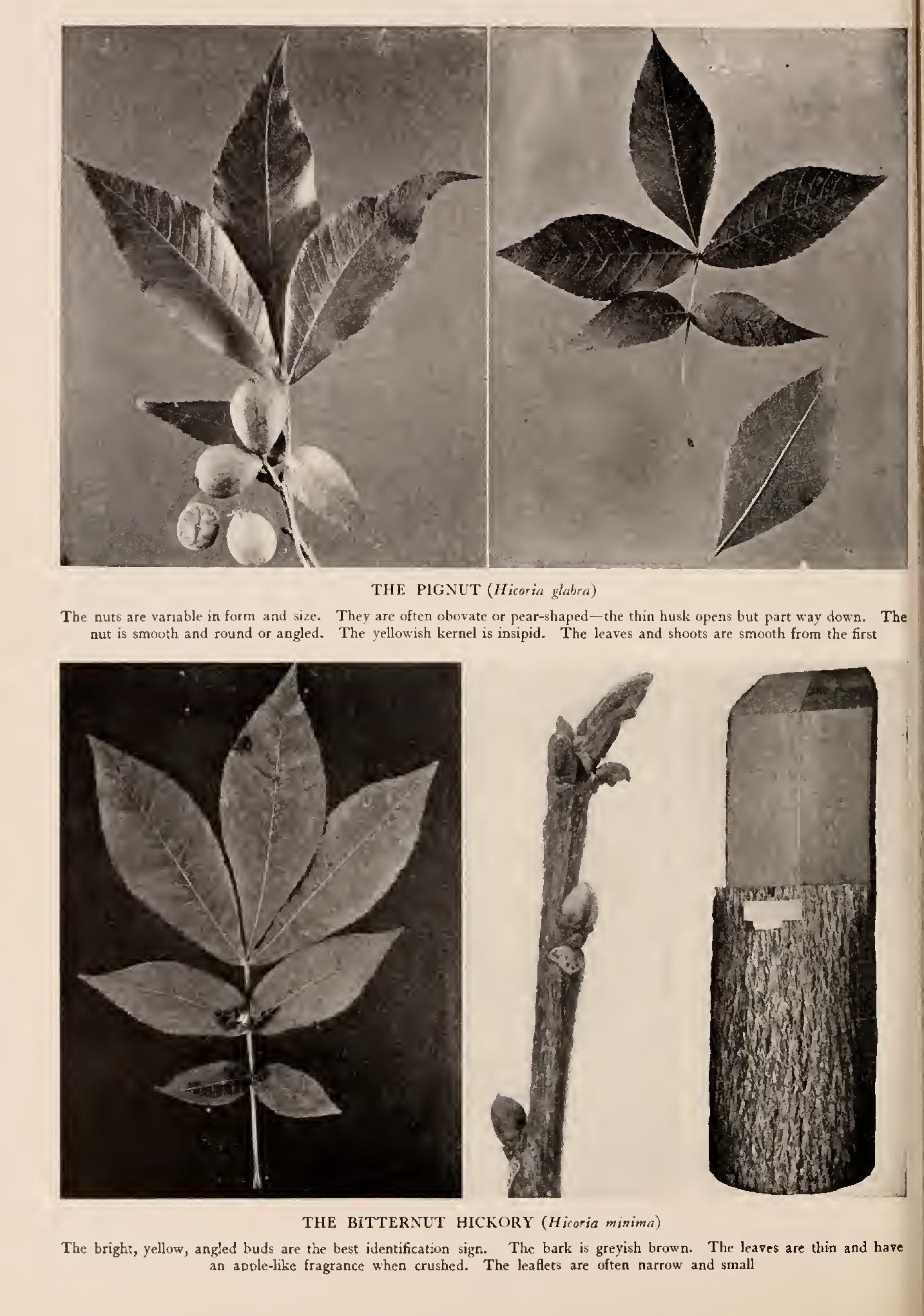
Yet here is one of the finest of the hickories. Its bark is close textured like that of a white ash. Its leaves and shoots soon lose their down and become smooth and lustrous. The small winter buds are ovate, and during autumn their outer scales drop. The nuts are roundish and smooth shelled. The thin husks split but half way down, and are there grown fast to the shell. These characters mark the typical Eastern pignut. West of the Allegha nies is a form that sheds its husks, and has angled, ovoid nuts. The bark of this variety—odorata—is rough, like an American elm, but not shaggy.
Variety microcarpa is a pignut with bark of the H. ovata type, stripping into narrow, thin, springy sheets. The roundish nut is white or grey, and thin shelled. The kernel is sweet. There are reasons for believing this to'be a natural hybrid between H. ovata and H. glabra. Its branches are likely to be pendulous, and the head more oblong than the ordinary pignut. It is commonly called "false shagbark." The extreme variability of the species glabra, and the good quality of fruit in var. nzicrocarpa make horticulturists believe that the pignut is worthy of cultivation. Experiments are now in progress looking toward the improvement of the fruit for com mercial purposes. The signs are hopeful.
With wood equal to the best in its genus, exceptional merits as a shade and ornamental tree, and promise of developing orchard varieties that will rival the shagbarks as nut trees, the pignuts seem to be one of the "coming trees" in the Eastern States. 1 t is to be hoped that the popular name will be abandoned and the more suitable one, "smooth hickory," substituted. This is a literal translation of its scientific name.
The Pale-leaf Hickory (H. villosa, Ashe) has tomentose slender twigs, with silvery scales, and very pale leaf linings. The
nuts are thick shelled and faintly angled like the mockernut, and the bark is very deeply furrowed and rough, but not shaggy. It grows, a small, narrow-headed tree, in barren soil from New Jersey to Florida, west to Missouri and Texas.
Big Shellbark (H. laciniosa, Sarg.)—A tall tree ioo to 120 feet high, with narrow, oblong head. Branches small, spreading.
Bark thick, grey, shedding in long thick plates that hang on fot years. Twigs orange yellow. Wood heavy, hard, strong, tough, very flexible, dark brown, close grained. Buds terminal, very large, ovate, obtuse; scales silky, outer ones, brown, keeled and pointed; inner ones grow to 3 inches long and 1 inch wide and recurve as leaves appear, turning rosy or yellow on inner, lustrous face; lateral buds small. Leaves 15 to 22 inches long, of 5 to 9 obovate or oblong-lanceolate leaflets, dark green and lustrous above, pale yellow-green or bronzy pubescent below; petioles stout, enlarged at base, recurved and persistent during winter. Flowers: staminate in catkins 5 to 8 inches long, smooth, or rufous pubescent ; pistillate in spikes, terminal, 2 to 5-flowered, pale tomentose, angled, green. Fruit solitary or paired, in woody, 4-valved husk, sutures opening half way at maturity, downy, orange brown, 1/ to al inches long; nut compressed, with 4 to 6 ridges, If to 21 inches long; hard, bony, thick, enclosing sweet, fine-flavoured kernel. Preferred habitat, rich, deep bottom lands. Distribution, Iowa, Missouri and Arkansas, eastern Kansas and Oklahoma; Illinois and Indiana to Tennessee, New York and Pennsylvania. Uses: Nuts commercially valuable. Wood not distinguished from that of H. ovata. A worthy ornamental tree.
In the markets we often see nuts of large size—more flattened than English walnuts and fully as large—which the dealer calls "shellbarks." They look like a larger form of the little shellbarks; but we hesitate. They are strangers, and their flavour is an unknown quantity. These are the "king nuts"—not equal to the little shellbarks in quality, yet sweet, edible nuts, though in thick shells. They are distributed from the cities along the Mississippi, and are appearing in increasing quantities in Eastern markets.