The Hickories
But the leaves soon declare themselves, and the scales fall. The tree is then draped in long chenille fringes of green. The wind shakes the pollen out of these staminate catkins, and the incon spicuous green nut flowers, clustered in the tips of leafy shoots, spread their stigmas wide to catch the vitalising golden dust. The fringes now strew the grass under the tree; the bloom is past. Summer matures the crop of nuts.
The first frost hastens the opening of the thick husks. The nuts fall, and schoolboys, who have marked the tree for their own weeks before, are on hand to bag the crop to the last sweet nut, if squirrels do not thwart them. In the open space in the barn loft alongside of the bin where pears are spread out to mellow, the nuts dry and sweeten. In the dead cold of winter evenings the story of "Snow Bound," in modern settings, perhaps, but still the same in spirit, will be re-enacted in farm homes in widely distant parts of the country. Nuts and apples and cider in the firelight ! We have been setting fuel down as the last of a tree's uses. Naturally, burning is the end of things, and it is often an ignoble end. But fire is one of the great elemental forces in nature. A great conflagration is magnificent ; a smouldering rubbish heap is not. Some kinds of wood sputter peevishly in burning. The most splendid wood fire is made of seasoned hickory. Wake up the old backlog, charred by half a hundred fires. Lay in the kindling and feed the growing flames at last with shagbark cord wood. There is no flame so brilliant as this; no wood burns with a more fervent heat. No wonder "the great throat of the chimney laughs." The passing of hickory wood in flames back to its primal elements is the fitting end of a noble tree.
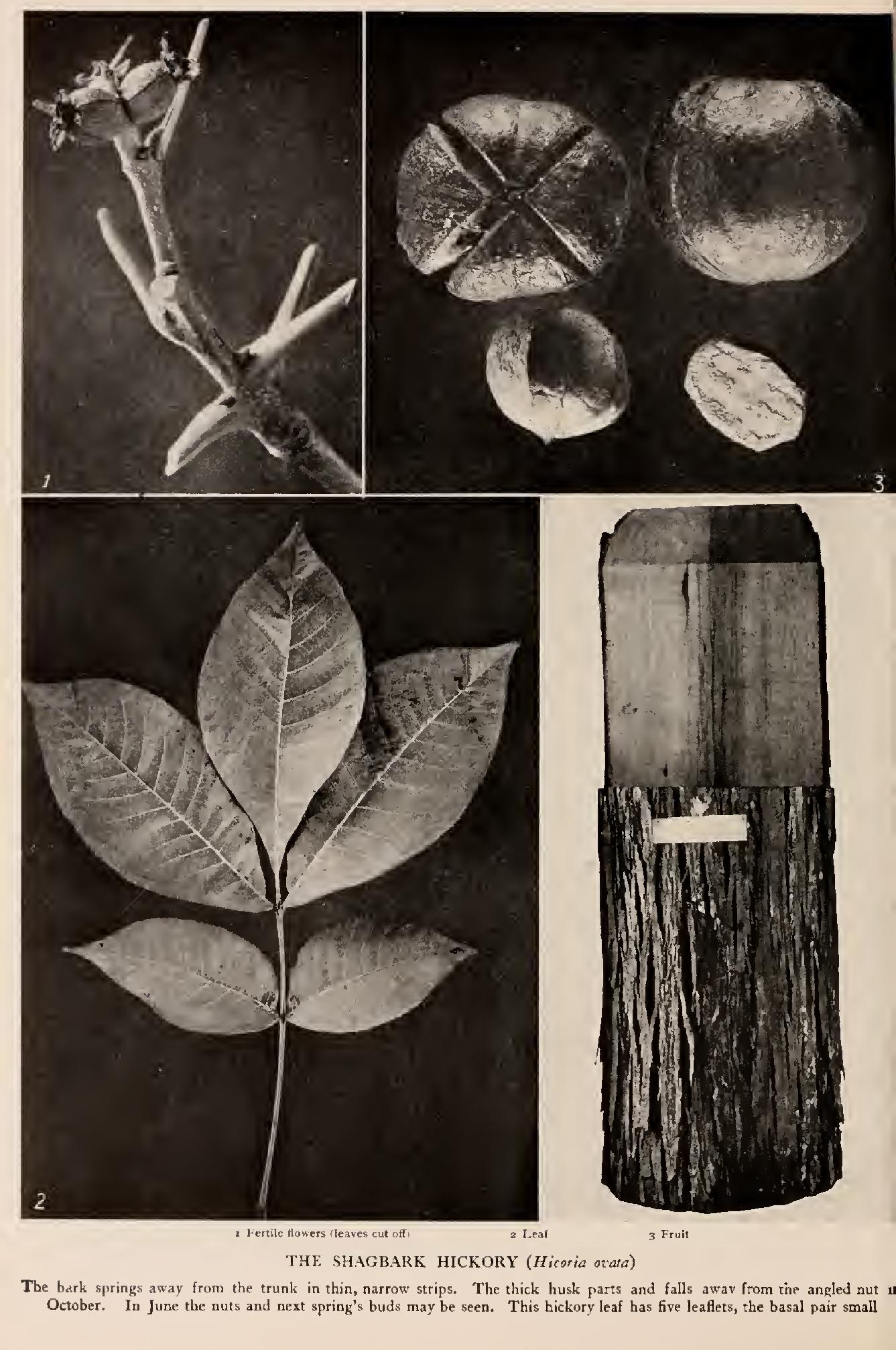
The North Carolina Shagbark (H.Carolince-septentrionalis, Ashe) differs from the preceding species in its smaller size and slen derer habit throughout. The twigs are dark red and slender and the leaflets are small, lanceolate, with long, tapering points. The buds are scarcely 4 inch long, thin inner scales lengthening to i to 2 inches and becoming bright yellow as they unfold. The little nuts have thin shells and the kernels are sweet. The bark of this tree is much like its more burly cousins. The strips are equally tough and persistent, but not quite so large.
The range of this shagbark covers the limestone uplands of eastern Tennessee and western North Carolina, and extends south along river bottoms into Georgia and central Alabama.
Mockernut, Big Bud Hickory (Hicoria alba, Britt.)—A slender, tall, pyramidal tree, 5o to 8o feet high. Bark grey, thick, hard, close, rough, scaly; twigs pubescent, resinous, dotted. Wood dark brown (sap wood white), heavy, hard, strong, elastic, close. Buds: terminal ones large, ovate; outer scales ovate, acute, often keeled, falling in autumn; lateral buds small, yellow ish brown. Leaves alternate, 15 to zo inches long, of 7 to 9 leaflets, sessile, except end one, serrate, oblong-lanceolate, downy, yellow green, russet or yellow in fall; petiole downy, swollen, large. Flowers : staminate in catkins 4 to 8 inches long, hairy; pistillate z to 3 on terminal spike, May. Fruit, October, i to 3 nuts, globose or oblong, often long-pointed ; 11 to z inches long, red-brown, strong scented; sutures opening to middle or nearly to base ; nut globular, 4-ridged near top, thick shelled; kernel small. sweet, edible; often replaced by spongy mass. Preferred habitat, rich soil, on hillsides, North; near bogs and swamps South. Dis tribution, Ontario to Florida; west to Kansas and Texas. Uses: Lumber confused with shellbark hickory; nuts edible, but small, and very thick shelled. Tree planted for ornament and shade.
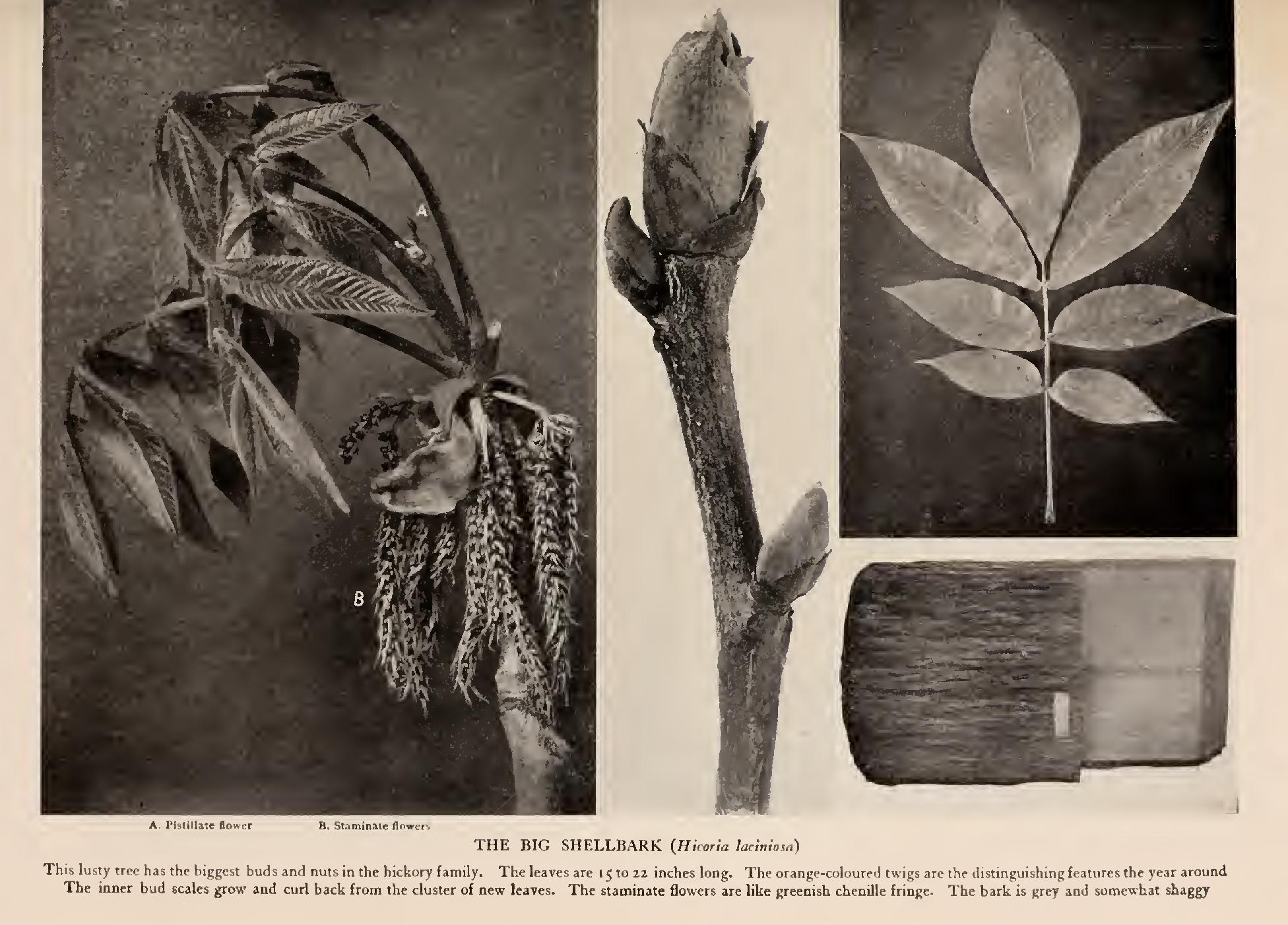
The mockernut has downy buds in winter—this alone will distinguish it from the two smooth-budded shellbarks, which have buds even larger than this species. The outer scales are almost black on the buds of H. ovata and H. laciniosa; on H. alba they are yellowish, for the darker outer scales fall early in autumn. The bark of the mockernut looks more like that of an ash than a hickory. It is broken by shallow fissures into intersecting ridges, and is coated with silvery scales. The branches are stout and curved, giving the tree in winter an expression of strength and grace.
The heart wood is dark brown, but the white sap wood largely predominates, to the advantage of the lumber. The elasticity of hickory wood is somewhat lost in the mature heart wood, so sap wood is best. For this reason second-growth hickory, which is almost all sap wood, is especially valuable. The names alba and white heart both refer to the colour of the sap wood.