The Hickories
One of the things that solaced Evangeline's people, homesick for their lost Acadia, and wandering in a new and unknown region, was the wealth of sweet, nutritious nuts that grew on trees the Indians called pecans. The "Cajons" called the trees, Pecanier, translating the name into their own language. Twice it stood between them and famine before they became established along the lower courses of the Great River.
The salvation of the pecan tree is the inferiority of its wood. Being brittle, it does not commend itself to the makers of wagon tongues and axe handles. Many a superb specimen adorns the roadside and more than pays its way at nut harvest, while other hickories have all been felled and dragged off to the factory. No finer tree adorns the avenues of Southern cities than the pecan.
Furthermore, the value and importance of the nut crop is an ever increasing quantity. Orchards of pecans are being planted, large thin-shelled nuts being chosen for seed. Grafting and budding have been attempted, but usually failed. Success in this is coming and will quickly improve the character of the nuts, only the trees with the best nuts being used for propagation by enter prising growers. Good seed cannot be depended upon to repro duce itself in the fruit of the seedling trees. Cions and buds produce the same sort of nuts, when they come to bear, as the parent tree.
Pecans are, 95 per cent. of them, still gathered in the woods. Buyers pay nut gatherers from 3 cents to 5 cents per pound for them at the railroad. The retailer gets 15 cents to 75 cents per pound. The yield varies with the years, and quantities are kept over in cold storage against a nut famine. The prices fluctuate s.irprisingly, and offer great opportunities for speculation.
The shiny red pecans in the grocer's box owe their polish and fresh colour to rapid friction with other nuts in revolving barrels. Unfortunately this process restores the bloom of youth to the shells of stale nuts which are commonly mingled with the fresh ones. In many places the nuts are cracked and shelled, the meats sold at 5o cents to 6o cents per pound. There is economy of time, at least, in this for the confectioner and the cook.
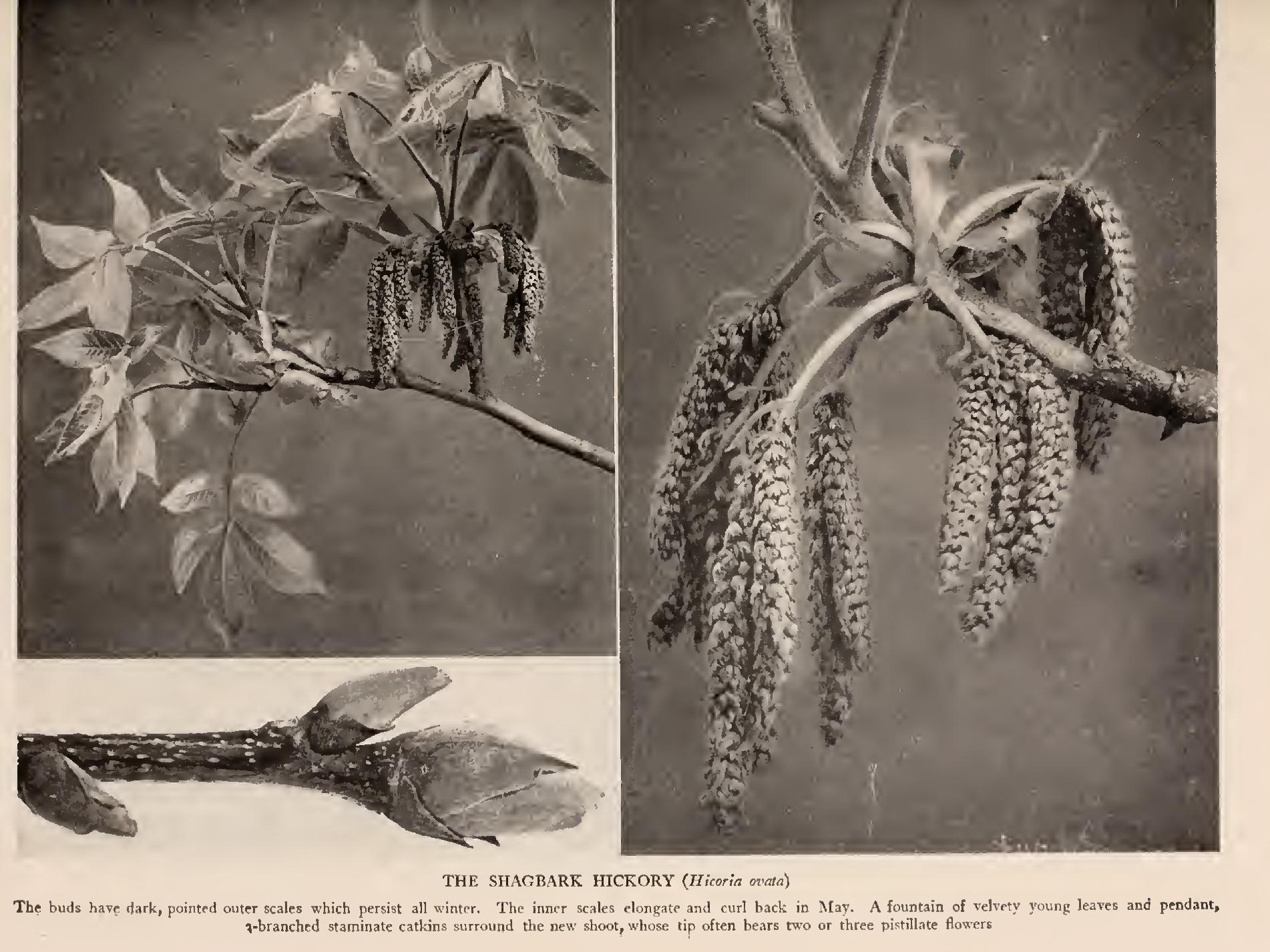
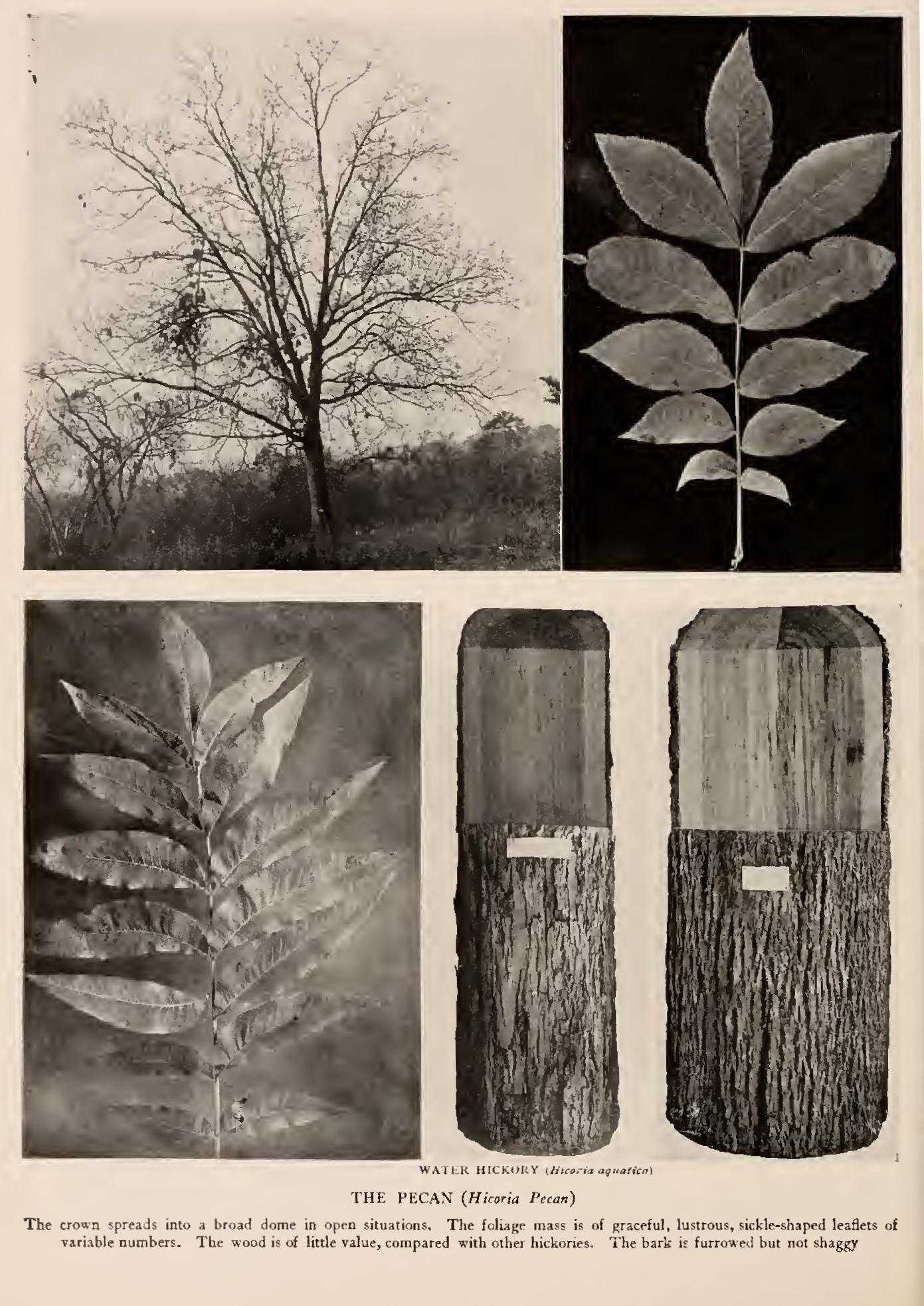
The "get-rich-quick" man is sure to be interested in pecans and pecan culture. Large, thin-shelled nuts, for seed, bring from 5o cents to $2.50 per pound. Budded and grafted trees, one or two years old, cost from 5o cents to $1.50 each at the nursery. An orchard of thrifty, prolific trees, whose nuts have thin-shelled, plump kernels, with delicate flavour and the minimum of the astringent red shell lining, is certainly as good as a gold mine on any farm.
Of the seventy and more varieties that have been described, not twenty are worth considering. Anyone interested in the subject should get the Report on Nut Culture, Division of Pomol ogy, Department of Agriculture, Washington, D. C.
Bitternut, Swamp Hickory (Hicoria Britt.)— A tall, handsome tree, 6o to too feet high, with straight trunk, stout branches and slender twigs, forming a broad, symmetrical head. Bark greyish brown, smooth, close; branches smooth;
twigs yellowish brown, pale, dotted. Wood brown, heavy, hard, close grained, tough. Buds slender, pointed, yellow, granular. Leaves alternate, compound, 6 to lo inches long, of 7 to 1 I narrow, almost willow-like leaflets, bright green, paler beneath, leathery; yellow in autumn ; petioles downy, slender. Flowers in May, with leaves; moncecious, staminate catkins, 3 to 4 inches long, in threes, stalked; pistillate on terminal peduncles, 1 to 3 flowers, inch long, with spreading stigmas, green. Fruit globular, or pear shaped, tot inch long, wider; husk thin, with 4 prominent winged sutures, reaching half way to base; sometimes 2 go to base, never 4. Golden scurf on husk. Nut thin shelled, com pressed, marked with dark lines; kernel bitter, white. Preferred habitat, low wet woods; swamps. Distribution, Maine and Ontario to Florida; west to Minnesota, Nebraska and Texas. Uses: Valuable ornamental and shade tree, not yet appreciated. Wood used for ox yokes, hoops and for fuel.
The bitternut is known among the hickories by its flattened, tapering, yellow buds, which it always carries, no matter what the season. There are always dormant buds in spring, even when growth is at its height. One needs only to follow along any twig to discover several of such lateral ones of the previous year. Very soon the new buds thrust their little yellow noses up from the axils of the leaves, and you have there the sign which remains until growth begins next spring.
The bark of H. minima is close and thin; the habit of the tree is like a hard maple's; its leaflets are the smallest among hickories, and the twigs are the slenderest.
One need not depend on the fruit as an identification sign. The smooth, round nut comes easily out of the thin shell. But the kernel, white and plump, is bitter as gall. No woodland creatures eat it. This is one of the reasons why the trees are so numerous. Nuts roll away from the parent tree, and are privileged to grow, while edible nuts are devoured.
The bitternut has all the good qualities of an ideal park tree, and excels the other hickories in rapidity of growth. The land scape gardener of the coming generation will know and appreciate it, for the native trees are receiving more and more consideration, and their names are appearing, in increasing numbers, in nursery men's catalogues.
The Bitter Pecan, or Water Hickory (H. aquatica, Britt.), is least in size and value among the hickories, though it shoots up occasionally to the height of ioo feet. It grows in inundated districts—in swamps of the coast region from Virginia to Texas, and along the Mississippi River to southern Illinois. There is little to regret in its comparative uselessness, for the trees are practically inaccessible. The bitter little nut is roughly sculptured and ridged, reminding one of the butternut shell. This probably led Michaux to call it a walnut. The kernel is thickly coated with a bitter red powder, like that of the pecan.