Nature of
x-rays, x-ray, examined, castings, radiographed, method, picture, materials and glue
The faults to which castings are so liable demand continuous research in the actual process of casting various metals, and here again X-rays have become a most valuable adjunct to the con ventional methods. The castings produced by a certain method are radiographed and weak places noted, the technique is then suitably modified and the resulting castings again radiographed and so on. Among the castings and forgings that are at present radiographed on a service routine scale are those for gun carriages, aeroplane parts, locomotive parts, high pressure steam installa tions, and expensive steel cylinders, together with many others of specialized importance. The method is in general use in America and installations are in use for the same purpose in the factories and dockyards of the British Government.
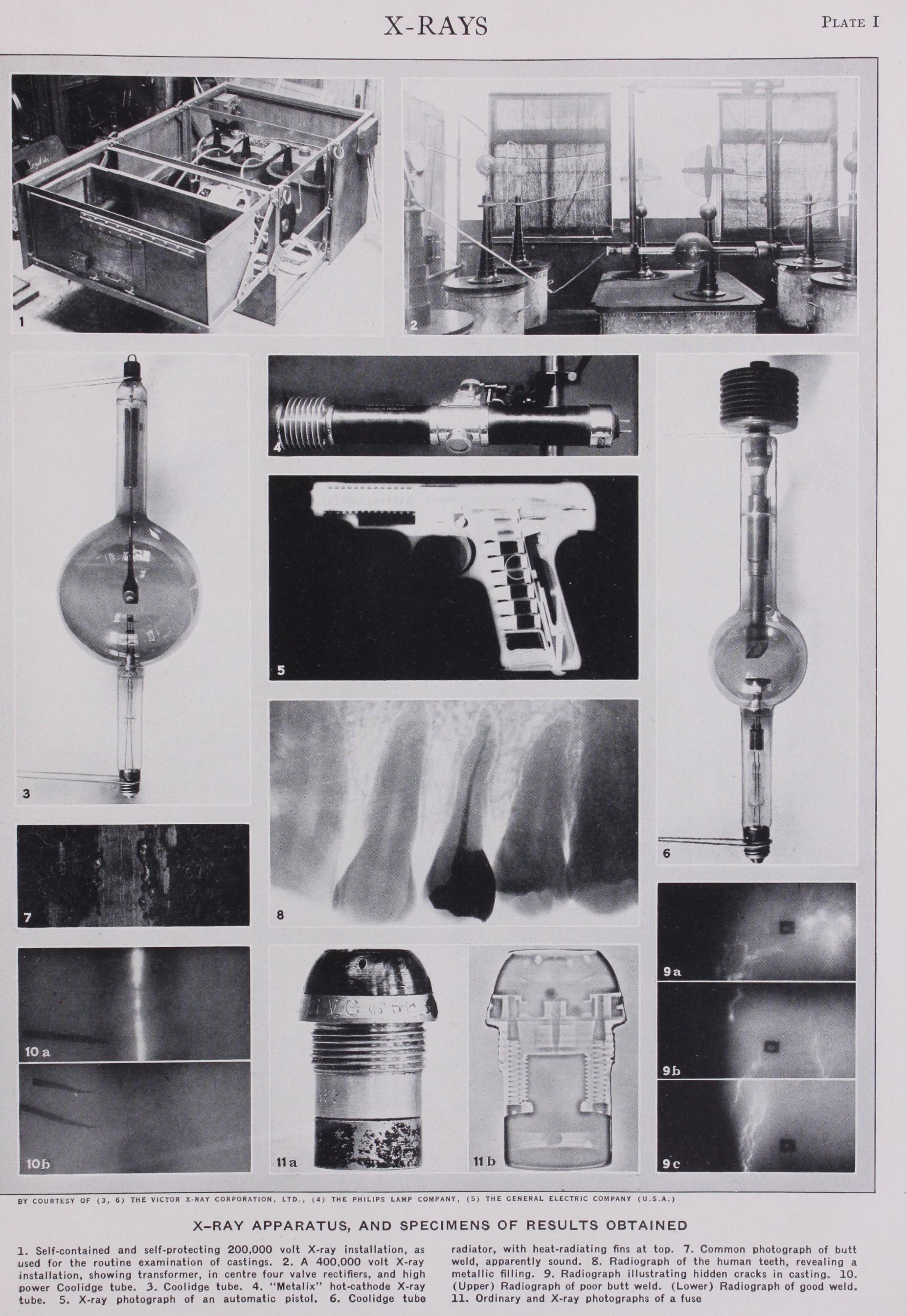
Metallic welding affords another wide field of X-ray useful ness. All welding is liable to faults and even the best methods depend very largely upon the skill and care of the individual work man. There is no method save X-rays of testing a weld with out destroying it. The illustra tions show the sort of X-ray pic tures yielded by good and bad welds. As a result of an exten sive experience it is customary at Woolwich to estimate the me chanical strength of a weld by a mere examination of the radio graph.
Another X-ray application has its main expression in the in spection of assembled articles, such as fuzes, where the finished product depends for its proper functioning on the completeness and correct assembly of its internal components. In such cases elaborate and expensive systems of inspection are often necessary. In many instances X-rays afford an accurate method of perform ing such a check. The inspection departments of the British Government have specially designed X-ray equipment for routine use in suitable cases.
Wooden structures, such as aeroplane spars, also offer a suit able field for X-ray application. Worm holes, resin pockets, and graining may be determined with great exactness.
A striking example of the value of X-rays was experienced in the World War, when strange ammunition of unknown con tent was radiographed before being cut up for examination, there by avoiding all risk of accident.
In the course of a research on glued joints it was necessary to determine the disposition of the glue. By adding a small per centage of a heavy salt to the glue, thereby rendering it opaque to X-rays, the dispersion of the glue in, the joint was shown with clearness in a radiograph. Motor tyres may be examined by X-rays to determine the position of the internal canvas or cords. Electric insulating materials, such as ebonite and built up paper materials, may be examined for the presence of impurities and electrically conducting particles. Abrasive wheels have been examined for
cracks, and fireclay pots used in the manufacture of glass have been inspected for the presence of harmful metallic impurities. X-rays have also been used by Customs authorities to investigate the contents of sealed packages. Real pearls may be distinguished from imitation by X-rays because the real pearl emits a visible fluorescence under the action of the rays. Diamonds, which are very transparent to X-rays, may be distinguished from imitations, which as a rule are much more opaque. The use of X-rays to demonstrate the fit of shoes and boots is now a familiar sight in a boot shop. The exact measurement of the fit of screw threads is a matter that has given rise to a good deal of difficulty; X-rays are now being used for this purpose with remarkable success.
Dr. Heilbron, of Amsterdam, conducted some very remarkable and beautiful experiments with X-rays on pictures painted by old masters. The pigments of modern painters are in general much less opaque to X-rays than those used many years ago. Dr. Heilbron was able to produce X-ray evidence of extraordinary alterations having been made to some pictures. One picture examined by Dr. Heilbron was by Cornelis Engelbrechtsen, where the X-ray picture showed the figure of a vested priest which had been covered at a later date by the painted portrait of a woman. This hidden feature of the original painting had been un discovered for 400 years. Another picture, a representation of the Madonna by Geertgen van St. Jans, was shown by the X-ray picture to have originally included an infant in the arms of the figure, which had subsequently been painted out. Many other pictures were examined with most interesting and striking results.
The development of X-ray apparatus has resulted in the pro duction of small and portable equipments for various purposes, among which may be mentioned a set for the use of plumbers and builders to enable them to locate the position of wires and pipes in the walls and floors of buildings. The rays have also been used to detect metallic corrosion in slabs of ferro-concrete. From the examples that have been quoted it will be realized that it is difficult to imagine an industry where X-rays will not ultimately prove of service. Such unlikely specimens as chocolates, golf balls, and even elephants have been subjected to the process with useful results. The biological properties of X-rays have been pressed into industrial service in that they have been used to sterilize tobacco and cigars, and experiments have been carried out to discover whether they could be usefully employed to destroy certain harmful larvae in packing cases required for transhipment of sensitive materials.