Life-Boat and Life-Saving Service
organization, countries, international, guard, voluntary, maritime, coast, persons and operations
National and International Aspects.
It is still more re markable that even thoL,e who believe in nationalization would not nationalize the life-boat service, and one of the best tributes to its success as a voluntary organization was paid by a leading expo nent of socialist theory, Mr. Sidney Webb, when he was president of the Board of Trade. He said that "one of the Institution's glories is that it is entirely voluntary," and to that he added an interesting analysis of the reasons why the Institution has suc ceeded as a voluntary body. "One of the advantages of voluntary organization is that it can initiate and experiment, which is very difficult for a Government department." The British life-boat service has been the acknowledged model of the other life-boat services of the world, and of the fourteen other countries which have national services, Holland, Belgium, the United States, Germany, Denmark, Norway, Sweden, France, Russia, Spain, Japan, Portugal, Latvia and Iceland, only four are maintained by the State, those in the United States, Belgium, Denmark and Russia. Four of the remaining nine—those in Ger many, Norway, Sweden and Spain—were originally State-services, but they have since been handed over to voluntary organizations, or such organizations have been set up to supplement the State service.
In 1924, by which year it had given rewards for the rescue of nearly 6o,000 lives, the Institution celebrated its centenary, and those celebrations showed what a secure place it holds in the pride and affection of the British people. The King personally deco rated with the Medal of the Order of the British Empire the eight men still living out of the eighty-seven who during the century had won the Institution's Gold Medal, the Victoria Cross of the Life-boat Service. On its hundredth birthday, March 4, the Insti tution held a centenary meeting at the Mansion House. Shortly afterwards an international conference was held in London, at tended by delegates from eight foreign countries, while five of them sent life-boats, so that, for the first time, an international life-boat fleet lay on the Thames. At this conference it was unanimously decided that an international life-boat organization, on the lines of the Red Cross Society, ought to be formed, and that it was desirable to have some organization for saving life from shipwreck in all the maritime countries of the world. This resolution was brought to the notice of the governments of all maritime countries and of the League of Nations. It was dis cussed at a meeting of the League's sub-committee on Ports and Maritime Navigation in the following year, at which the Institu tion was represented by its secretary, and the sub-committee de cided that it could best encourage the promotion of life-boat services by asking governments to induce their national life-boat organizations to keep in constant touch with one another. For
this purpose the sub-committee placed its own secretariat at their disposal. Thus, a little more than a century after Sir William Hillary launched his appeal for a national life-boat service, the international value of such services, and the duty of all maritime countries to provide them for the succour of the seafarers of their own and other nations, were fully and formally recognized.
For the use of rockets in life-saving, see ROCKET AND ROCKET The Life-Saving Service of the United States was merged with the Revenue Cutter Service in 1915, the combined service taking the name of the Coast Guard (q.v.). The Life-Saving System, while an integral part of the Coast Guard, retains its distinctive organization, equipment, and methods of operation.
Extent of Operations.
In the extent of coast-line covered, the magnitude of operations, and the extraordinary success which has crowned its efforts, the Life-Saving Service of the United States is not surpassed by any other institution of its kind in the world. Notwithstanding the exposed and dangerous nature of the coasts stretching between the approaches to the principal seaports, and the immense amount of shipping concentrating upon them, the loss of life, out of a total of 178,741 persons imperilled by marine casualty within the scope of operations of the service, from its organization in 1871 to June 3o, 1914, was 1,455—less than I%— and even this small total is made up largely of persons washed overboard immediately upon the striking of vessels and before any assistance from shore could possibly reach them, or lost in attempts to land in their own boats, and persons thrown into the sea by the capsizing of small craft.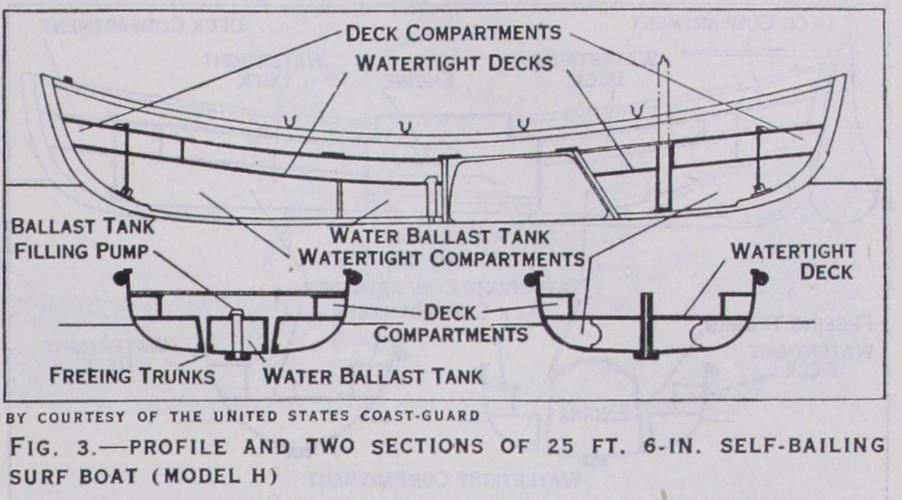
In the service, next in importance to the saving of life is the saving of property from marine loss. During the period named, vessels and cargoes to the value of nearly $300,000,000 were saved, while considerably less than a quarter as much was lost. Separate statistics of the operations of this branch of the service subsequent to its incorporation in the Coast Guard in 1915 are not available; but with the marked improvement in equipment following the per fection of motor-propelled boats, and the greatly extended radius of operation made possible thereby, the efficiency of the service has kept pace with the rapidly increasing volume of maritime commerce. Brief statistics of the operations of the Coast Guard as a whole during the year ending June 3o, 1927, are given in the article on the COAST GUARD. The number of persons aboard ves sels assisted during that year alone was 14,496, and the value of the vessels and cargoes was nearly $40,000,000.