Life-Boat and Life-Saving Service
stations, station, watch, boats, crew, patrol-man, beach, patrol and charge
The maintenance of the property, buildings, wharves, launch ways, sea walls, etc., is in the hands of a civil engineer attached to headquarters in Washington, with a number of assistants in immediate personal charge of extensive sections of the coast. The general administration of the service is conducted by the com mandant of the Coast Guard with headquarters at Washington.
Station crews are composed of an officer in charge holding the rank of a boatswain, and, at a majority of the stations, from six to eight surfmen, with a larger number, up to as many as fifteen, at certain stations where the service is particularly arduous. The number of men in each crew is determined principally by the number and kind of boats, the extent and nature of the coast line to be served, the climatic conditions at various seasons, and the amount of shipping in the locality. Nearly all stations are now equipped with motor-powered boats. One or more of the members of the crew are trained in the care, operation and repair of these engines, those so qualified being rated motor machinists.
For this purpose there is maintained, at the ship repair and boat building yard of the service, at Baltimore, Md., a school for the special instruction of men who show an aptitude for this work. The surfmen are enlisted for periods of from one to three years, after a thorough medical examination. All stations on the ocean coasts are in commission and fully manned throughout the year. The floating station at Louisville, and a number of stations on the Great Lakes situated at harbours where shipping is in opera tion during the winter months, are in continuous commission.
Stations.
The stations contain, as a rule, suitable living quarters for the officer in charge and members of the crew, and a boat and apparatus room. Many of the stations, particularly on the Lakes, have living quarters for the family of the officer in charge. Each station has a look-out tower for the day watch, on the station building proper, or separately placed at a point of vantage. In some places the dwelling and boat-house are built separately, and a number of stations also have additional boat houses situated at danger points distant from the main station. Those equipped with the larger life-boats have launchways or marine railways for the launching of the boats directly into deep water, with power winches and cradles for launching and hauling out. The Louisville station guards the falls of the Ohio river, where life is much endangered from accidents to vessels passing over the falls, and to small craft which are liable to be drawn into the chutes. It consists of a dwelling with look-out tower, appara tus room, and ways for small boats, the whole mounted on a scow-shaped hull. Its equipment includes several river skiffswhich can be quickly launched directly from the ways at one end of the station. These skiffs are modelled much like surf-boats, designed to be rowed by one or two men.
Equipment.
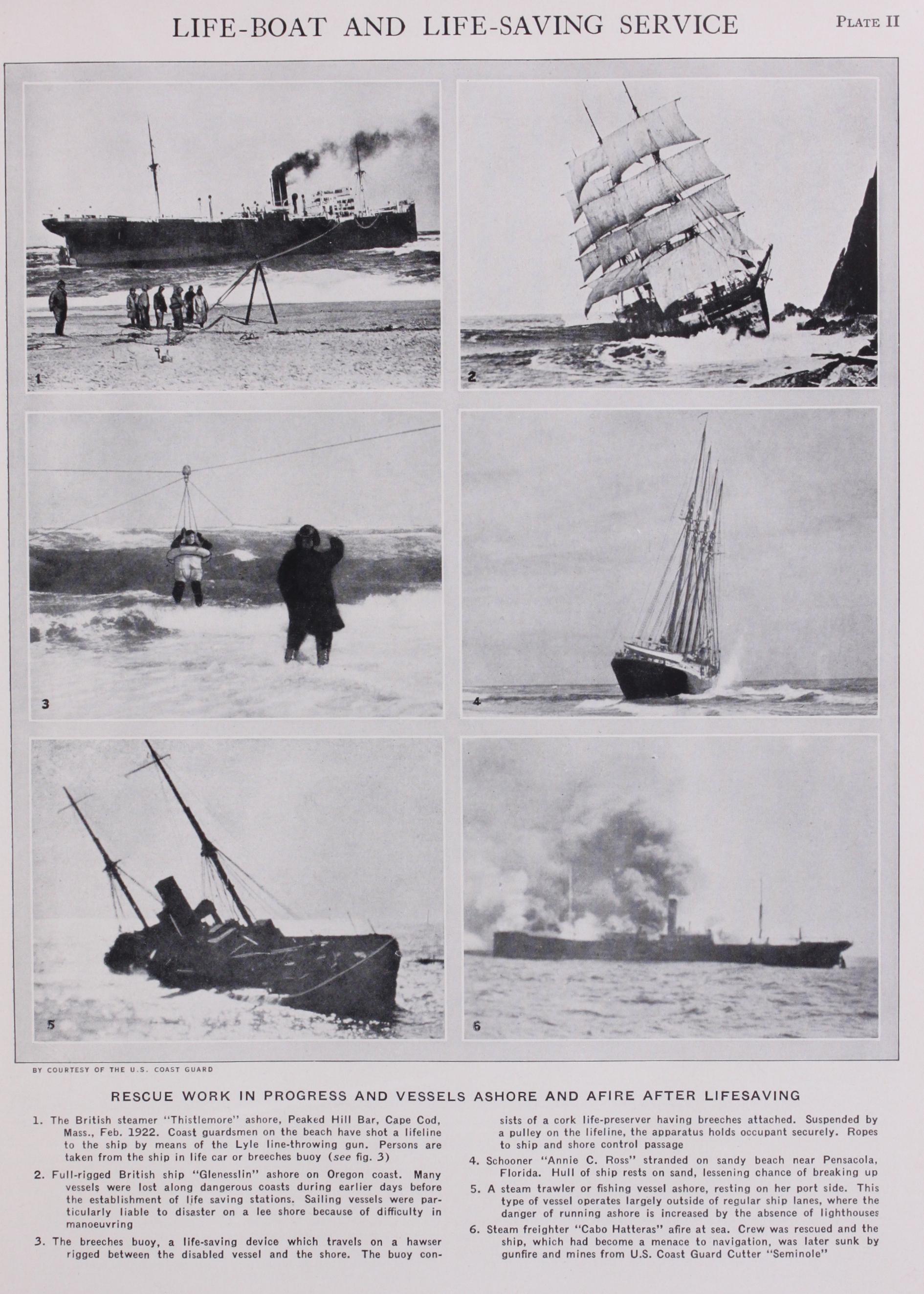
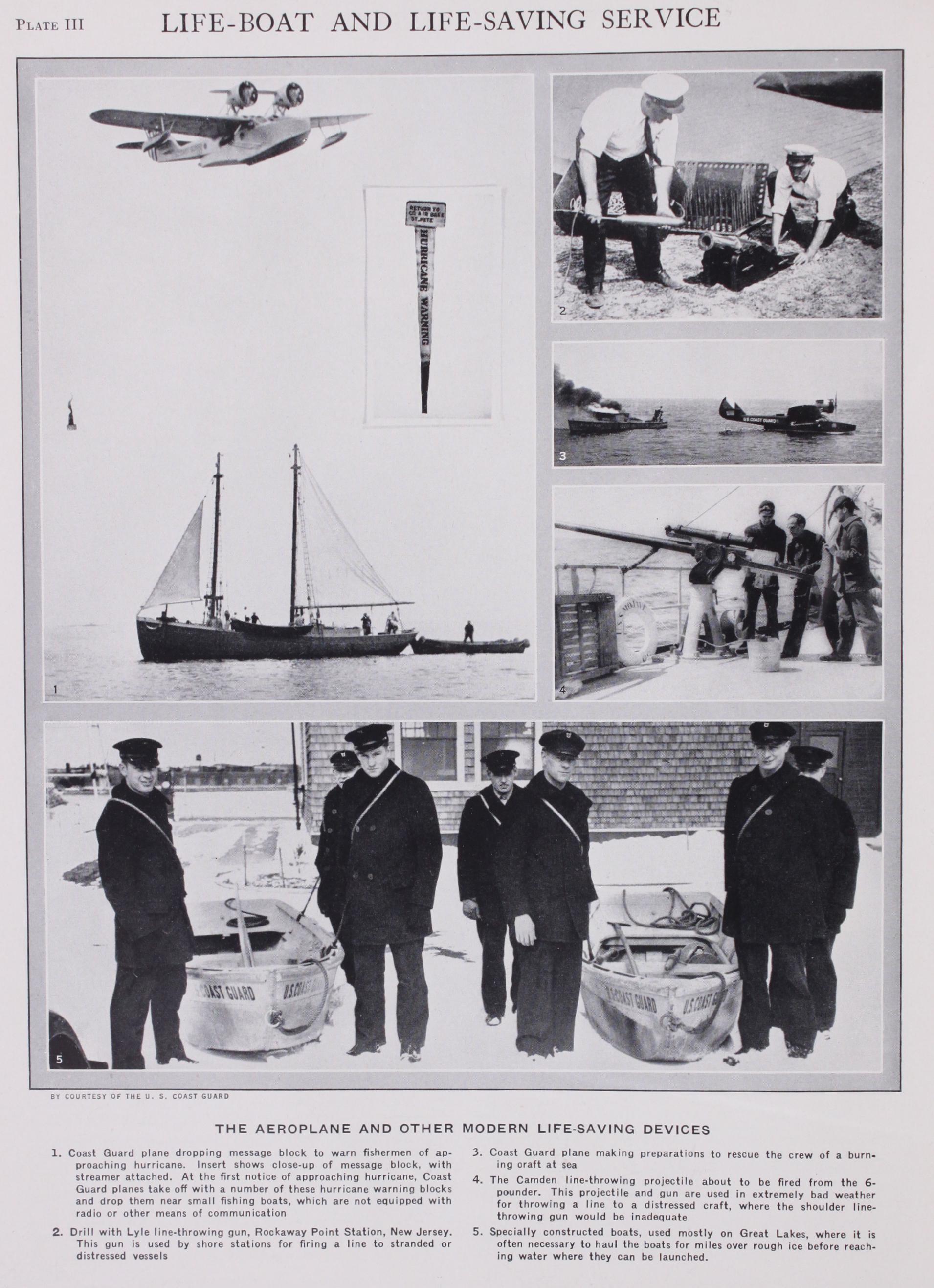
The equipment of the stations consists of the beach apparatus—line-throwing guns, hawsers, breeches-buoys and life-car—flag and pyrotechnic signals, heaving sticks and lines, life-preservers and life-boats, surf-boats and other special types of boats. The outfits are practically the same at all stations, but the boats are of various types, depending upon their suitability for rescue work on the different coasts. The larger life-boats are too heavy to be launched from the beach into the surf, and launch ing ways are provided for them where comparatively smooth water prevails—on rivers, bays and inlets. The surf-boats are mounted on boat-wagons by which they are drawn to a point abreast of a wreck and launched directly from the beach.