Life-Boat and Life-Saving Service
stations, coast, crews, equipment, government, congress, society, charge, district and time
The Massachusetts Humane Society,
as early as 1789, began the erection of rude huts along the coast of Massachusetts for the shelter of any destitute persons who might escape death in the sea. At first no attempt was made to provide means of rescue, but in 1807 a station, equipped with a boat for use by volunteer crews, was erected at Cohasset, Mass., and additional stations were placed at exposed points along the coast from time to time. The Federal Government, soon after its organization at the close of the Revolutionary War, commenced the erection of lighthouses, which were placed under the charge of the Treasury department ; but it was not until 1838 that it was suggested, by two officers of the navy who had been assigned to make a general inspection of the lighthouse system, that life-boats be added to the equipment of seven of the lighthouses, and it is not recorded that this suggestion bore any immediate fruits. However, on March 3, 1847, Congress appropriated the sum of $5,000 "for furnishing the lighthouses on the Atlantic coast with means of rendering assist ance to shipwrecked mariners." No steps having been taken to expend this sum, the Massachusetts Humane Society in the follow ing year made application to the secretary of the Treasury and was granted the use thereof. The society at that time represented that it was maintaining "16 or more life-boats on the coast at the most exposed places, also a number of houses on exposed beaches." During the period from 1849 to 1870 this society secured addi tional appropriations aggregating $40,000 from Congress for the prosecution of its work. The society today maintains twenty-one stations on the Massachusetts coast.
First Government Efforts.
The first Government life-saving stations were plain boat-houses, a few of which were erected along the coast of New Jersey in 1848, each equipped with a fisherman's surf-boat, a mortar for firing a line across a stranded vessel, a life-car or enclosed metallic boat to be hauled between the shore and a wreck, and a few simple accessories. In 5849 the service was extended to the coast of Lohg Island, and in 185c one station was placed on the Rhode Island coast, thus protecting the coasts con verging on the principal American seaport, New York city. No provision was made for crews or even for responsible caretakers, and as a result the buildings and equipment rapidly deteriorated from the ravages of the elements, and much of the equipment was stolen or destroyed. In 1854 provision was made for the appoint ment of paid keepers for the New Jersey and Long Island stations, and a superintendent for each of these coasts, marking the begin ning of an organized, effective governmental life-saving service. Volunteer crews were depended upon until 187o, when Congress authorized crews at each alternate station for the three winter months.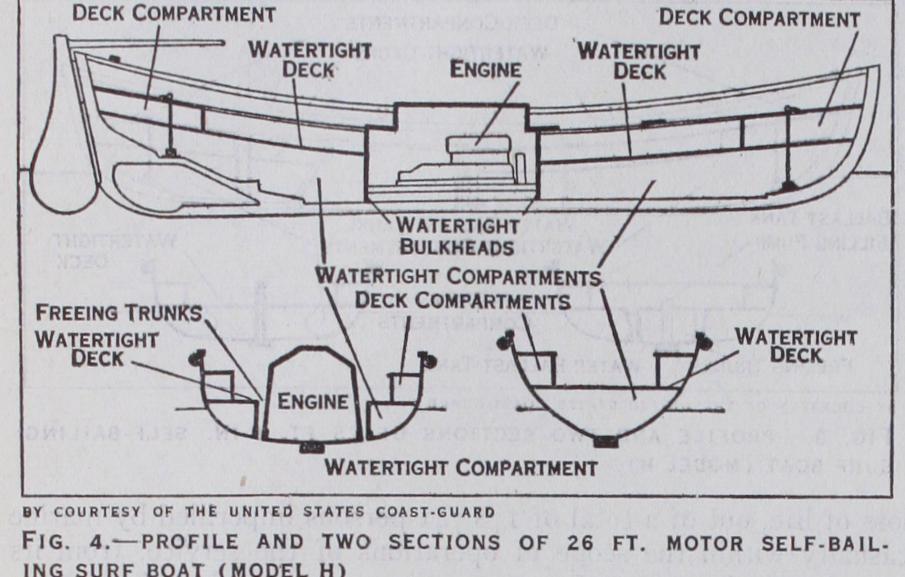
The present extensive and thoroughly organized system was inaugurated in 1871 by Sumner I. Kimball who in that year was appointed chief of the Revenue Cutter Service which, some years pointments and promotions was inaugurated, ard effective regula tions for the government of the service and training of the crews were adopted and enforced. A beach patrol maintained throughout the hours of darkness and in thick and stormy weather in the day time. tor the warning of vessels standing into danger and the
prompt discovery of such as were cast ashore, was instituted. The result of this transformation was immediate and striking. At the end of the year not a life had been lost within the domain of the service ; and during the next year but one life was lost although the service now embraced the dangerous coast of Cape Cod.
Establishment of Regular Service.
The service continued to grow rapidly in extent and importance until, in 1878, Congress established the Life-Saving Service as a distinct and independent organization, operating under the Treasury department. Its ad ministration was placed in the hands of a general superintendent appointed by the president and confirmed by the Senate, his term of office being limited only by the will of the president. Mr. Kim ball, who had displayed such energy and ability in its develop ment, was appointed to this position, which he held until the Life Saving Service was united with the Revenue Cutti r Service in 1915, when, in recognition of his distinguished service, he was granted the unique distinction of being the first civil employee of the Government outside of the judiciary to be retired with pay.
Organization.
The service in 1928 embraced 13 districts, with 277 stations of which 252 were active, situated at selected points upon the sea and lake coasts. Eight districts on the Atlantic and Gulf coasts contained 193 stations, including eight houses of refuge on the coast of Florida, each in charge of a keeper only, without crews; three districts on the Great Lakes contained 63 stations, including one at the falls of the Ohio river at Louisville, Ky. ; and two districts on the Pacific coast contained 21 stations, including one within the Arctic circle at Nome, Alaska.
Each district is in command of a district commander, who is a commissioned officer of the Coast Guard, selected by competi tive examination from the warrant officers in charge of stations. The district commander has immediate supervision over the opera tion of the stations, the selection and enlistment of the crews and their assignment, the enforcement of discipline, the procurement of supplies and equipment, and the payment of compensation. He is held responsible for the efficiency of the stations in his earlier, had been given charge of the embryo system. He secured from Congress an appropriation of $200,000, and authority for the employment of crews for all stations for such periods during the year as were deemed necessary. The existing stations were thoroughly overhauled and put in condition for the housing of crews; the best available boats and equipment were provided; inefficient station keepers, who had secured appointment through political influence , were succeeded by men carefully selected for their skill and experience ; additional stations were established, and all were manned by capable surfmen; the merit system of ap district, and is a bonded disbursing officer. District commanders are assisted in the performance of these duties by one or more warrant officers (boatswains) selected from the corps of officers in charge of stations.