Lighthouse Structures
tower, ft, rock, water, completed and structure
Inst. C.E. vol. CV III. (1892).
a more exposed situation than any other in the world. The first lighthouse erected there was begun in 1847 under the direction of N. Douglass. The tower consisted of a cast and wrought-iron openwork structure having the columns deeply sunk into the rock. On Feb. 5, 1850, when the tower was ready to receive the lan tern, a heavy storm swept away the whole structure. In 1851 the erection of a granite tower was begun and the light was first exhibited in 1858. This structure also proved insufficient to with stand the very heavy seas to which it was exposed. Soon after its completion the 5-cwt. fog bell, fixed to the lantern gallery too ft. above high-water mark, was washed away and the tower vibrated considerably during storms. In 1874 it was strength ened by bolting continuous iron ties to the internal surfaces of the walls. In 1881 further signs of damage appeared and the structure was encased from its base upwards with granite blocks dove-tailed to each other and to the existing work. At the same time the elevatior of the light was increased. The work was be gun in 1883 and completed in 1887. Profiting by the experience gained after the construction of the new Eddystone tower, Sir J.
N. Douglass decided to build the lower portion of the improved Bishop Rock tower in the form of a cylinder, but with consid erably increased elevation (fig.
4).
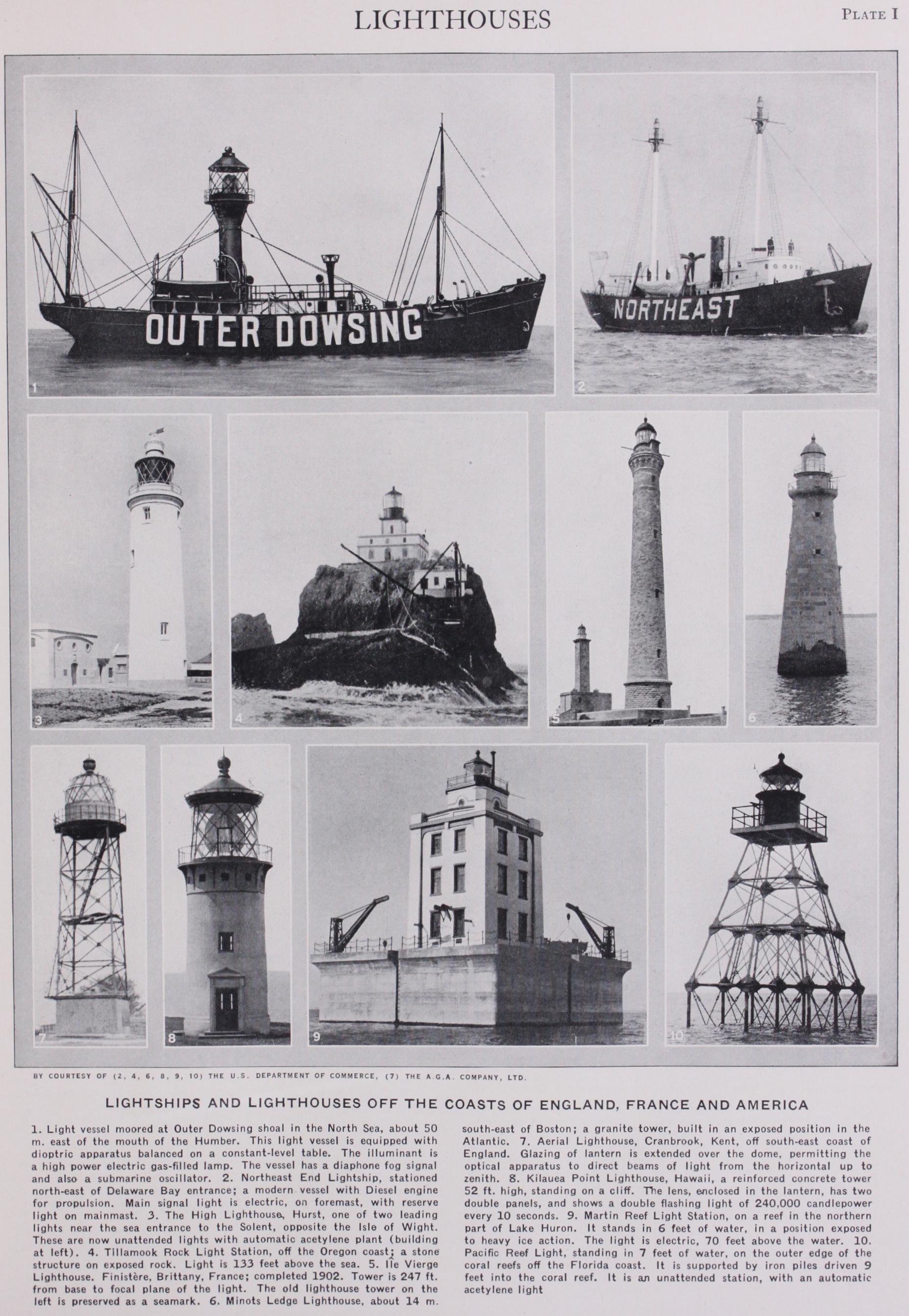
Minot's Ledge (Plate I.). The tower, 89 ft. in height, is built of granite upon a reef off Boston Harbour, Mass., and occupied five years in construction, being completed in 186o. The rock just bares at low water. The stones are dovetailed vertically, but not on their horizontal beds, bonding bolts being substituted for the horizontal dovetailed joints in the lower 4o ft., or solid portion of the tower.
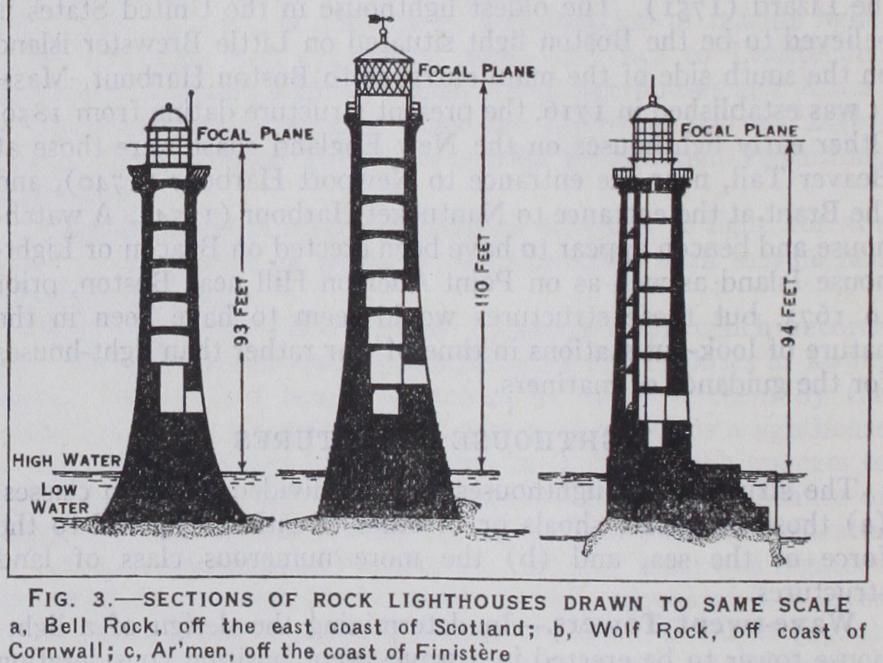
Wolf Rock.—This much-exposed rock lies midway between the Scilly isles and the Lizard point, and is submerged to the depth of about 6 ft. at high water. The tower was erected in 1862-9 (fig. 3b). The lower part of the base has projecting steps or scarcements in order to break up the sea'.
Dhu Heartach Rock.—The Dhu Heartach Rock, 35 ft. above high water, is 14 m. south-west of the island of Mull. The tower occupied six years in erection, and was completed in 1872. The focal plane is at a level of 145 ft. above high-water.
Ar'men.—The masonry tower, erected by the French Light house Service, on the Ar'men rock off the western extremity of the Ile de Sein, Finistere, occupied fifteen years in construction (1867-81). The rock is barely uncovered at low water and of small area, which made it impossible to construct a tower having a base diameter greater than 3o ft. (fig. 3c).
St. George's Reef, California.—This structure, completed in 1891, consists of a square pyramidal stone tower rising from the easterly end of an oval masonry pier, built on a rock to a height of 6o ft. above the water. The focal plane is at an elevation of 146 ft. above high water. The site is one of great exposure.
Fastnet.—The first lighthouse on the Fastnet rock, off the south-west coast of Ireland, was a circular cast-iron tower 86 ft. in height completed in 1854. It was erected on the summit of the rock which in 1895 was found to be considerably undermined. In 1899 a granite structure of increased height and founded upon a sound ledge of rock on one side of the higher, but undermined, portion of the reef, with its foundation laid near high water, was commenced and completed in 1904 (Plate II.). The focal plane is at a level of 158 ft. above high-water mark.
Maplin.—The screw-pile lighthouse erected on the Maplin Sand in the estuary of the Thames in 1838 is the earliest of its kind and served as a model for numerous similar structures in various parts of the world The piles, nine in number, are of solid wrought-iron with screws 4 ft. in diameter.
American Shoal, Florida.—This tower is typical of the open work pile structures on the Florida reefs, and was completed in 1880. The focal plane is 109 ft. above high water.