Lighthouse Structures
ft, light, rock, towers, caisson, plane, stones and tower
Wolf Trap.—This lighthouse was erected during the years 94 on Wolf Trap Spit in Chesapeake bay, near the site of an old openwork structure which was swept away by ice early in 1893. The tower is built upon a cast-iron caisson 3o ft. in diameter sunk 18 ft. into the sandy bottom. The depth of water on the shoal is 16 ft. at low water. The caisson was filled with concrete, and is surmounted by a brick superstructure 52 ft. in height from low water to the focal plane of the light. A somewhat similar struc ture was erected in 1885-87 on the Fourteen-Foot Bank in Dela ware Bay. The foundation in this case was, however, shifting sand, and the caisson was carried to a greater depth.
Rothersand.—This lighthouse, off the entrance to the river Weser, in Germany, is a structure of great interest on account of the difficulties met with in its construction. The tower had to be founded on a bottom of shifting sand 20 ft. below low water and in an exposed situation. Work was begun in May 1881, when attempts were made to sink an iron caisson under pneumatic pres sure. Owing to the fact that scour removed the sand from one side of the caisson it tilted to an alarming angle, but eventually it was sunk to a depth of 7o ft. below low-water. In October of the same year the whole structure collapsed. Another attempt, made in May 1883, to sink a caisson of biconvex shape, in plan 47 ft. long, 37 ft. wide and 62 ft. in height, met with success, and after many difficulties the struc ture was sunk to a depth of 73 ft. below low-water, the sides being raised by the addition of iron plating as the caisson sank. The sand was removed from the inte ‘rior by suction. Around the cais son foundation were placed 74, 000 cu.yd. of mattress-work and stones, the interior being filled with concrete. The lighthouse (fig. 5) was completed in 1885.
Other well-known wave-swept towers are those at Haulbowline Rock (Carlingford Lough, Ire land, 1823); Heaux de J3rehat (Brittany, 1839) ; Horsburgh (Singapore, 1851); Bayes d' Olonne (Bay of Biscay, i861); Smalls (Pembrokeshire, 1861) ; Hanois (Guernsey, 1862) ; Dae dalus reef, iron tower (Red sea, 1863); Alguada reef (Bay of Bengal, 1865); Longships (Land's End, 1872) ; Great Basses (Ceylon, 1873) ; the Prongs (Bombay, 1874) ; Spectacle reef (Lake Huron, 1874) ; Chicken rock (Isle of Man, 1874) ; Fowey Rocks (Florida, 1878) ; Rattray Head (Aberdeenshire, 1895) ; Beachy Head (Eastbourne, 1902); the Graves (Boston, U.S.A., 1905) ; and Jument d'Ouessant (Brittany, 191i).
Jointing of Stones in Rock Towers.—Various methods of jointing the stones in rock towers are employed in building. The
great distinction between the towers, built by successive engineers to the Trinity House, and other rock lighthouses is that, in the former the stones of each course are dove-tailed together both laterally and vertically and are not connected by metal or wooden pins and wedges and doweled as in most other cases. This dove-tail method was first adopted at the Hanois rock at the sug gestion of Nicholas Douglass. The cement mortar in the joint formed between the faces so locks the dove-tails that the stones cannot be separated without being broken.
Effect of Waves.
The wave stroke to which rock lighthouse towers are exposed is often considerable. During the erection of the tower at Dhu Heartach, 14 joggled stones, each of 2-tons weight, were washed away after having been set in cement at a height of 37 ft. above high water, and similar damage was done during the construction of the Bell rock tower. The effect of waves on the Bishop rock and Eddystone towers has been noted above.
Land Structures for Lighthouses.
The erection of light house towers and other buildings on land presents no serious difficulties of construction; such buildings are usually of simple architectural character. Besides being built of stone, brick or reinforced concrete, land towers are frequently constructed of cast-iron plates or open steel-work with a view to economy. Fine examples of the former are to be found in many British colonies and elsewhere, that on Dassen Island (Cape of Good Hope), being typical. A cast-iron tower erected at Kijkduin, near Helder, in Holland, in 1875 is 197 ft. in height to the focal plane. Many openwork structures up to 200 ft. in height have been built. Examples are the towers erected at Cape San Thome (Brazil) in 1882, 148 ft. to the focal plane; Mocha (Red sea) in 1903, 18o ft.; and Sanganeb Reef (Red sea) 1906, 165 ft.
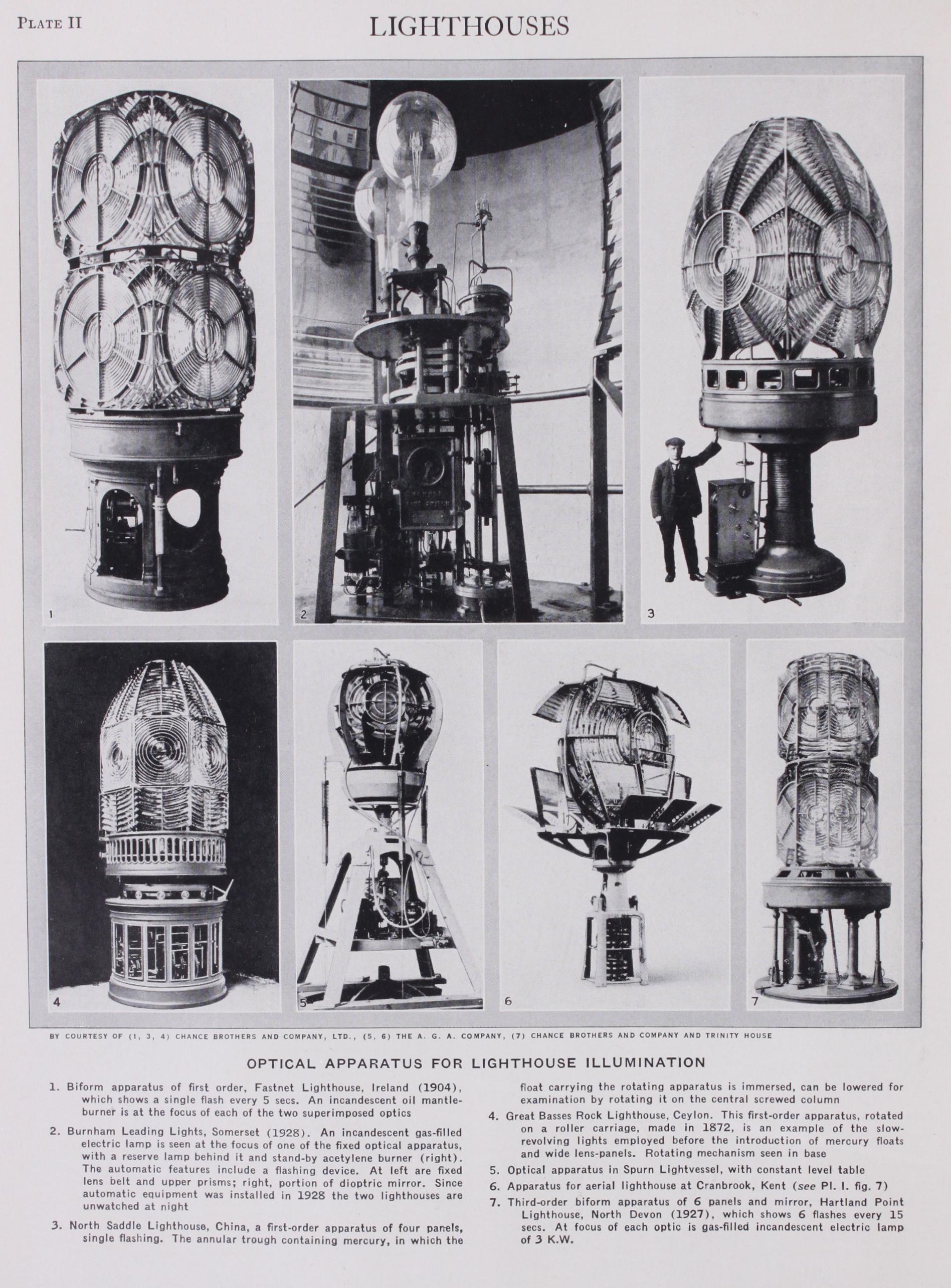
Optical apparatus in marine lighthouses is employed for con centrating the rays of light derived from a light source : (I) in the vertical plane only, to show a fixed belt of light all round the horizon, which can be made either flashing or occulting by eclipsing the light or by interposing mechanically a screen; (2) in both the vertical and horizontal planes simultaneously to produce a high-powered beam or cone of light which can be revolved, to show a flashing light, or fixed, to mark an isolated danger or narrow channel where a limited azimuth suffices; and (3) in the vertical plane and afterwards in the horizontal plane for diverting or condensing a portion of the fixed belt of light to strengthen a sector.