Architectural Forms
ft, furniture, shown, fig, method, line and wide
All dimension lines are to be noted as shown on this same plate, in which the arrow-heads are black, the connecting line is red, and the figures are in black, always above this line. This is the best practice, though sometimes dimen sions are placed in the center of the line, the line being stopped to allow the figures to be inserted. This method takes more time and is not so practical, since the dimension line is broken and in some cases there might be a dispute as to just how much the dimension is intended to include.
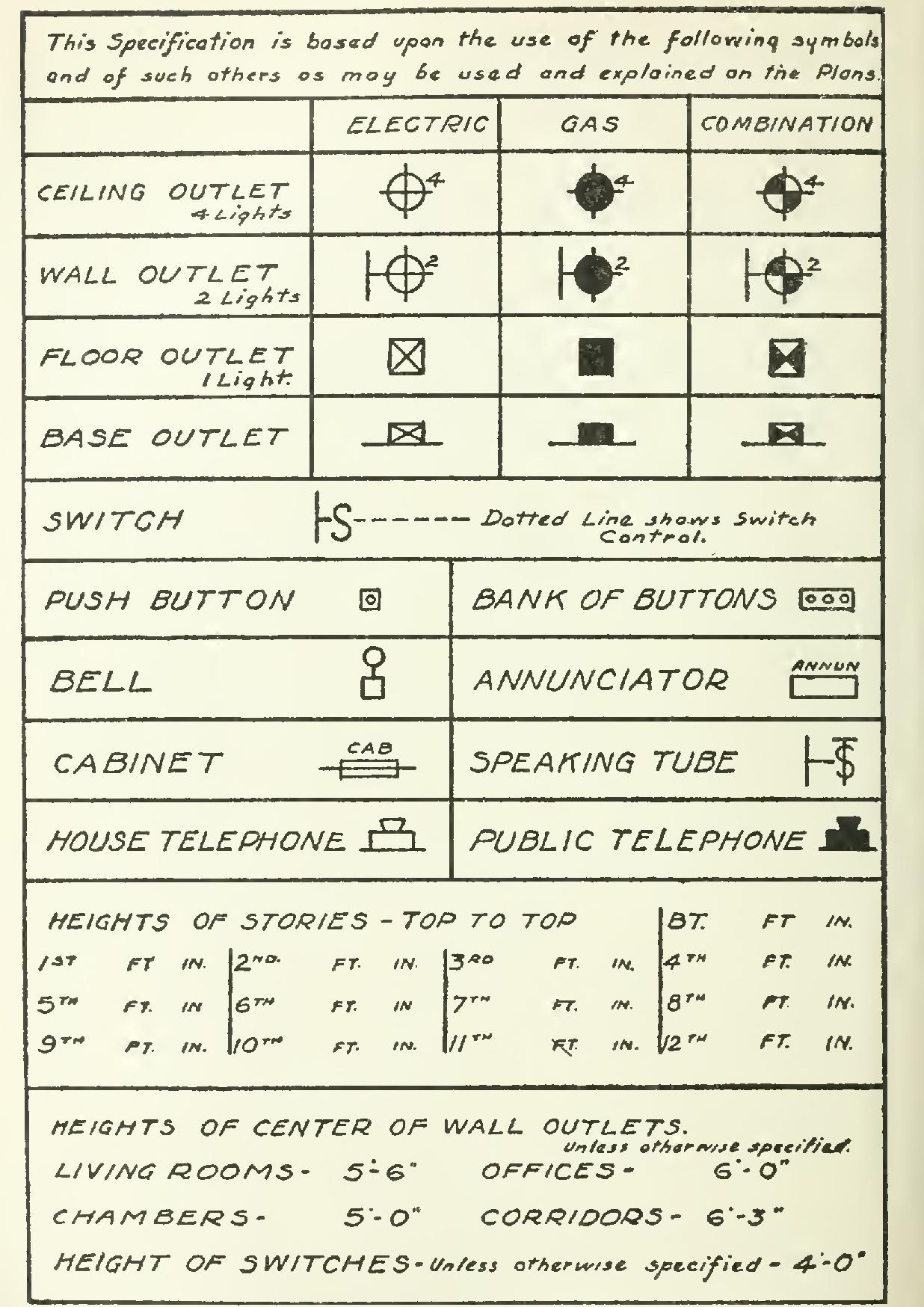
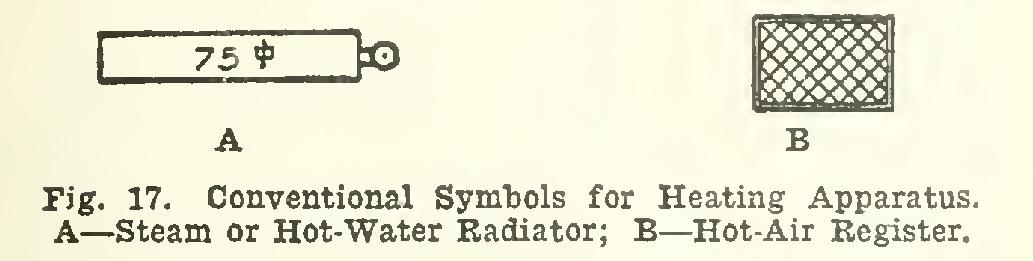
For lighting, there are standard symbols adopted by the National Electrical Contractors' Association of the United States. These are published on a card convenient for reference, and copies may be had by applying to the Secretary. Another form of symbols has been adopted by the Boston Society of Architects, copies of which may also be had on application. The latter sym bols are shown on Plate C. These are given for convenience in laying out plans, and are not intended to be complete in every respect. It is essential to show the location of the light outlets in all rooms; also whether they are to be gas, or electric, or a combination of both. Push buttons, bells, and telephones are also indicated. If these locations are not shown, the contractor for this work will naturally place them in a posi• tion requiring the least amount of pipe, wire, etc. Therefore show all of these fixtures, and there can then be no dispute as to the true intent of the plans and specifications. • For the heating, about all that is necessary is to show the location of the registers or radiators, marking the number of square feet of radiation on each radiator. The usual method is shown in Fig. 17 (A) for steam or hot water, and in Fig. 17 (B) for hot air. The specifications should describe the kind of heat, and go into detail about pipe, fittings, etc.
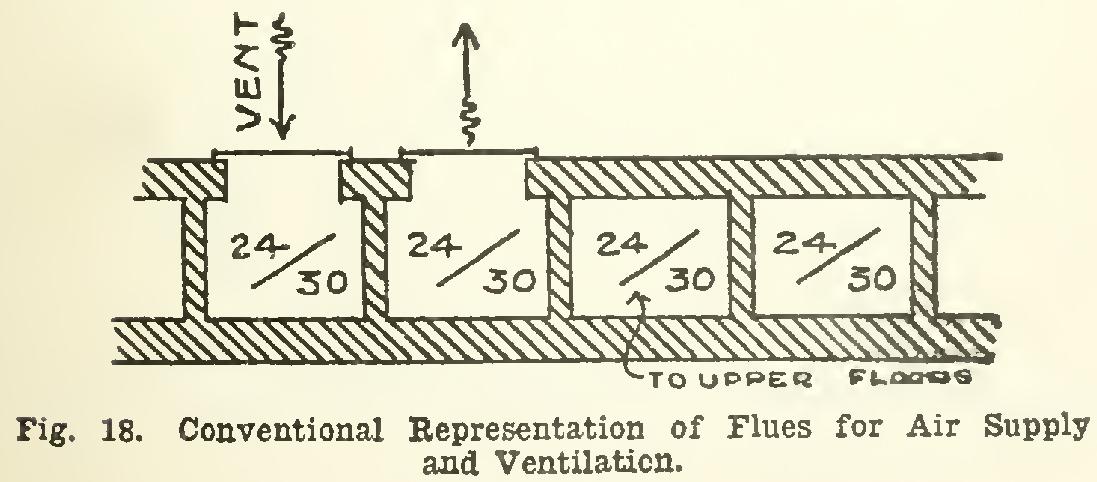
In hospitals, public buildings, and school houses, where there are a number of occupants in each room, it will be necessary to furnish a fresh-air supply, also a vent flue. These are all figured, and should be located conveniently.
The method of figuring the correct location for such work will be considered under "Heating and Ventilating." The conventional method of showing flues for air supply and ventilation is shown in Fig. 18.
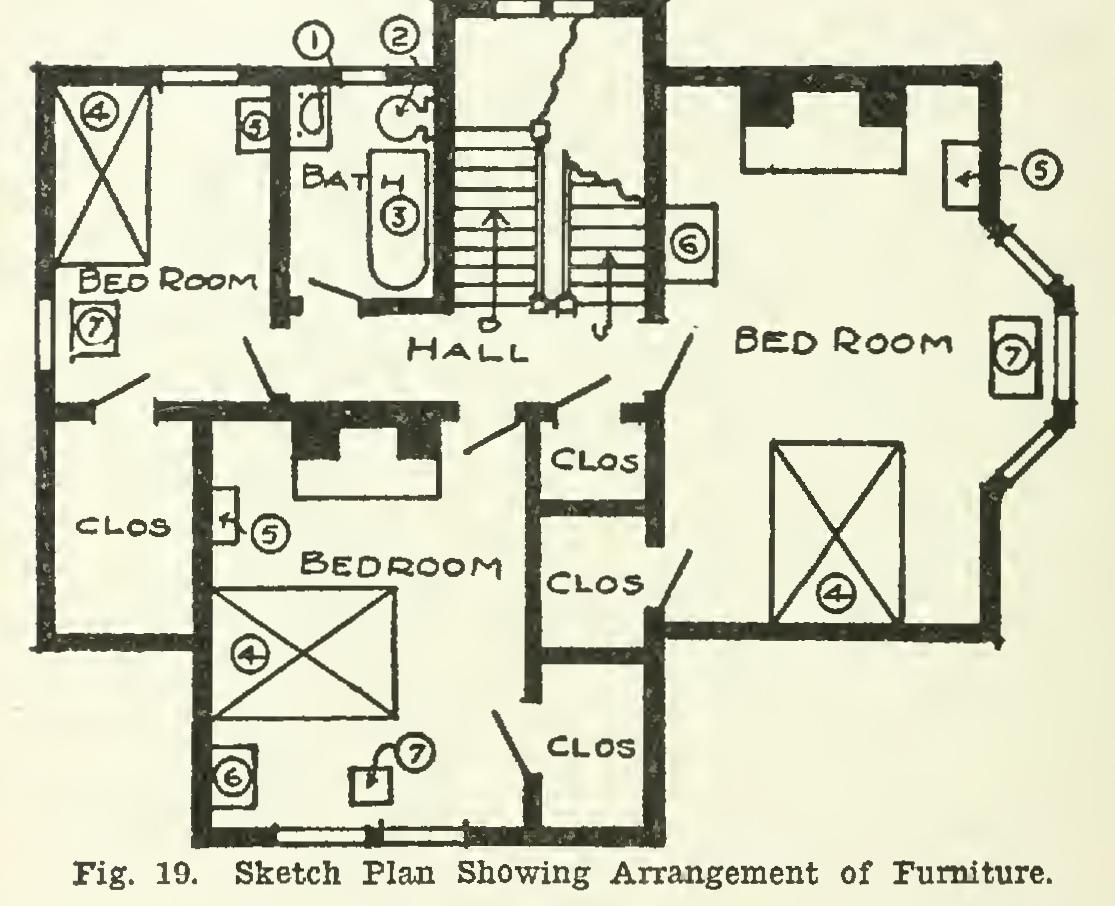
For furniture, certain conventional forms are used, and shown on all plans. The furniture of the bedrooms and bathrooms is usually laid out on the plans, since these are usually made as small as practicable; therefore the furniture and fittings are laid out to make sure that there will be room to get them all iu. This applies to the cheaper classes of houses, for in the larger and more expensive residences the rooms are always amply large to accommodate all the fur niture and fittings desirable. In Fig. 19, a bath room and bedrooms are laid out, the furniture being indicated by munbers, (1) representing the lavatory or wash-bowl, (2) the closet, (3) the bathtub, (4) the bed, (5) the chiffonier, (6) the dresser, and (7) a table or writing desk. See also Fig. 20.
Sometimes a client has furniture he wishes to put into a new home. It will be found very convenient to get the dimensions of such furni ture, and cut out pieces of cardboard the exact sizes of this furniture according to the scale of the plan. Then lay them on the plan as drawn, and see how they will fit wall spaces, nooks, etc. By this method, pieces can be arranged, and it will very soon be shown whether or not the rooms will accommodate the furniture. This will be found very convenient in all classes of work (see Fig. 20).
Below are given the dimensions of some of the common pieces of furniture. These sizes will vary somewhat, but in general they will be accurate enough in laying out work.
Dining Tables-3 ft. 6 in. to 4 ft. wide, and to extend to 10 ft. to 12 ft. by extra leaves, and 2 ft. 5 in. high. Writing Tables-2 ft. 6 in. high.

Fig. 20. Plan Showing Method of Laying Out Furniture and Rugs.
Carving Tables-3 ft. high.
Ordinary Tables-2 ft. 6 in. high. Beds, Single-3 ft. 6 in. wide; Beds, Three-quarter-4 ft. to 4 ft. 6 in. wide; Beds, Double-4 ft. 6 in. to 5 ft. wide.
All beds should be 6 ft. 8 in. long inside. Dressers-1 ft. 6 in. to 2 ft. by 3 ft. 5 in. Couehes-2 ft. 6 in. by 6 ft. 8 in.
Chiffoniers-2 ft. by 3 ft., and 4 ft. 6 in. high. Sideboards vary according to design, 4 ft. to 6 ft. long, and from 2 ft. to 2 ft. 2 iu. deep.
Pianos, Upright, vary, being usually 3 ft. 3 in. by 6 ft. 6 in. long, and 4 ft. to 4 ft. 9 in. high.