Architectural Forms
ft, wood, stone and wide
Bookcases—JO in. to 16 in. deep, any length and height.
Chairs and Scats—Usually 17 in. high at front, 16 in. at back, and the scat is usually 17 in. high by 16 in. inside ; the back, from 1 ft. 6 in. to 1 ft. S in. high, slightly inclined at the top.
For plumbing fixtures, consult any plumbing cata logue. The washstand varies, 1S in. deep by 2 ft. long being about the minimum. The bathtub varies from 3 ft. 6 in. to 4 ft. 6 in. long, about 1 ft. 11 in. high above the floor, and 2 ft. wide across the rim. Closets are about 1 ft. 4 in. wide, and about 2 ft. from the wall.
Ranges-26 in. to 30 in. by 36 in. by 42 in.
Ranges, Gas-26 in. by 34 in.
Lunch Counters—Height, 3 ft. 3 in.
Stool, 2 ft. 2 in.
Counter projects 9 in. and is 2 ft. 2 in. wide.
Foot-rest, 7 in. high and 9 in. from counter.
Urinals-26 in. to 30 in., center to center.
Rugs-4 ft. 6 in. by 7 ft. 6 in. up to 11 ft. 3 in. by 15 ft.
The above dimensions are only general, but will be of assistance in laying out the furniture of a house.
There will be found a great variety of materi als for the construction of buildings, nowadays. In some localities, one material will be used more than others; for instance, in the vicinity of a stone quarry, stone will usually be cheaper than anything else—even in some cases cheaper than wood. Should your client be interested in
a brick concern, brick would undoubtedly be used. In a locality where timber is cheap, that material would be largely employed.
For the cheaper class of work, we find wood to be the cheapest material, although, within the past ten years or so, wood has advanced in price at a great rate. The kind of wood used will vary with each locality. In some sections—espe cially the South—yellow pine will be used; in our Western States, fir and local varieties will be selected. An architect in a new locality, therefore, should become familiar with the local woods used, and should govern his work, such as spans of beams, interior finish, etc., by these conditions. The use of terra-cotta for the facing of masonry walls, for ornamental courses, cor nices, and window-sills, is quite common. Since this is a product made of clay, properly mixed, moulded, and burned, it can be treated as plainly or as elaborately as the design of the building warrants. Terra-cotta, of course, is used only with masonry, such as brick, stone, or concrete.
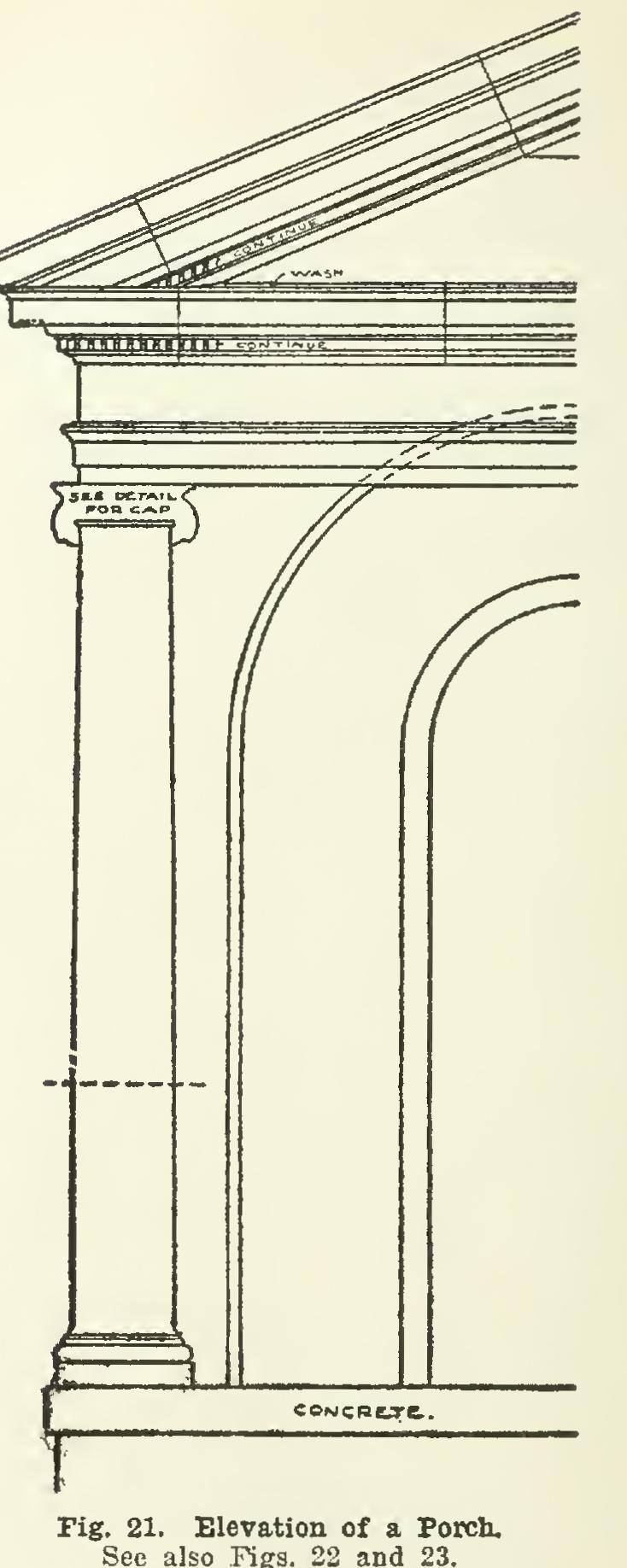
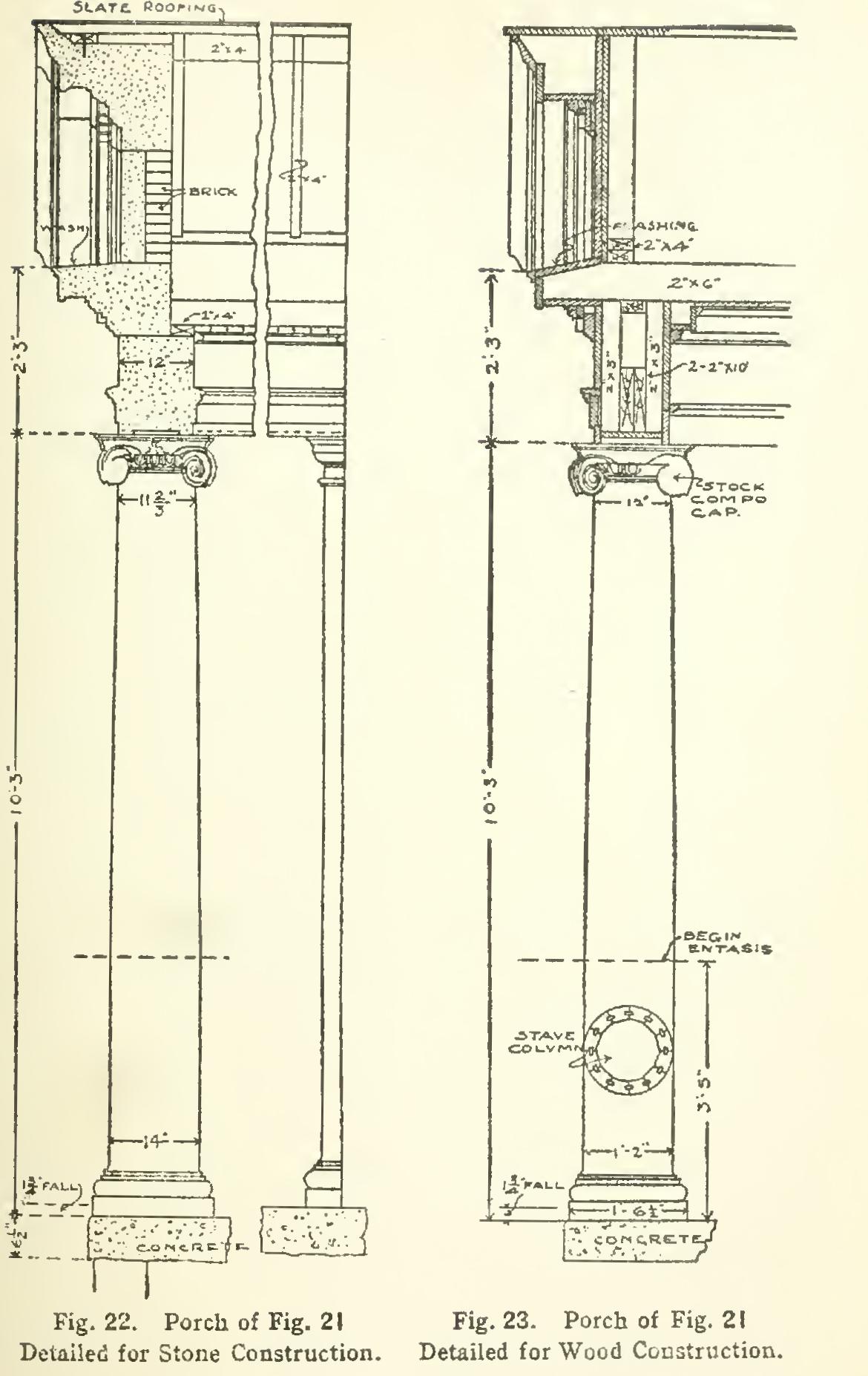
Fig. 21 shows the elevation of a porch, and Fig. 22 shows this porch detailed for stone con struction; while Fig. 23 shows the same porch detailed for wood.