Structural Drafting 148
drawings, time, lines, drawing, corners, architects, scales and method
Architectural drawings should have some character to them; the lines should be firm and straight, making them a full, even thickness. Very often good drawings are spoiled by the lines being very poor and also too faint. Use a good, heavy line, and make it look as if it was there for a purpose.
One way in which a drawing can be made attractive and "snappy," as you will hear archi tects say, is to overrun all corners and inter sections of lines, slightly. In mechanical draft ing other than the work of the architects, it is always required to stop the lines at the corners, making the drawing exact and very mechan ical in appearance. The architect, however, is allowed some liberties in his work. He will resort to methods, to improve the looks of his drawings, which would not be permissible in other work.
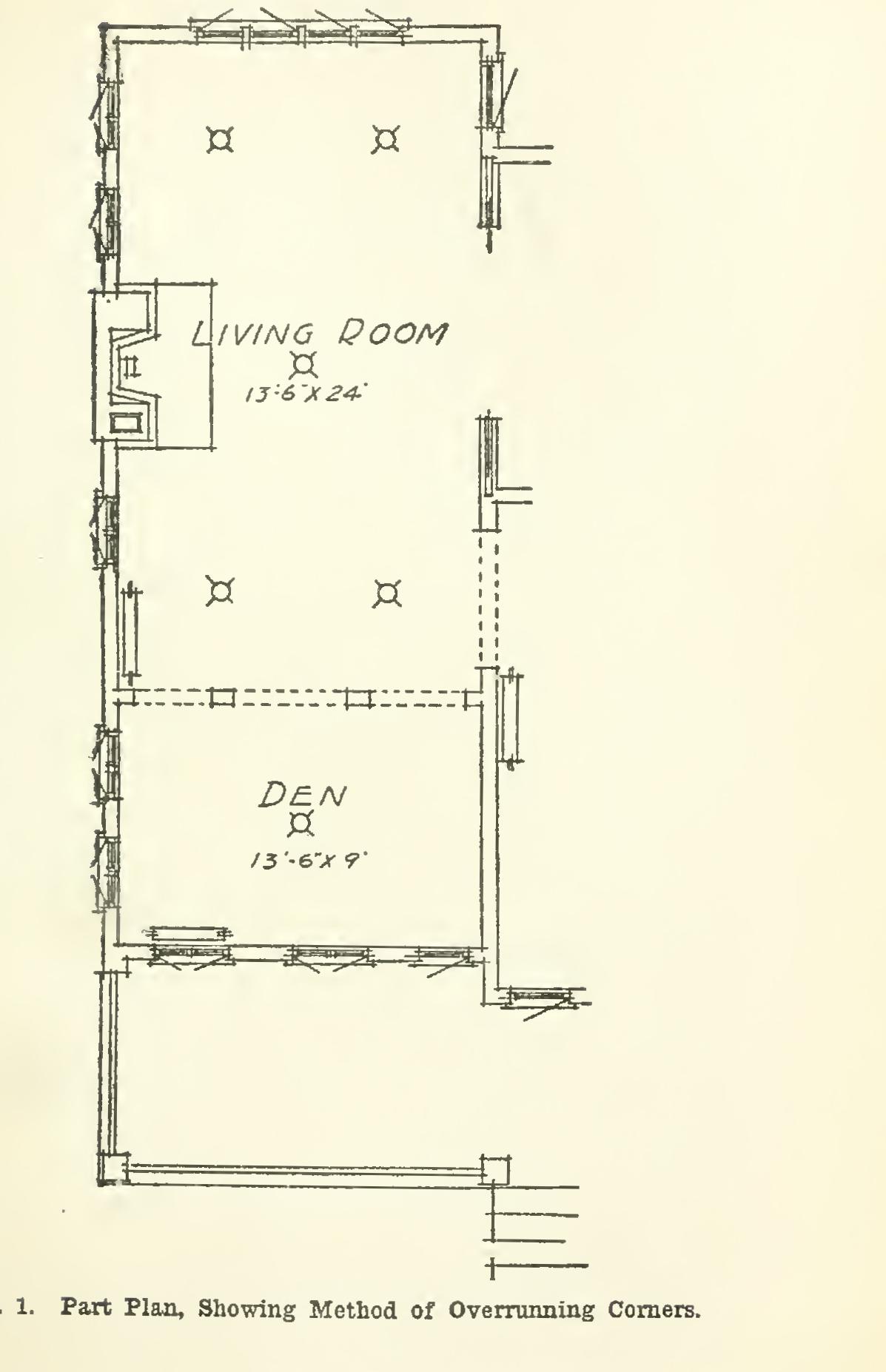
Referring to Fig. 1, it will be seen that the corners and intersections are emphasized by the overrunning of the lines. This does not mean long lines past the corners, but just enough to show a sharp intersection. A little practice will soon enable a draftsman to do this work skil fully, and once this method is adopted it will be used on all future work, as there is no com parison in the general attractive appearance of two drawings, in one of which this method is used, and in the other the strict mechanical method is adhered to. The actual time con sumed in getting out a drawing is less with the method described than with the true mechan ical drawing, in which it is necessary to start and stop at exactly a certain point. In mechan ical drawing, it is frequently necessary, after two lines at an angle have been drawn, to go over the first line in order to continue it a short distance to the exact corner.
Very often, a few minutes spent on careful lettering, indicating materials, and an additional explanatory note, will be the winning feature of a set of drawings.
Too much emphasis cannot be placed upon always being on time, whether in office work or in getting out drawings. When a time is set for the completion of any drawing, or a time of meeting arranged, have your work ready at that time, and keep your appointment exactly as arranged. Before setting a time of comple tion, be sure you are giving yourself time to do the work completely, and then see to it that your work is ready at that time.
The architect's services usually consist in preparing the necessary studies or preliminary sketches, working drawings, specifications, and large-scale and full-size details, together with a general supervision of the work. For this
service, there is usually a price based upon a minimum percentage of the completed work. This percentage varies in different States and localities, from to 7 per cent. As the work progresses, or different sets of drawings are completed, payments are made. If we consider the architect receiving five per cent commission, one-fifth the entire fee is due upon the com pletion of the preliminary sketches, two-fifths upon the completion of the working drawings and specifications, the balance being paid as the work progresses. This percentage is based on the total cost of the buildings. These prices are those adopted by the Chicago Architects' Busi ness Association. Should work on the drawings be abandoned, a charge should be made for services for the amount of work done.
This will give an idea as to the general prices charged, and the usual times of payment. It does not pay to do work at a small percent age, for the work on the drawings and specifi cations will necessarily have to be inferior and incomplete.
The scales at which drawings are usually made are in., in., in., % in., % in., in., and 3 in., to the foot. These are convenient for all parties concerned. We see that by using the first three scales we can use the regular divisions on a rule, without having an architect's scale. The last scales are also convenient for the same reason. Take, for instance, a detail drawn at 3-inch scale; then we see that inch equals one inch, and an ordinary rule can be used to advantage. On the actual construction work, the foreman always uses his two-foot rule for scaling the drawings; and if the above scales are used, they are easily read from an ordinary rule.
A complete set of drawings should include a survey, or City Engineer's plan, of the lot, on which the outline of the building is marked; a foundation plan; a plan for each floor; a roof plan; an elevation of each side of the house; all necessary %-inch scale detail sections; all necessary elevations of interior finish; large scale details of the window-frames and sash and interior trim; and any other details of unusual construction. After the contract is let, then get out full-sized details.
Should any changes be necessary after the drawings are completed, secure the owner's written order for such changes. If everything is in writing, there can be no cause for dispute, especially in the matter of changes.