Working Drawings 134
tracing, drawing, lines, line, shade, blue-print and right-hand
Examples of Shade Lines. In Fig. 105 is shown a stick with rectangular pieces projecting up from the surface. The right-hand and lower edges of the stick are shaded in both views; and in the plan, the right-hand and lower edges of the two uprights are also shaded; while in the elevation, only the right-hand edges are made shade lines.
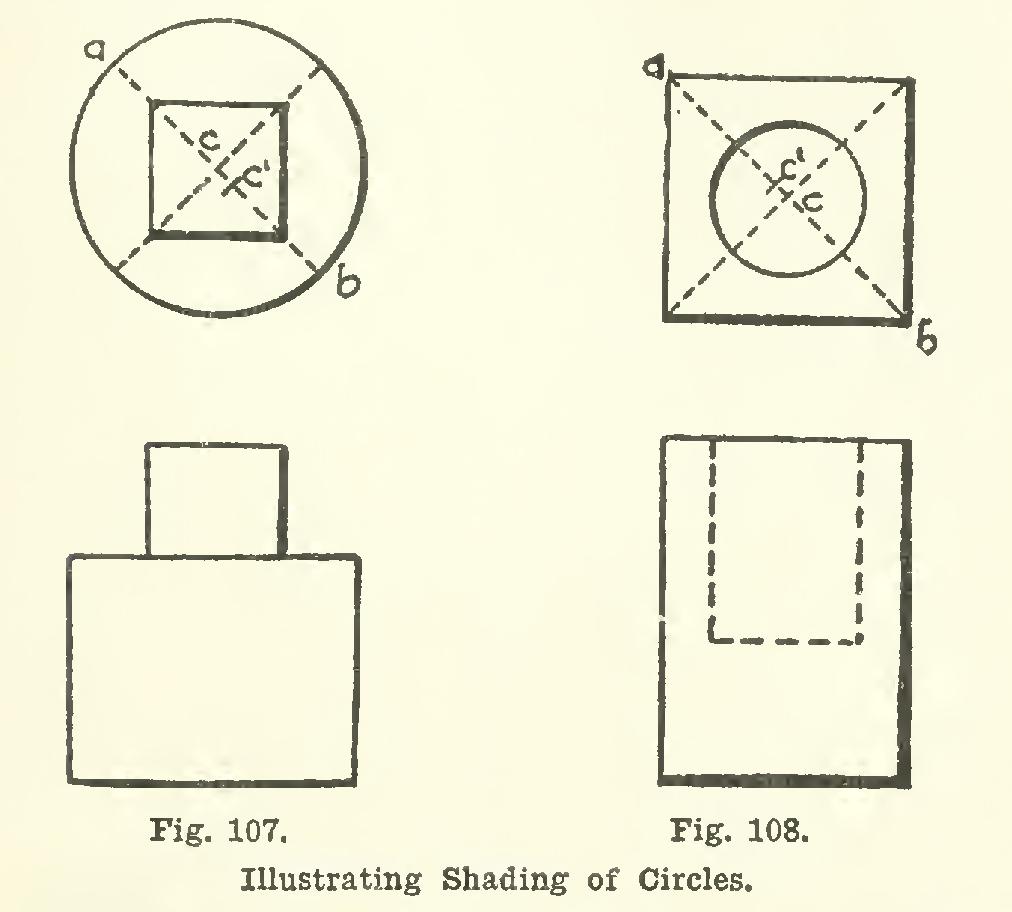
Fig. 106 represents the same stick with holes instead of uprights. Notice, in the plan, the change in the position of the shaded edge. This is in strict conformity with the rule, since the upper and left-hand edges of the opening are the lower and right-hand edges of that portion of the object. It is in cases like these that shade lines have practical value in assisting to make clear the actual meaning of the drawing.
Shading of Circles. The shade line of a circle always begins and ends on a 45-degree line, as shown in Fig. 107 and 108, the 45-degree line in this position marking the division between what may be called the lower and right-hand edge and the upper and left-hand edge. The shade line begins at the extremities of the 45-degree diameter, with the same width as the unshaded part, and gradually increases in width. This smooth and pleasing effect is produced by drawing the other 45-degree line, a-b, shifting the center c slightly to c', and, with the same radius, drawing over the part to be shaded.
The excess width of a shade line over the ordinary line is generally placed on the outside of the area inclosed by the figure. Exceptions occur when the placing of the shade line in this position would unduly distort the figure or tend to produce a jagged effect.
139. Blue-Prints. The form in which a working drawing goes out from the office to the shop, or field, or wherever the actual construc tion is to he made, is the blue-print. The steps which lead up to the final form of blue-print are: first, pencil drawing; second, tracing; and third, the blue-print. Sometimes the second step is omitted, as will be explained later.
Assuming that the preliminary sketches are made, a scale at which the drawings are to be made is then chosen. The particular scale to be used is determined by various considerations.
The drawing should be on a scale large enough so that the different views and dimensions may be clearly read; but, on the other hand, they should not be unnecessarily large and unwieldy. Various scales are used in engineering and machine work. Sometimes certain parts or pieces are drawn greater than full size. In this country, common architectural practice is to make drawings at a scale of ft., with details at in.=1 ft., and also details at full size.
The scale decided upon, the center lines of the various views are laid out, the outlines blocked in, and then the details supplied. Where the different views are on the same sheet, the constructions of each should be carried on at the same time.
The pencil drawing may be made on brown duplex paper, on thin white bond, or on tracing cloth. No matter which kind is used, the lines should be bold and distinct; and to this end, the pencil used should be not harder than 3H, and in some cases softer.
The Tracing. If the penciling is done on the duplex paper, a tracing is next made. This is done in ink on the tracing cloth, which for this purpose is tacked on the board over the draw ing. Some draftsmen prefer to ink on the dull side of the tracing cloth; and some, on the side with the glossy finish. In either case, the sur face should first be rubbed over with powdered chalk, in order to remove all grease from the surface. The chalk must then be brushed off, and the surface is then ready for the ink. Iii case the pencil drawing is made on the bond paper or on the tracing cloth, it may be inked directly, and no separate tracing is required.
A common fault with beginners is to make the lines on a tracing too fine. In order to secure a good blue-print the lines on the tracing must be fairly heavy. This is also true of letters and numbers.
The Blue-Print. The blue-print, which re produces the original drawing with white lines on a blue ground, is obtained from the inked tracing or inked drawing, and is made on a sheet of specially prepared white paper which may be bought ready for use. One side of the paper is rendered sensitive to the light by means of a chemical coating.