Working Drawings 134
fig, cross-hatching, shown, section and bolt
Dimensioning of Bolts. For a bolt, one view—showing the length—is all that is re quired. Fig. 118 shows a half-inch bolt with all the necessary dimensions. In addition to the diameter of the bolt, the thickness of the head, and the length under the head, there should also be given the length of either the threaded or the unthreaded portion. The num ber of threads per inch should also be briefly given—as 10th, 12th, etc., as the case may be. For a bolt with a hexagonal or an octagonal head, the short diagonal is given. If the head of the bolt were round, D would be substituted for HEX; if square, SQ would be used, etc.
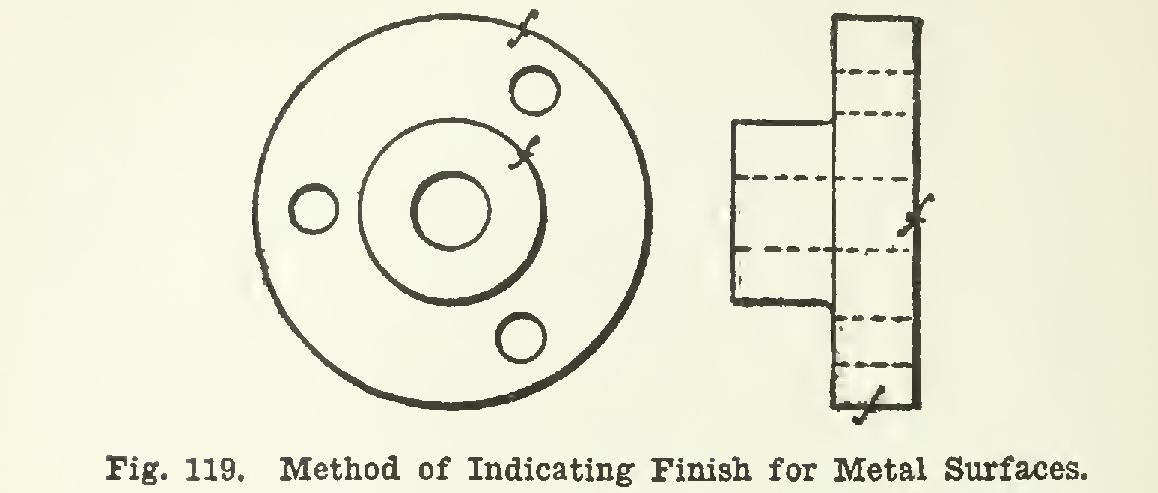
141. Finished Surfaces. When metal sur faces are to receive a smooth finish in the shop, the edge view of the surface is marked on the drawing with an italic F, as shown in Fig. 119. If all of the surfaces are to be finished, a note is made, "F all over." 142. Duplication of Parts. If two or more parts or pieces are to be made exactly alike, as bolts, pins, rods, etc., one figure is drawn and dimensioned, and a note added: "Make 2 (or 8, or 10, etc.) of this," specifying the desired number.
143. It is often convenient, and sometimes necessary, to take a plane cutting through the object, remove one portion, and show the cut surface, or section. This may be necessary in order to give a clear idea of interior or hidden parts, whether the object be a small piece, or an office building, or a masonry structure. It may sometimes be inconvenient to show the external shape of an object by an end view; and in such a case a section, placed as in Fig. 120, may be shown instead. The shape and
proportions of a fluted column may also be well shown in section, as in Fig. 121.
144. Cross-Hatching. When sections are made on a working drawing, it is customary to distinguish between the various materials rep resented, especially in the case of metals, by a system of one or more sets of parallel lines covering the sectioned surface. The surface treated in this way is said to be cross-hatched. In the matter of cross-hatching, there is no uni versally accepted standard for all substances; and indeed, in some drafting rooms, the kind of hatching is arbitrarily chosen.
When, on a working drawing, different ma terials are shown in section, they should be dis tinguished by cross-hatching; and somewhere on the sheet, there should be placed small blocks of the kinds of cross-hatching used, giving the names of the materials which they are intended to represent. When, in section, two adjoining parts are shown, the cross-hatching on the two parts should run in different directions, as in Fig. 122.
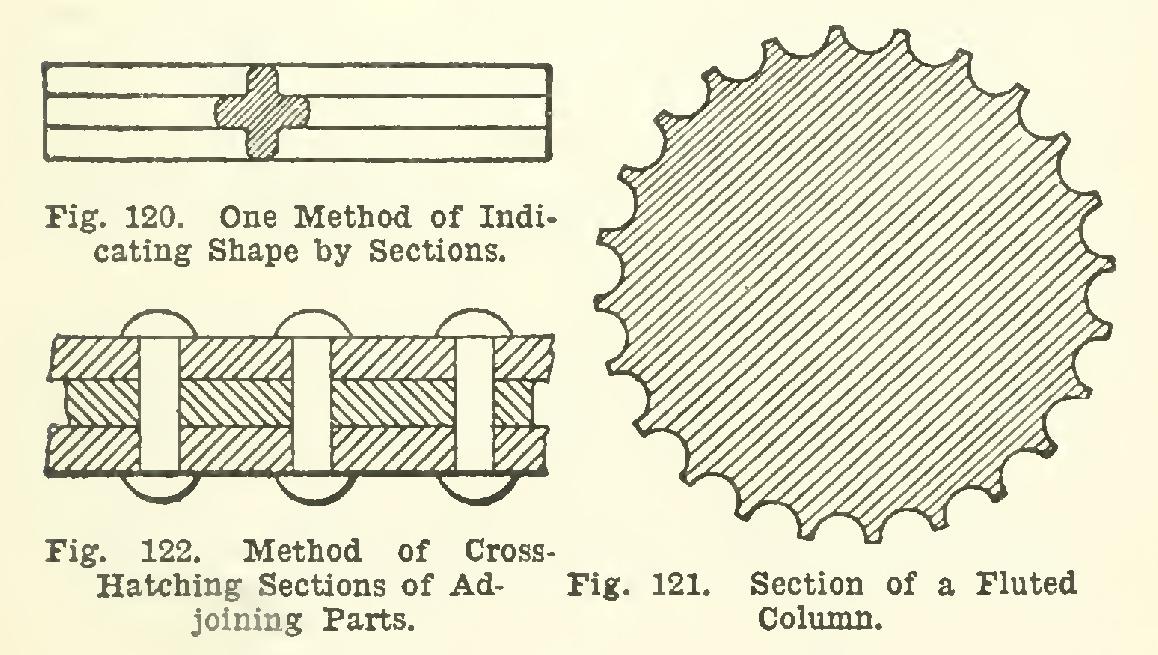
Fig. 123 shows blocks of cross-hatching as used for some of the common substances with which the draftsman has to deal.
On architectural working drawings, stone and terra-cotta are represented in section, and also in plan and elevation, as shown in Fig. 124.

If, in architectural drawings, colors are used, they may be chosen as follows: Brick Light red.
Concrete Payne's gray, mottled.
Glass New blue.
Old work Gray or black.
Slate Indigo.
Steel and iron Prussian blue.
Stone Raw umber or Payne's gray.
Terra-cotta Burnt umber.
Wood Yellow ocher.